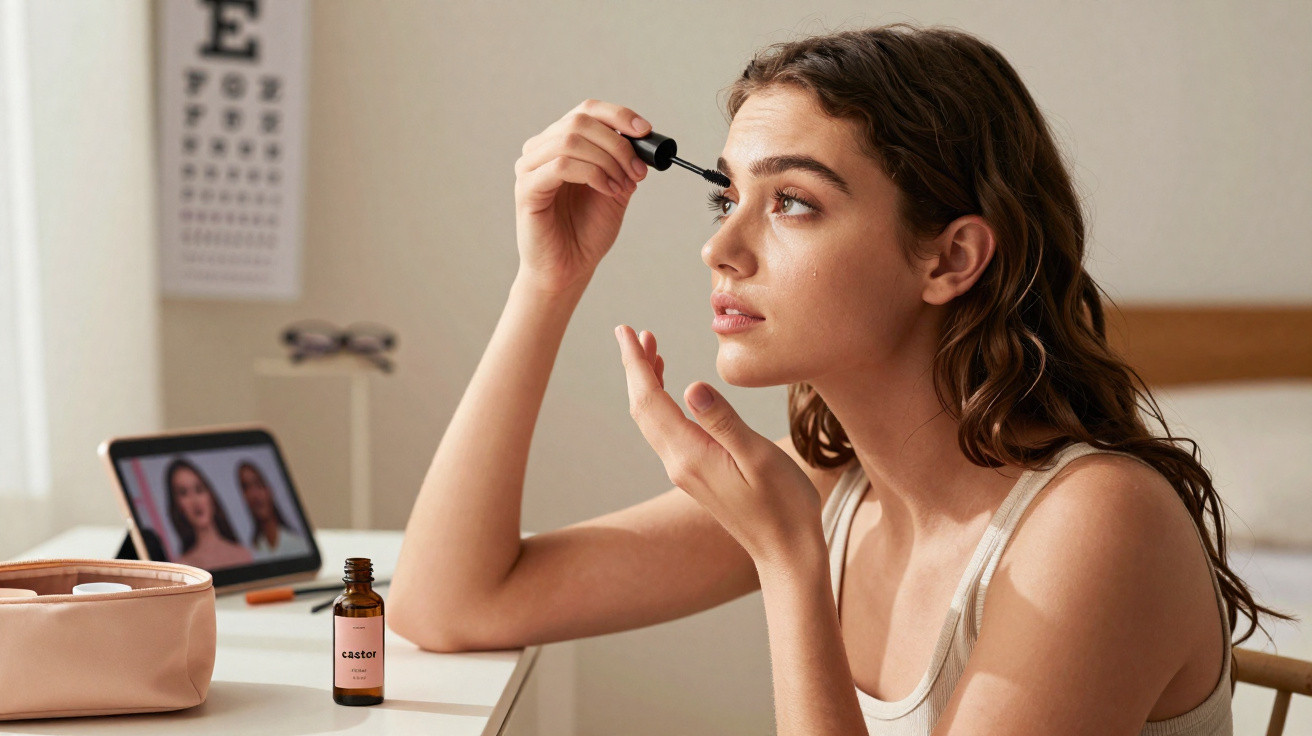
A mascara that has become slightly too dry, or an overly vigorous eyelash curler, can suddenly leave lashes looking thinner and more delicate. On TikTok and Instagram, the supposed miracle answer is repeated like a mantra: apply a drop of castor oil every evening and achieve lashes that resemble natural extensions. The at-home ritual has found its way into bathrooms, including those of teenagers. Before-and-after clips attract millions of views, while bottles of oil sell rapidly in chemists. As influencers insist it is “100 % safe”, ophthalmologists are raising concerns. These are two worlds watching one another without really having a conversation.
Between promises of doll-like lashes and eye-emergency diagnoses, an uncomfortable question remains: how far should anyone go with their eyes for a few extra millimetres?
Why castor oil lashes went viral – and what we’re not seeing on camera
What stands out first in these lash-growth videos is not the product itself, but the sense of closeness. A young woman in an oversized hoodie, hair pinned up, leans over her sink and films herself at close range. She dips a cotton bud into a small bottle of golden oil, draws it along her lashes and looks into the camera as if to say: “You can trust me.” It feels almost as though you are in her bathroom, being let in on a friend’s private tip.
That perceived intimacy has real influence. It makes castor oil seem less like a chemical choice and more like a comforting ritual, rather like a homemade treatment a grandmother might have used. Yet the camera captures the shine rather than the consequences. It does not show nights spent with stinging eyes, urgent appointments or vision that gradually becomes blurred. Social media is very good at presenting the route from “before” to “after”, but it rarely dwells on what happens in between.
In 2024, #castoroillashes accumulated millions of views across TikTok and Instagram. Some creators claim their lashes doubled in length within a month. A 22-year-old student in London told me she began using castor oil after a lash-extension disaster. Having lost sections of her lashes, she felt exposed without mascara. After applying it nightly for three weeks, she believed her lashes appeared fuller. However, she also said she woke several times with sticky, irritated eyes. Her GP later diagnosed mild blepharitis, an eyelid inflammation that can be associated with oils and residue trapped along the lash line.
Clinicians are encountering another side of the trend. Ophthalmologists in Europe and North America have reported a subtle increase in patients applying plant oils to their lash lines, with some experiencing redness, allergic responses or blocked meibomian glands. These glands create the oily component of tears. If they become obstructed, the tear film can become unstable, leading to dry eye or ongoing irritation. Castor oil is not inherently harmful: it features in certain eye-care and skincare products, but in filtered, controlled and accurately measured formulations. The concern is not simply castor oil itself, but the application site, amount used and awareness of possible risks.
How to stay safe if you’re still tempted by castor oil for lashes
If you still intend to use castor oil, approach it for what it is: a foreign substance being placed extremely close to one of the body’s most sensitive surfaces. The least risky option is cold-pressed, hexane-free oil, preferably bought from a chemist or a trusted brand that clearly states it is intended for cosmetic use. Never use an unverified bottle of cooking oil instead. Transfer a very small quantity to a clean dish rather than dipping into the main bottle. A fine coating at the upper lash roots is more than enough. If the lash line looks glossy and wet, you have probably applied far too much.
Before using oil anywhere close to your eyes, perform a patch test on a small area of skin, such as behind an ear or on the side of your neck, for 24 to 48 hours. It is tedious, admittedly, and let’s be honest: few people genuinely do this every time. But if your skin reacts away from the eye area, consider how your eyelid margin might respond. Should you continue, use it at night once makeup has been removed and your face cleansed. Keep it strictly on the lash roots rather than the waterline. Blurred vision after application indicates that the oil is reaching the surface of the eye, not merely coating the lashes.
People often wrongly interpret irritation as “proof it’s working”. A little redness or tingling may make them think, my follicles are waking up. In fact, this discomfort could indicate an emerging allergy or disruption to the tear film. Ophthalmologists caution that repeated exposure to non-sterile oils at the lash line may alter eyelid function and the way tears spread across the eye. Some users develop lasting dry eye, which can feel as though sand is trapped beneath the lids all day. Unlike a broken nail, it is not something forgotten within a week. Oil sitting heavily on lashes can also collect dust, makeup pigments and bacteria, raising the likelihood of eyelid inflammation.
“Your desire for thicker lashes is valid,” says Dr Emma Collins, an ophthalmologist in Manchester. “But you have to ask yourself one blunt question: am I willing to trade comfortable, clear vision for a bit more density at the lash line? Your eyes are not an area where trial-and-error beauty hacks are harmless.”
For anyone seeking a more careful routine, these are practical alternatives and habits that experts genuinely support:
- Choose mascara containing conditioning ingredients, then remove it carefully using a water-based remover.
- Look at clinically tested lash serums with published safety information rather than oils from the kitchen shelf.
- Give lashes days off from mascara and heated tools to limit breakage.
Balancing beauty trends with eye health: finding your own line
Most trends do not seem risky when you are immersed in them. Using castor oil on lashes now has something in common with DIY hair bleaching in the 2000s: nearly everyone knew a story, most escaped unscathed, and a small number were left with lasting damage. The difference is the body part at stake. Sparse lashes can be frustrating, but eyes that sting whenever you step into the wind can alter everyday life. The appeal of this trend lies in how effortless it appears: an inexpensive bottle, one nightly swipe and the promise of waking up looking better. There is no clinic, prescription or waiting room.
There is another aspect that is rarely examined. Fuller lashes have become an unspoken beauty expectation, particularly for women appearing on camera throughout the day. Work Zoom calls, dating apps and Instagram Stories all keep eyes constantly visible. Castor oil shortcuts offer a way to “keep up” without acknowledging the standard being pursued. Posting the ritual online can give it an empowering gloss. Still, many regular users admit off-camera that they are frightened to stop, convinced their natural lashes no longer measure up. That emotional attachment is seldom mentioned in polished tutorials.
Perhaps the real issue is not whether castor oil is entirely harmful or completely safe. It is whether we are happy to let viral beauty hacks determine which risks are acceptable for our bodies. You might decide to avoid castor oil altogether and use mascara with a lash curler instead. You could consult an eye doctor and try a regulated lash serum. You may choose to experiment, but only with genuinely tiny quantities, proper patch tests and a commitment to stop if burning, redness or blurred vision occurs. Beauty has always occupied a boundary between desire and danger. This trend simply places that boundary directly across your eyes.
| Key point | Details | Why it matters to readers |
|---|---|---|
| Where you apply castor oil | Oil must never be applied directly to the waterline or put inside the eye. Even a light layer along the outer lash roots is the maximum, and many doctors would rather it did not touch the eyelid margin at all. | The nearer oil gets to the eye’s surface, the greater the chance of stinging, blurred vision and infection. Understanding where to stop can prevent a cosmetic trial from becoming a medical problem. |
| Product quality and type | Cold-pressed, hexane-free castor oil from a chemist or established cosmetic brand is less likely to contain irritants. Avoid fragranced products, blends with unidentified additives, and bottles designed for industrial or hair-only purposes. | Castor oils are not all the same. Selecting a purer formulation lowers the risk of allergic reactions and eyelid irritation, particularly on sensitive, thin eyelid skin. |
| Recognising danger signs | Ongoing redness, burning, crusty lashes on waking, severe dryness or any alteration to vision are warning signs. Stop using the oil and seek medical advice rather than trying to endure the reaction. | Identifying issues early may prevent chronic problems such as blepharitis or long-term dry eye, both of which are much harder to treat than a straightforward cosmetic rash. |

















Comments
No comments yet. Be the first to comment!
Leave a Comment