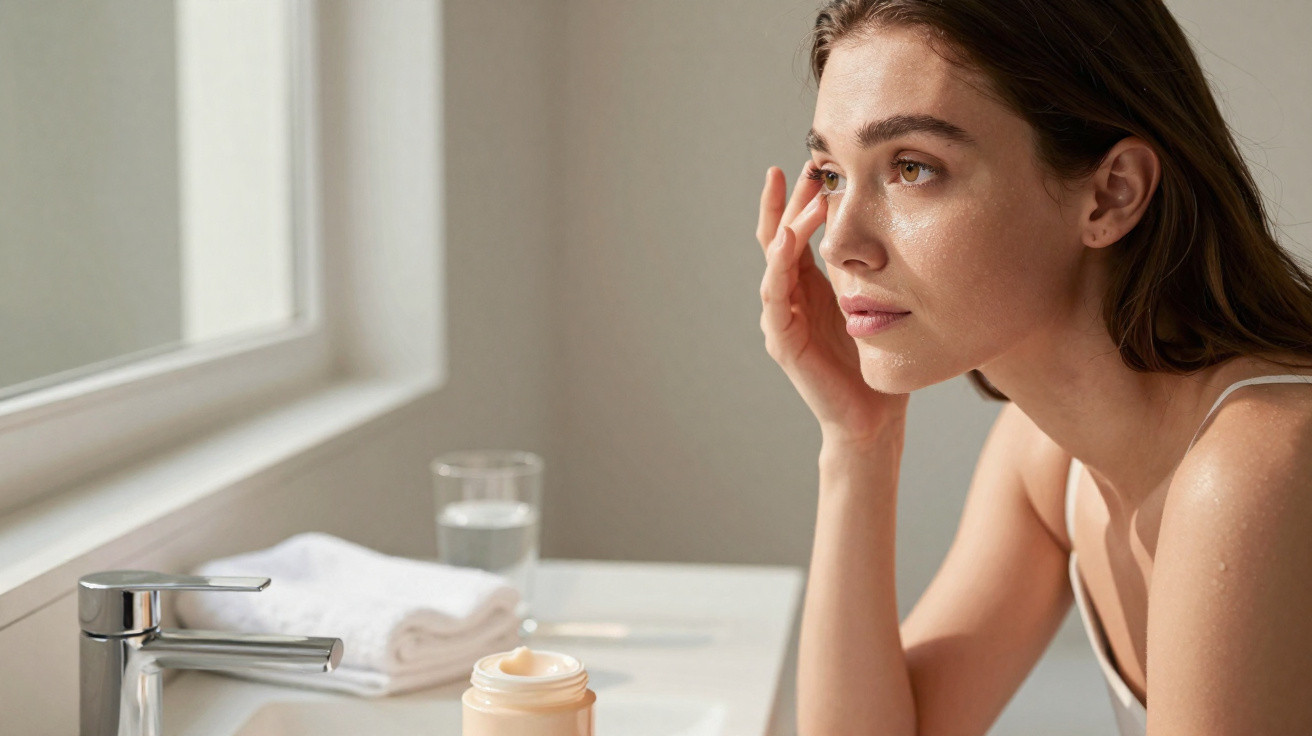
For months, you have followed every skincare rule “properly”.
You layer hyaluronic acid, a rich moisturiser and face oil to “lock it in”, perhaps finishing with an overnight mask. Your complexion ought to look radiant. Yet, one morning, you move closer to the mirror and notice that the fine lines around your eyes seem more pronounced rather than smoother. Your once-favourite foundation is settling into creases. Meanwhile, your forehead appears strangely glossy and fatigued all at once.
Perhaps you blame age, stress or the wrong serum. You respond by adding extra hydration, richer balm and more illuminating drops. But as the layers build, those small lines seem to attract even more attention. They reflect the light. They no longer seem to blur as they once did.
It feels deeply unfair. You are embracing “self-care”, but your skin appears older. Clearly, something is not adding up.
And it is not an issue most skincare advertising discusses.
When “more moisture” backfires on your face
There is an unspoken bathroom moment that no before-and-after video captures: your cream has finally absorbed, you pause, and your skin feels… weighed down. Not nourished, simply covered. Almost wax-like.
Your cheek may feel smooth to the touch, yet there is an unusual tightness beneath the surface. Expression lines no longer seem as springy as before. It can feel as though the product is resting on top of the skin, making each minute crease a narrow channel that catches and intensifies light.
That is the paradox: products designed to create plumpness can sometimes make fine lines resemble more deeply etched marks.
Dermatologists encounter this more frequently than you might expect, particularly among people whose skin is naturally oily or combination. The pattern is often familiar.
A person begins with a straightforward routine. They then hear about “skin flooding” on TikTok and introduce a hyaluronic acid serum, followed by a dense cream, then a coating of petroleum jelly or face oil. For several days, their skin feels soft.
After a week, make-up starts creasing around the mouth. At two weeks, closed comedones emerge on the cheeks. By the third week, fine lines previously visible only while smiling can be seen even when the face is relaxed. In photographs, the skin may look unusually puffy, while the lines cut through the puffiness like small folds in fabric.
A survey by a UK beauty retailer found that women now apply an average of nine skincare products each day. Most are moisturising or “hydrating” products. Fine lines nevertheless remain the leading concern.
The reasoning becomes straightforward once it is recognised. If the skin barrier is continually covered in weighty occlusives and dense formulations, it may regulate its own moisture and oil production less effectively. The outer surface becomes overly softened, almost waterlogged, even while the deeper layers remain dehydrated.
Think of damp paper: it initially looks smooth, then becomes fragile and easy to crease. Excess moisturising may also create low-level swelling in the stratum corneum. This swelling can make every small line open slightly, much like a fold in wet fabric.
Product can also accumulate in the face’s natural creases: smile lines, crow’s feet and the “11s” between the brows. That residue traps make-up pigment and pollution, making these lines look deeper.
Skin does not require limitless moisture. It requires balance.
How to moisturise so fine lines look softer, not sharper
The first useful measure may seem counterintuitive: apply less rather than more. Reduce your routine for two weeks to one gentle cleanser and one uncomplicated moisturiser, preferably fragrance-free, medium-weight and made with a short ingredient list.
Use moisturiser only on areas that are truly dry instead of applying it automatically as a full-face mask. A lighter gel-or simply your hydrating serum-may be sufficient for an oily T-zone. At night, use a pea-sized amount of cream across the entire face rather than a thick layer applied “for safety”.
Assess your fine lines in natural daylight rather than beneath bathroom spotlights. Once their skin is no longer smothered every evening, many people find that lines around the eyes and mouth appear less “puffy-defined” and more naturally softened.
One practical swap is to replace a heavy-cream step with a humidifier and a glass of water at your desk. Skin hydration depends not only on what you put on your face, but also on the water available in your body and the surrounding air.
This is often where guilt enters the picture. Skincare has become a ritual tied to self-worth: if you are not completing an eight-step routine, are you genuinely caring for yourself? On a difficult day, missing your night cream can feel almost as wrong as not brushing your teeth.
Ironically, many people overwhelm their skin because they are afraid to see it uncovered. On a Sunday evening, they may prefer the shine of layered “glow” products to facing their real texture in the mirror. That is profoundly human. No one wants their face to betray how tired they feel inside.
However, this over-correction can lead to further issues: breakouts that stretch lines, milia beneath the eyes and foundation slipping into creases by midday. Let us be honest: nobody really follows that perfect layering routine seen on Instagram every day.
One of the gentlest changes you can make is to view moisturiser as a tool rather than a personality trait. On some evenings, your skin may need a serum and light lotion. On others, cleanser and sleep may be enough.
“Fine lines are less about how much product you use and more about how cleverly you use it,” says Dr. L., a London-based dermatologist. “Think of moisturizer as a prescription, not a blanket. Dose, texture, and timing matter more than having the fanciest jar.”
There are several immediate adjustments that may prevent your cream from drawing attention to every crease:
- Replace rich, buttery formulations with lighter lotions if you have combination or oily skin.
- Reserve occlusive products, such as petrolatum and thick balms, for genuinely dry patches.
- Allow 10–15 minutes after moisturising before applying make-up, so complexion products do not settle into soft, swollen lines.
- Add structure-supporting actives, such as retinoids and peptides, on alternate evenings instead of simply layering on extra moisture.
- Apply SPF every morning; UV damage emphasises fine lines far more than any individual cream can “fix” them.
These modest changes will not transform things overnight. They do, however, move the focus away from drowning the skin and towards helping it return to its natural rhythm.
Rethinking what those fine lines are telling you
There is something unusually intimate about examining your face at 7 a.m., with your hair pulled back and unforgiving daylight filling the bathroom. Some mornings, the lines appear soft, even gentle. On others, every small crease around the eyes can feel like a public account of each late night and every worry.
We often call them all “wrinkles” and respond by applying moisturiser. But lines are not all the same. Some are dehydration lines: shallow marks that fade quickly when the skin’s water balance is restored. Others are expression lines, showing that you laugh often or frown while concentrating. Some are structural, gradually shaped by sun exposure and time.
When all of them are saturated with heavy moisture, the signal becomes unclear. You notice the puffiness rather than what the lines may be indicating.
Rather than instinctively pursuing “plumpness”, it may be more useful to ask what the fine lines are actually communicating. Do they feel tighter after a day in air-conditioned spaces? Do they look sharper when you are stressed and not drinking enough water? Are they deeper after a week at the beach without properly reapplying sunscreen?
This kind of calm observation is more difficult than purchasing another jar. It is also less expensive and reveals more.
Over-moisturising often has its roots in fear: fear of ageing, fear of seeming insufficiently “fresh” beside filtered faces, or fear of being perceived as tired or beyond your peak. In a subtle way, every additional layer can become a form of armour.
Yet skin responds most positively not to armour, but to respect. Respect means allowing your natural oils to exist rather than constantly blotting them away before restoring shine from a bottle. It can also mean accepting a little winter tightness instead of immediately covering it with a dense balm that will only settle into smile lines by midday.
Those fine lines do not mean your creams have failed. They are part of your biology and your story. When you stop battling them with excessive moisture, they can often soften into something far less alarming-and far more like you.
| Key point | Detail | Why it matters to the reader |
|---|---|---|
| Over-moisturising can swell the surface | Too many heavy layers hold water in the outer skin and create mild puffiness | Explains why fine lines can suddenly appear deeper and more noticeable |
| Less product, better targeted | Lighter textures and smaller quantities help the skin regulate itself | Offers a practical way to soften the appearance of lines without buying more creams |
| Listen to your lines | Different lines-dehydration, expression and structural-require different responses | Helps you adapt your routine rather than reacting with panic and piling on products |













Comments
No comments yet. Be the first to comment!
Leave a Comment