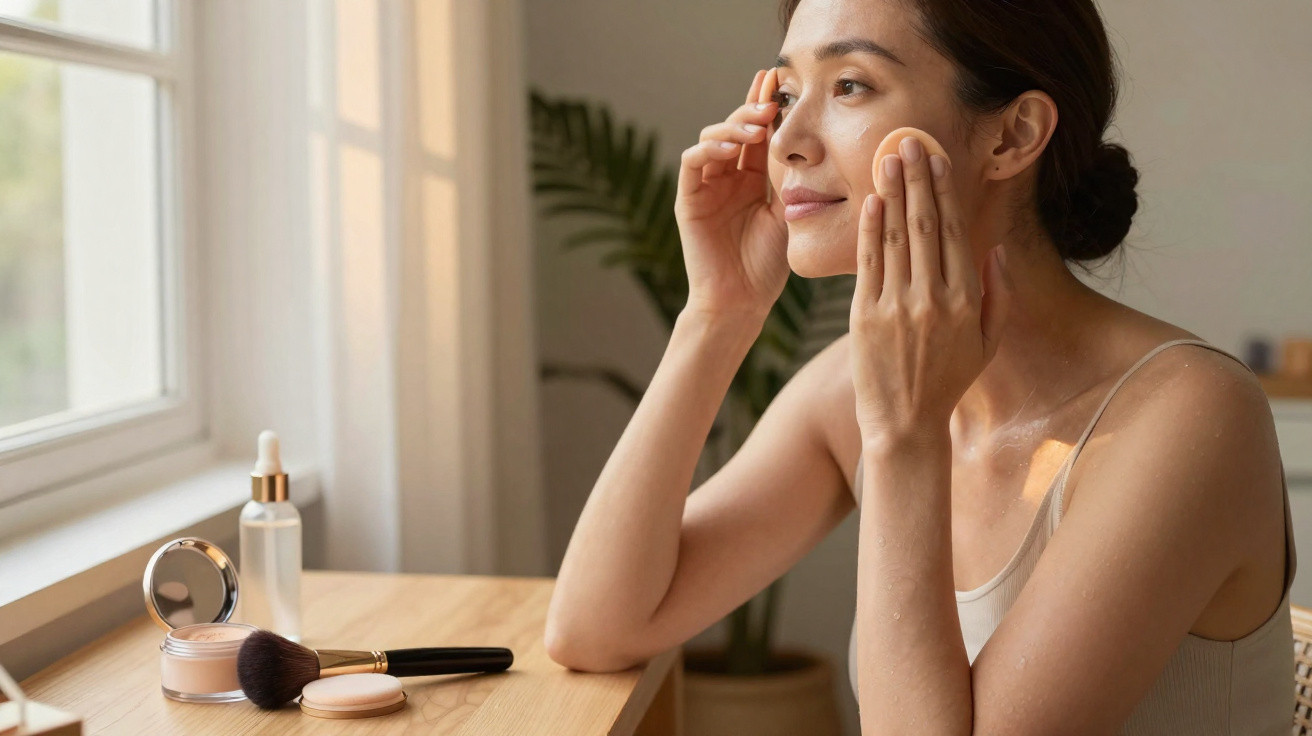
“Powder should blur what’s already there, not build a new layer of texture,” says London-based makeup artist Emma Cole.
The mirror tells you that you look “glowy and fresh”.
Your phone camera tells a different story: “tired and creased”.
You may have blended foundation with monk-like patience, pressed in concealer expertly and set it all with powder or spray. Yet, a few hours later, fine lines that are barely noticeable without makeup can suddenly resemble tiny canyons. Rather than softening the signs of time, your makeup seems to draw attention to every year.
The frustrating truth? Your foundation is often not to blame, nor is your concealer. What undermines the result is usually something you do in the final 30 seconds of your routine.
There is one small setting error that many people make, particularly around the eyes and mouth, and it can make fine lines stand out dramatically.
The setting step that quietly ages your makeup
You have likely watched it countless times on TikTok and YouTube: a large fluffy brush, a cloud of loose powder and the promise to “Bake under the eyes, it’s soooo smoothing.”
Away from studio lighting and filters, though, that very technique can go badly wrong. A dense layer of powder, pressed or baked onto skin that moves throughout the day, settles into folds. The result is an odd contradiction: more product creates more texture, and every small crease suddenly turns into a pale line.
On a 20-year-old with no visible lines, it may give a soft-focus effect. On a face that smiles, squints at emails and laughs at memes, however, it can make you look older within minutes.
Picture the friend who insists that her concealer “always creases no matter what”. She applies more product, adds another sweep of brightening concealer and then piles on translucent powder because a creator claimed it “locks everything in for 12 hours”.
By lunchtime, her under-eyes are drier than her inbox at 3 a.m. Lines that were not there at 8 a.m. emerge as soon as she smiles. Horrified, she checks her camera in the lift, zooming in and pinching the screen as though that might repair her makeup.
This is common across social media. Hacks that appear extraordinary on filtered, smoothed skin can magnify fine lines and shadows on everyday faces. The figures speak for themselves: “how to stop concealer creasing” has gained millions of views, because so many people feel quietly let down by their setting routine.
From a technical perspective, it is logical. The thinner the skin, the easier it is to see texture. The under-eye area, the skin around the mouth and the space between the brows all move constantly and produce less natural oil. Add a heavy, dry formula and it grips, clings and cracks as the day progresses.
The classic error is setting everywhere identically: using the same product, pressure and brush across the face. The T-zone benefits from a light veil of mattifying powder; your under-eyes generally do not. Still, many people approach the entire face as though it were one large forehead.
As a result, makeup does more than sit on the skin. It separates, catches light in every fold and makes previously subtle fine lines look visibly highlighted.
How to set makeup without emphasising fine lines
The solution begins before powder even comes into contact with your face. Treat your complexion as a map rather than one uniform surface. Certain areas need staying power, while others simply need a softer finish.
Begin with the areas that genuinely become oily: the sides of the nose, the centre of the forehead and the chin. With a small soft brush, collect the smallest amount of loose powder and tap away any excess. Then press and roll it onto the skin rather than sweeping it over the surface. This press-and-roll technique smooths the complexion without pushing powder into creases.
Use different rules beneath the eyes. Choose a micro brush or damp sponge, then pick up only the faintest veil of finely milled powder. Think “whisper”, rather than “blanket”. A gentle tap exactly where concealer naturally gathers - commonly at the inner corner and in the first small line - is often all that is needed.
One straightforward habit can make a significant difference: set once creases have appeared, rather than before they form.
Apply and blend concealer, then leave it for 20–30 seconds. Look upwards, smile gently and make a few expressions. Allow the initial tiny folds to emerge. Next, lightly tap them out with a clean fingertip or sponge. Then set only that smooth area with the thinnest possible layer of powder.
Many people miss this tiny step, moving directly from blending to baking. In doing so, they effectively “freeze” makeup into the first crease it creates. However luxurious the products may be, once they are set in a line, that line will deepen throughout the day.
There are several familiar pitfalls that almost everyone encounters: following a heavy “Instagram-era” setting routine for ordinary days, or copying baking methods designed for hot studio lights and eight-hour shoots before wearing them in a softly lit office.
Then there is the seemingly innocent oversized fluffy brush. Although it appears light and airy, it can deposit far more powder than you realise, especially below the eyes. Honestly, many of us use the same brush for bronzer, powder and sometimes blush, then wonder why our under-eyes look muddy and dry. Let’s be honest: nobody really does this every day with the precision of a professional makeup artist.
The setting routines that are easiest to wear are also the lightest. Use less contact, less product and more intention.
“When fine lines suddenly ‘appear’ after setting, what you’re seeing is powder sitting in the skin’s natural movement.”
- Keep a dedicated, very small brush solely for under-eyes and smile lines.
- Opt for ultra-fine, talc-free or hybrid powders in delicate areas.
- Reserve baking for performances, photoshoots or very oily skin, rather than every Tuesday.
- Apply a mist of setting spray first, then use powder only where shine starts to break through.
- If your skin is mature or dry, try omitting powder beneath the eyes altogether - a tiny amount at the inner corner may be sufficient.
Rethinking what “flawless” makeup should look like
At some stage, the ideal quietly changed from looking “fresh and alive” to looking flat and poreless. Faces began to resemble retouched images even in real life, while any visible line came to feel like a failure.
The issue with this fantasy complexion is that it cannot move. The moment you laugh, squint in sunlight or spend too long talking on a video call, makeup that has been over-set fractures like dry paint. Fine lines are not the problem; the way products settle into them can be.
When setting becomes a gentle edit rather than a rigid lock, the effect changes. Skin starts to look like skin again. The lines remain, but they no longer shout at the camera.
There is a comfort benefit too. Makeup that has been “cemented” with excessive powder can feel tight, itchy and heavy by late afternoon. You touch your face more often and rub your eyes, which ironically makes the makeup disappear more quickly in patches.
A lighter, more targeted approach has the opposite effect. The T-zone remains matte without appearing chalky. Cheeks retain their glow. Under-eyes appear rested rather than wrinkled. Your skin can make it through a day of work, coffee and late-night scrolling without making you desperate to remove everything the moment you arrive home.
We have all caught sight of ourselves in unflattering lighting and thought, “When did my skin start looking like this?” At times, it is not that your skin has aged overnight. It is your setting step making more noise than it should.
The most interesting change comes when people let a little life show through. One faint line by the eye, softened with light-reflecting concealer and a breath of powder, can look younger than an entirely frozen under-eye that cannot move.
Makeup artists who work with actors and presenters understand this well. For HD close-ups, they rarely bake under the eyes; instead, they use thin layers and set only the areas where the camera picks up unwanted shine. The skin remains real and expressive while still lasting under studio lighting. The same principle applies in everyday life, simply with less pressure and more personality.
So, next time you blame your age or genetics for suddenly “deeper” fine lines, consider examining your final step rather than blaming the mirror. The mistake may be small and almost imperceptible, but its effect on your face is not.
| Key point | Detail | Why it matters to the reader |
|---|---|---|
| Powder collecting in folds | Too much product, particularly beneath the eyes, settles into fine lines and makes them more pronounced | Understand why lines can look more visible after applying makeup |
| Targeted setting, not uniform setting | Mattify the T-zone, while reducing or adapting setting around the eyes and mouth | Adapt your routine for a more natural, flattering result |
| Gentle setting techniques | Press-and-roll, tiny quantities, waiting before applying powder and possible use of setting spray | Gain practical techniques to reduce the “cracking skin” effect |












Comments
No comments yet. Be the first to comment!
Leave a Comment