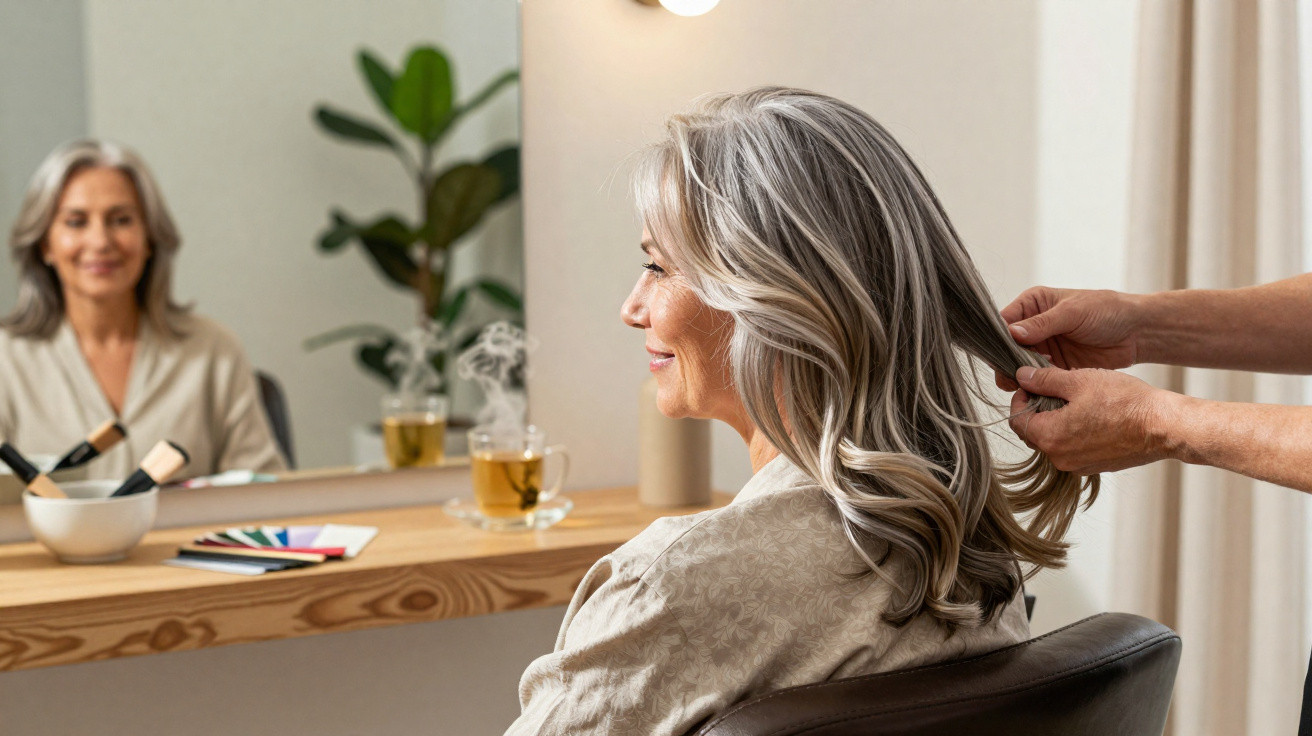
At 9:15 on a Tuesday morning, the salon is already full of life. A kettle whistles in the staff room, foils rustle, and women chat quietly about holidays and hormone levels. In chair three, a woman in her early fifties winds a section of hair around her finger as she studies the mirror. Her roots are quickly turning silver, the lengths remain an ageing chestnut brown, and the overall finish is… uneven. “I don’t want to look 25,” she tells the hairdresser. “I just don’t want to look tired.” The stylist smiles, raises the salt-and-pepper roots with a comb and replies softly: “You’re ready for lowlighting balayage.”
Something changes in the reflection.
Why lowlighting balayage makes sense after 50
If you are over 50 and feel as though your grey hair appeared all at once, it is not simply your imagination. At first, you may be disguising a couple of strands near your parting; then, seemingly overnight, silver appears at the temples and your old colour begins to look dull. Traditional all-over colouring can start to seem overly severe, as though you are in conflict with the person in the mirror. This is where lowlighting balayage can help. Rather than trying to defeat the grey, it works with it and makes it appear deliberate. Your salt-and-pepper hair becomes a colour in its own right instead of a “problem” to solve. The benefits include a softer regrowth line, fewer lengthy salon visits and a face that can instantly seem more refreshed.
Hairdressers are noticing this change in attitude every week. One Paris colourist told me that, since 2020, many of her clients over 50 have stopped attempting to conceal 100% of their grey. Instead, they request something “between blonde and gray” or “not too fake, but not too old either.” She regularly shows before-and-after images of women with streaky, grown-out home colour who leave with natural salt-and-pepper hair threaded with subtly deeper ribbons. You do not necessarily think, “wow, nice balayage.” Instead, the impression is simply: “she looks rested.” That is the understated strength of this technique once grey begins to dominate the hairline.
There is sound reasoning behind the trend. As the complexion softens over time and facial contrast reduces, the solid dark shade that worked at 35 can look harsh by 55. Going fully light towards white is not always the solution either, as it may make the face appear washed out. Lowlighting balayage introduces measured depth precisely where the grey is too flat or uniform. The stylist hand-paints slightly darker shades beneath and between the silver strands. Your natural greys serve as built-in “highlights”, while the lowlights create dimension and movement. Instead of demanding attention, your hair colour becomes more subtle.
How lowlighting balayage works on salt-and-pepper hair
Imagine lowlighting balayage on grey hair as adding shadow to a pencil sketch. The colourist does not cover the salt-and-pepper pattern in a block of solid dye. They assess where the grey is concentrated - commonly at the hairline, crown and temples - then apply slightly deeper tones around those areas. The strokes are gentle and diagonal rather than straight or stripy. A skilled colourist blends cool and neutral shades that sit close to your natural base, creating a result that looks established from the first day. Its appeal lies in respecting the grey rather than removing it. You leave the salon looking unmistakably like yourself, only… refined.
A London stylist described a client in her late fifties who had coloured her hair dark brown for years. White regrowth appeared every three weeks, leaving her feeling tied to constant appointments. Together, they chose to end the ongoing battle with her roots. The stylist lightened some of the old dark pigment and then placed soft lowlights around the client’s natural grey, particularly through the back where the colour looked overly even. The front was kept lighter, with more silver left to frame her face. Following two appointments, her friends said: “You look younger, did you sleep more?” No one could identify the change as her hair. More importantly, she moved from colouring every 3–4 weeks to having her balayage refreshed twice yearly.
Technically, grey hair has a different texture and level of porosity, which explains why all-over colour can take too darkly or fade in an unusual way. Lowlights colour only carefully chosen strands, allowing the hair to retain more of its natural personality. The colourist can tailor the formula too: a cooler lowlight when grey turns yellow, or a slightly warmer shade when the complexion needs added warmth. The grey itself acts like free, built-in highlights, which means less overall processing. This can be gentler on hair that is becoming drier or more delicate. It offers a considered middle ground between “I give up” and “I’m pretending I never went gray.”
The hairdresser’s lowlighting balayage method: consultation to glow
The work begins well before the colour is mixed. A thoughtful hairdresser will sit with you and map the pattern of your salt-and-pepper hair. They will section it, assessing where it is predominantly white, where colours are blended and where your former natural shade remains strongest. Then comes an essential question: how much grey are you emotionally comfortable seeing? Some women prefer 60% to remain visible, while others begin at 30% and gradually gain confidence. On that basis, the stylist selects two or three lowlight shades rather than relying on a single colour. These are applied in V-shapes and sweeping strokes, with plenty of grey left untouched. The intended result is a soft, watercolour-like blur rather than obvious bands.
The biggest mistake is often attempting to “try out” lowlighting balayage at home using an arbitrary box dye. This is when uneven results occur, particularly on previously coloured hair. Another frequent error is requesting strongly warm caramel lowlights against cool, icy grey. That can leave you feeling as though the hair belongs to somebody else. Rather than naming a celebrity, explain how you want to feel: brighter, softer or less contrasted. Your stylist can convert that into suitable placement and tones. If you are anxious, ask for deeper colour through the back and a gentler approach around the face. The initial shock in the mirror is likely to be easier.
A colorist I spoke to put it plainly: “Gray hair after 50 doesn’t need correcting, it needs curating. The lowlights are like punctuation marks; they guide the eye so people see your face, not just your roots.”
- Request a consultation before booking colour: photographs, your colour history and enough time to talk are essential.
- Take daylight selfies from the front, side and back, allowing the stylist to understand your genuine grey pattern.
- Begin with delicate lowlights and build them over 1–2 sessions; a dramatic change in one appointment can often feel “too much.”
- Pick a haircut that allows the colour to move. Soft layers, a fringe or a bob all work particularly well with salt-and-pepper hair.
- Consider upkeep in advance: for most women, a gloss every 6–8 weeks and lowlight refreshes twice a year work well.
Living with your new salt-and-pepper hair beyond the salon
The experience does not end when you leave with bouncy, toned salt-and-pepper hair. During the first week, many women describe an unfamiliar combination of surprise and relief. You may catch yourself in a shop window and think, “Oh, that’s really me.” Then you notice how the lowlighting balayage appears in daylight, beneath office LED lighting or in a friend’s bathroom mirror. The greys glimmer rather than gathering in flat patches, while the lowlights create a subtle root shadow. Suddenly, the silver appears intentional rather than accidental. This is often when unexpected compliments begin - from a teenage niece, a male colleague or a neighbour in the lift.
| Key point | Detail | Value for the reader |
|---|---|---|
| Respect your natural grey | Use lowlights to create depth and definition rather than eliminating salt-and-pepper hair | Hair appears authentic, current and simpler to maintain |
| Think long-term maintenance | Balayage every 4–6 months, with gloss appointments in between and no frantic root touch-ups | Less salon time and spending, with greater freedom from regrowth anxiety |
| Choose the right colourist | Seek grey-blending expertise, photo portfolios and a proper consultation | Lowers the chance of flat, ageing colour and helps create a smoother transition to grey |















Comments
No comments yet. Be the first to comment!
Leave a Comment