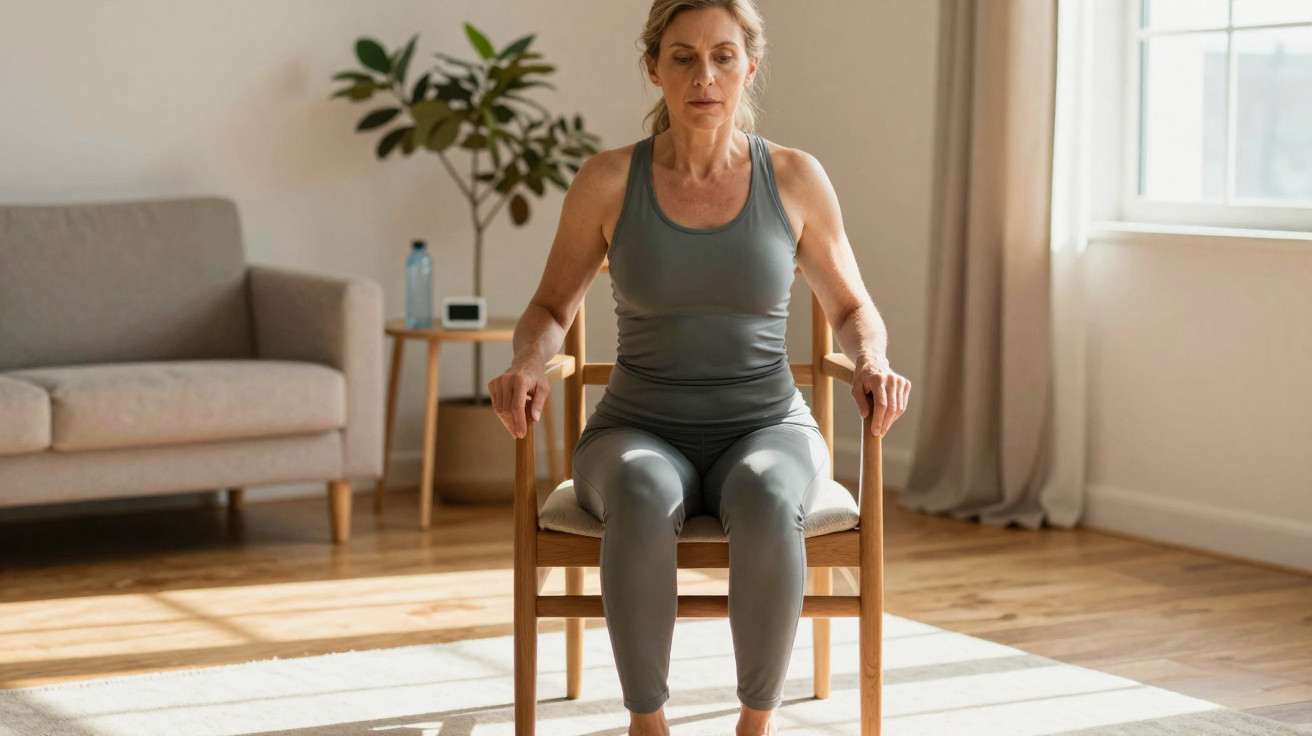
Getting up from a chair is involved in many everyday activities, but it can also be used as a bodyweight exercise. Performed with control, the movement mainly works the muscles in the legs and hips while also requiring balance.
Why can standing up from a chair work as exercise?
To rise from sitting, the body must generate enough force to lift its own weight while keeping the movement stable. The thighs, hips and core area all contribute to this action.
As a functional movement, this exercise has a useful benefit: it mirrors something already done in daily life. Practising this ability may help preserve independence for activities such as getting out of bed, rising from the sofa or standing up from the toilet.
How to perform the movement safely
Begin with a solid, stable chair positioned on a non-slip surface. Sit near the front edge, place both feet flat on the floor and lean your torso slightly forwards.
From there, push through your feet and stand up in a controlled way. Then reverse the action by moving your hips backwards and bending your knees until you sit down again, rather than dropping into the chair.
Is it better to start by using your hands?
Yes, for anyone who does not yet have sufficient strength or balance. Placing your hands on the chair arms or another stable surface can make the movement easier at first.
As it becomes more comfortable, you can gradually reduce this support. Progression should not come at the expense of technique. There is no need to be able to stand up without using your hands on the very first attempt.
How can you gradually make chair stands harder?
An easy way to progress is to begin with a small number of repetitions, then increase them gradually as the movement becomes easier. You may also use a slightly lower chair, provided this does not reduce safety.
Slowing down the lowering phase is another option. The aim is not to complete as many repetitions as possible, but to build strength and control through proper execution.
Stop the exercise if you experience pain, dizziness, a significant loss of balance or unexpected difficulty completing the movement. People with physical limitations or particular health conditions should seek professional advice before beginning an exercise routine.
In this way, the simple act of standing up from a chair without using your hands can become more than an everyday task: it can be an accessible way to develop strength, body control and independence.
















Comments
No comments yet. Be the first to comment!
Leave a Comment