There is a very specific kind of disappointment that strikes at about 1:17pm in the workplace loo.
You glimpse yourself in the mirror, tidy your hair and lean closer for a comforting sniff of the costly perfume you sprayed at 7:45am… only to find nothing there. Perhaps there is the merest echo of citrus. Mostly, though, it is “office air” and stale coffee. You stand there irritated that it matters to you, and equally irritated that your perfume has vanished.
Fragrance is a tiny daily ritual, but it holds an absurd amount of emotional importance. It is the invisible outfit we choose, the version of ourselves we want to inhabit that day. When it disappears before lunchtime, it feels strangely personal, as though your carefully selected mood has simply… expired. People will advise you to “spray pulse points” and “dab, don’t rub”, yet they rarely mention the less glamorous reality: many of us apply perfume in entirely the wrong places. One small adjustment can transform it.
The moment I realised my perfume was not the issue
For years, I assumed I had the sort of skin that simply “eat perfume”. I would spray something beautiful on my wrist in a department store, immediately fall for it, then find it disappeared completely when I wore it in everyday life. I blamed the label, the cost, my hormones and the British climate – virtually everything except the place and method I used to apply it.
The revelation arrived during a particularly vain moment in an office lift. A colleague got in, the doors closed, and the small space filled with a warm, creamy fragrance. It was not overpowering, just softly self-assured. “What is that?” I blurted out. With a slightly smug smile, she gave me the perfume’s name. It was exactly the same one sitting rather sadly on my dressing table at home.
There was a short pause as my ego attempted to understand that we wore the identical perfume, yet she smelled like a drifting cloud from French cinema while I generally smelled like… the recollection of a duty-free sample. I asked how she put it on. She shrugged: “Behind my knees, back of my neck, on a bit of body cream. Never on my wrists, they’re basically perfume graveyards.” At that point, something clicked in my mind.
The “classic” perfume application advice – and why it fails you
Most of us were raised on the same imprecise guidance: spritz your wrists, dab behind the ears and perhaps walk through a cloud of perfume like a Disney princess. It seems logical. These are pulse points, where blood supposedly “warms” the fragrance. It sounds sufficiently scientific to lodge in your mind for life. In practice, however, the truth is much messier and much more… human.
Consider what your wrists do all day. You wash your hands, type at a keyboard, pull jumpers on and off, knock your watch against door frames and thoughtlessly rub your wrists together because someone once claimed it “activates the notes”. It does not. It only crushes them. Each tiny movement wears away another layer of scent. It is hardly surprising that it has gone before the second batch of emails.
Behind the ears comes with a separate issue. The skin there is frequently dry and exposed and, when you wear your hair loose, continually brushed by strands that collect and carry off the fragrance. Then there is the advice almost nobody observes: apply perfume to bare, moisturised skin rather than clothing. Honestly, who manages that every day? You pull on a jumper, grab the bottle and spray straight onto the fabric because you are already running late.
The small perfume tweak: keep fragrance away from your hands
Here is the unglamorous fact that genuinely altered how long my perfume lasts: your wrists are the enemy. Not because they are “wrong”, but because they are constantly occupied. The easiest change is to stop treating them as premium fragrance territory and instead choose areas that do not repeatedly encounter soap, keyboards and door handles.
Spray the inner elbows rather than the wrists. They are still warm pulse points, but they are more protected. Your sleeves shelter them. You are not knocking them against the printer or coating them in antibacterial gel. The little crease inside your arm gently heats the perfume throughout the day, releasing soft wafts whenever you stretch or reach for something.
Another unexpectedly effective place is the back of the neck, high on the nape beneath the hairline. Position the fragrance just below where your hair falls, or where a collar brushes lightly. Clothing produces a gentle “friction cloud” that diffuses the scent without removing it. Suddenly, someone catches a subtle trace when you turn your head in a meeting or lean over a notebook. It feels intimate rather than overwhelming. Almost secretive.
The “wrong” places that are actually brilliant
Behind the knees: an understated powerhouse
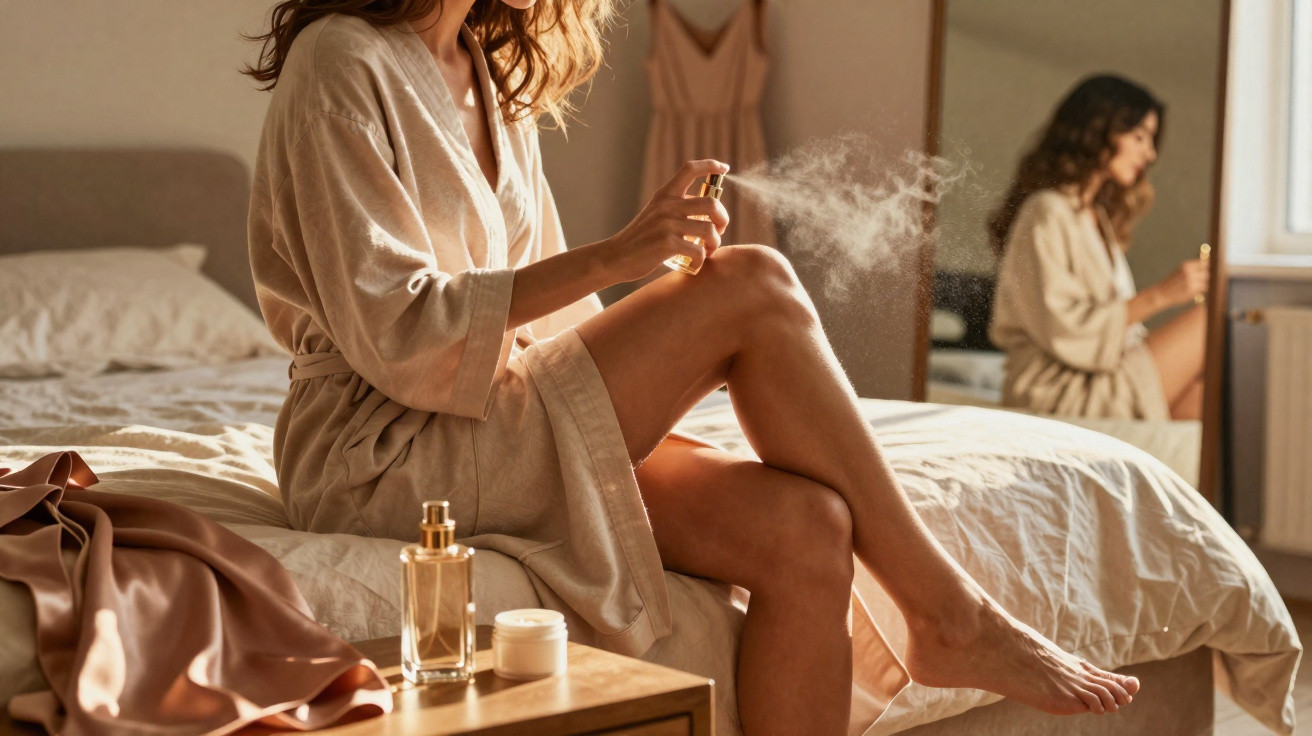
Applying perfume behind your knees initially sounds ridiculous, as though an overly enthusiastic beauty columnist invented it. Then you try it on a day when you are wearing a skirt, dress or even wide-leg trousers, and realise it is exceptionally good territory. The area is warm, concealed and moves with you in a slow, swishing rhythm as you walk.
The perfume rises gently into the air as you climb stairs or cross your legs. Nobody can quite work out where it is coming from. You do not wash that area with strong soap ten times a day, nor do you rest it against a sticky pub table or steering wheel. As a result, the fragrance simply… remains there. Quietly. Throughout the day. You may almost forget you applied it until a passing breeze brings it back to you.
On moving fabric, rather than clingy fabric
There is an old “rule” that perfume should not be sprayed onto clothing because it may stain. That is partly correct: dark fragrances and delicate silk are not a happy pairing. A light mist over cotton, linen or a blazer lining, though, is another matter. Fabric retains fragrance molecules in a way skin cannot, particularly if your skin is dry or you spend the day in central heating.
The key is spraying from a sensible distance – roughly arm’s length, not an aggressive close-range assault. Allow the mist to settle on fabric that shifts in the air: inside a coat, along a dress hem or at the back of a scarf. As you walk, sit and stand, it stirs the fragrance and releases an occasional suggestion of scent rather than one strong blast that has vanished by midday. It becomes less “I am wearing perfume” and more “this is just how my clothes smell”.
The moisturiser step nobody wants to do – but which works
Experts are always going on about “moisturise first, then perfume”, as if we all linger with body lotion at 7am like extras in a skincare advert. In reality, most mornings are teeth, clothes, keys, out. The prospect of a luxurious, layered hydration routine sounds lovely, but life is more often yesterday’s jeans and a quick spritz near the front door.
Nevertheless, this irritating piece of advice genuinely works. Perfume adheres better to hydrated skin. Dry skin resembles sand: it absorbs the fragrance and swallows it up. If a full-body moisturising session feels impossible, be selective. Pick two areas, perhaps your inner elbows and the back of your neck. Apply a little unscented or gently scented lotion, let it absorb and then spray.
The fragrance rests on that added cushion of moisture and evaporates more gradually. You do not need expensive cream; a standard supermarket body lotion will do. The aim is not perfection, but providing something for the perfume to hold onto. A small thirty-second habit can add a couple of hours to your fragrance’s life. It feels a little magical, even if you know it is only ordinary chemistry.
Why your “invisible cloud” may seem to vanish
We have all had the experience of being certain we can no longer smell our perfume, only for somebody else to say “you smell amazing”. It is confusing and slightly frustrating. You question whether you applied enough, so you add more. Then you find yourself choking in the car while people on the bus quietly suffocate in your wake. What is actually happening is nose fatigue: your brain categorises your own scent as background information and politely turns down the volume.
That is where spraying in slightly “strange” areas becomes useful. When scent rises from behind your knees or reaches you from the bend of your elbow, you notice it in brief flashes rather than one prolonged, numbing blast. Your nose receives little reminders instead of permanent fog. Your brain does not mute it in quite the same manner. You experience perfume more as those around you do: light, fleeting and unexpected.
The other thing no one admits is that our expectations are often too high. We expect one spray at 8am to remain powerful at 8pm, like a persistent ex. Certain perfumes are designed to do that – heavy orientals, strong ouds and bold vanillas. A transparent citrus created for a summer in Mykonos will never behave that way in a Lancashire office in February. Changing your application spot gives you additional hours, not immortality.
The emotional comfort of smelling like “you” all day
There is something surprisingly grounding about catching your own fragrance in the middle of a chaotic day. You are managing emails, phone calls and WhatsApp drama in family group chats when, reaching for a mug in the cupboard, you catch a soft trace of perfume from your sleeve. You remember the version of yourself who calmly stood before the mirror that morning, deciding which “you” to wear. It is a subtle form of checking in with yourself.
When your scent has disappeared by lunchtime, that connection is lost. The ritual begins to feel futile. You may stop bothering altogether because “what’s the point, it never lasts on me”. That small adjustment – moving perfume away from your hands and allowing it to settle in the hidden, warmer parts of your body – preserves that connection. It does not demand attention. It simply remains.
There is power in that. Not the obvious Instagram version, but the discreet, personal power of feeling polished when nobody is really paying attention. The power of smelling like yourself as you enter a difficult meeting, board a packed train home or walk into a quiet pub when you are not entirely sure how the evening will unfold. Your fragrance is still present, soft but determined, reminding you that you exist beyond your calendar and inbox.
Where should you spray perfume tomorrow morning?
If you removed all the noise, rules and marketing nonsense, the answer would be simple. Spray less on the bits that work hard, more on the bits that quietly mind their business. Choose inner elbows over wrists, the nape of your neck rather than the sides, behind your knees when your outfit permits it and the inside of your clothes rather than the front of your jumper.
Add a tiny bit of moisturiser where your scent lives. Use unscented lotion where possible, or something that will not clash with your perfume. Wait thirty seconds, then spray from a little distance and allow the mist to settle instead of pressing the nozzle directly against your skin. Do not rub. Simply leave it alone. Go about your day and see how long it stays with you.
Perhaps, the next time you are in that 1:17pm work bathroom, fixing your hair and checking your teeth, you will lean in for that cautious sniff and be pleasantly surprised. That soft trace of who you chose to be at 7:45am will still be there, clinging to the inside of your sleeve, warming from the bend of your arm, rising quietly from your collar. It will not be shouting for notice or disappearing without a trace. It will simply stay, as a good story does, long after the first spray.











Comments
No comments yet. Be the first to comment!
Leave a Comment