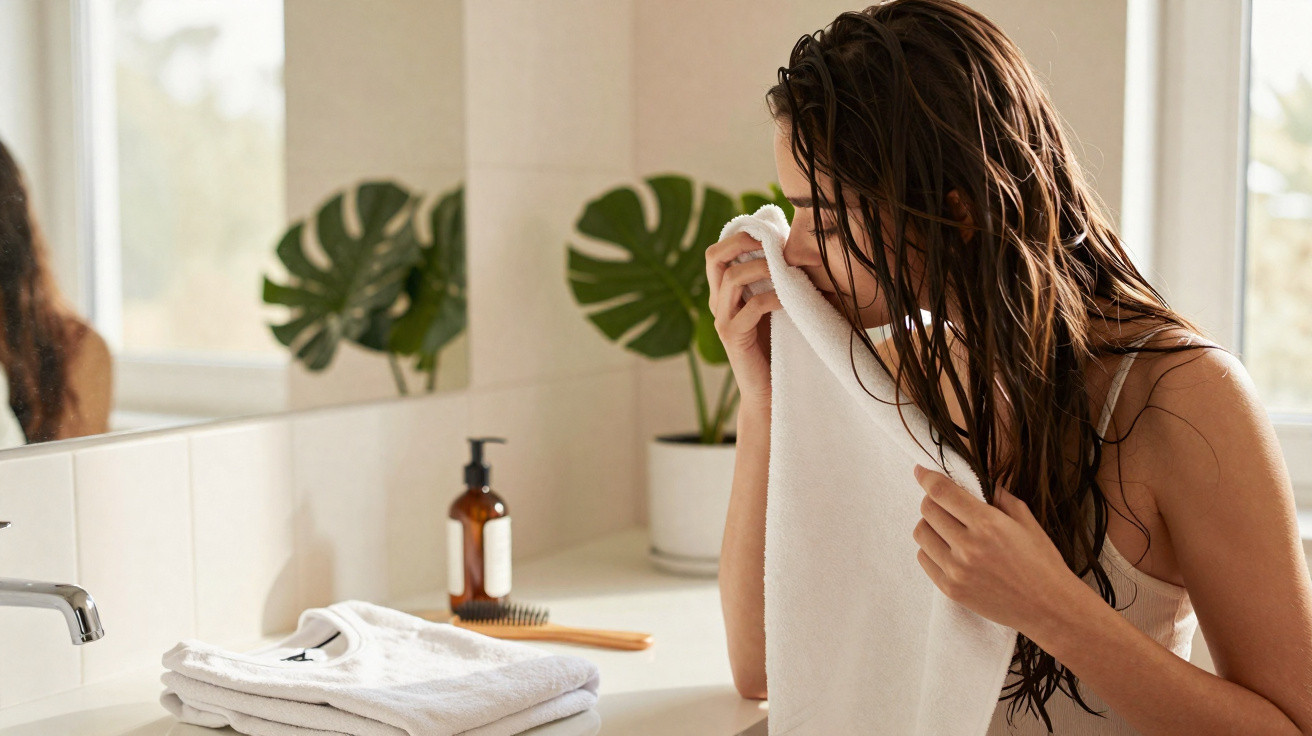
Stepping out of the shower and briskly rubbing a towel over your head may seem like a practical way to dry your hair. However, this action increases friction at the very point when wet strands are at their most vulnerable. Replacing rubbing with gentle pressing can help keep hair less tangled and more orderly.
Why can rubbing with a towel leave hair looking untidy?
Moving a towel back and forth makes its surface repeatedly brush against the hair. This friction can lift the cuticle, the strand’s outer layer, which may encourage tangles, frizz and a flyaway appearance. The result is often more noticeable on long, curly, bleached or naturally dry hair.
This does not mean you need to stop using a towel after washing your hair. The main difference is the motion you use. Rather than applying force to speed up drying, remove the excess water first in a controlled way. It is a small adjustment to your routine, but it can prevent a few rushed seconds from becoming minutes spent detangling your hair afterwards.
Is squeezing better than rubbing your hair with a towel?
One straightforward option is to wrap small sections of hair in the towel and press gently. The material soaks up water without requiring repeated movements across the strands. Start at the ends and work upwards carefully, without pulling, squeezing too firmly or piling all your hair on top of your head.
The difference is easy to picture. Rubbing sends strands in several directions at once, whereas squeezing keeps the hair more still. The aim is not to make it completely dry before you leave the bathroom, but simply to remove dripping water and allow the rest of the drying process to happen with less friction.
What is the difference between rubbing, twisting and squeezing?
Although all three actions may seem alike when you simply want to remove water, they affect hair differently. Rubbing creates friction, twisting forces the strands around themselves, and squeezing lets the fabric absorb moisture with less movement. In practice, the third approach is generally the gentlest.
- Rubbing repeatedly moves the strands and can make flyaways more noticeable.
- Twisting concentrates force on wet hair and may lead to tangles and breakage.
- Squeezing absorbs excess water while helping to keep strands more organised.
It is also best to avoid securing your hair in a very tight turban or twisting the towel firmly to hold it in place. The intention is to minimise handling while the strands are still soaking wet. Once the excess water has been removed, detangle according to the needs of your hair type and continue with your usual styling routine.
Watch the video shared by the YouTube channel Bela em Casa, which shows how to dry your hair properly without damaging the strands.
Can a cotton T-shirt replace a towel?
If the towel you have is particularly rough, a clean, soft cotton T-shirt can work as a home alternative. Its smooth fabric lets you wrap and press the strands with less friction. Choose a garment without stiff prints, zips or details that could catch in the hair during the process.
The method remains the same: do not rub the T-shirt over your head. Place the fabric around sections of hair and press lightly to absorb the moisture. This can be especially useful for anyone who notices a lot of frizz after showering, as it helps prevent the vigorous movement that leaves strands pointing in different directions.
Is it worth changing such a small habit?
Hair care does not always rely on expensive products or time-consuming routines. Sometimes, the outcome starts with how the strands are handled. Replacing the automatic habit of rubbing and twisting with a few gentle pressing motions can make the drying stage kinder and detangling easier.
At your next shower, try it before reaching for the towel on autopilot. Squeeze instead of rub and see how your hair responds over the next few washes. A change that takes only a few seconds may be enough to simplify your routine and reduce the untidy look that often appears straight after drying.
















Comments
No comments yet. Be the first to comment!
Leave a Comment