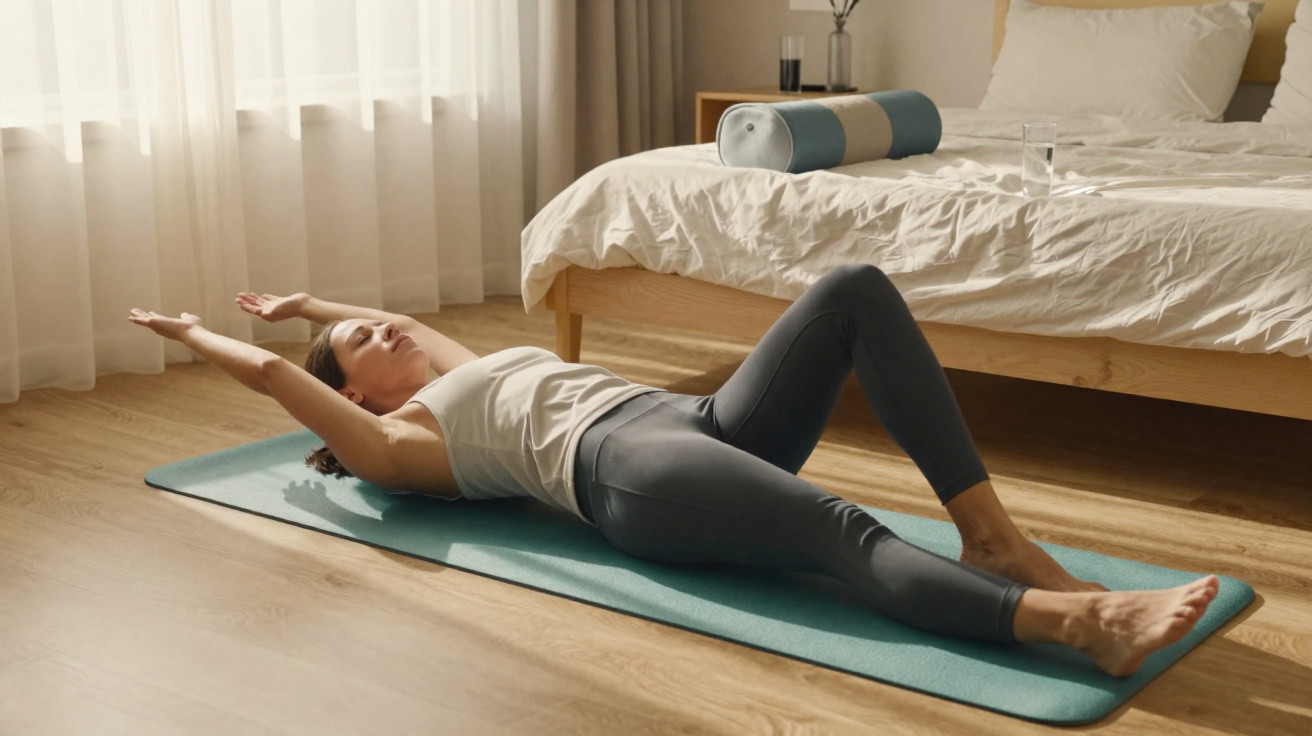
Back pain on waking can have several causes, with muscle weakness being only one possibility. Where there are no warning signs or specific conditions that rule out exercise, strengthening the abdominal muscles, deep trunk muscles, glutes and lower back may improve the ability to support everyday movement and loads. Guidance on low back pain includes trunk strengthening and endurance exercises among the recommended options.
1. How can you begin abdominal activation without overloading the lower back?
The first approach is to learn how to engage the deep muscles without holding your breath or moving the spine excessively. Lie on your back with your knees bent, then gently tighten your abdominal muscles as though preparing your torso for a light impact. This control helps create a foundation for more demanding stability exercises.
- Keep your feet flat on the floor and your knees bent.
- Tighten your abdominal muscles without forcefully pressing your lower back into the floor.
- Keep breathing normally while maintaining the contraction.
- Begin with a few seconds, then increase the duration gradually.
2. Why does the bridge strengthen more than just the glutes?
The bridge starts from the same position but introduces movement: engage your abdominal muscles and glutes, then slowly lift your hips until you form a comfortable line from the shoulders through the hips to the knees. As well as working the glutes, this exercise requires trunk stabilisation and features in strengthening programmes used for people with lower-back discomfort.
Movement should come chiefly from the hips, rather than turning the lift into lower-back hyperextension. If sharp pain, pain spreading into the leg or progressively worsening symptoms occur during the exercise, there is no need to persist in order to “build strength”: the exercise should be adapted or stopped until the cause of the symptom has been assessed.
3. How does the bird-dog develop stability without requiring large spinal movements?
With the bird-dog, you begin on hands and knees, then slowly extend one arm and the opposite leg while aiming to keep the pelvis and spine stable. The challenge is not to raise the limbs as high as possible, but to prevent the torso from rotating or collapsing. This combination develops coordination, endurance and muscle control, all of which are included in exercise recommendations for low back pain.
- Start on your hands and knees.
- Gently engage your abdominal muscles before moving your limbs.
- Extend the opposite arm and leg without rotating your hips.
- Return slowly, then repeat on the other side.
- Reduce the range of movement if you cannot keep your torso stable.
4. The side plank strengthens areas that traditional abdominal exercises barely challenge
The side plank places greater demand on the muscles along the side of the torso, including the obliques and other stabilisers that resist the body tilting sideways. To begin, you can keep your knees on the floor and lift only your hips; as strength improves, you can progress to the version with straight legs. Trunk-focused exercises may reduce pain and disability in people with chronic low back pain, although no single exercise is regarded as superior for everyone.
Progression matters most. Holding the position for a few seconds with proper alignment is usually more useful than staying there for a long time while compensating through the shoulders, hips or lower back. The strength required also differs according to age, activity level and daily tasks, which is why individualised programmes may be more suitable when pain keeps returning.
5. How can you use the dead bug and turn strengthening into a routine?
The dead bug completes the sequence by requiring the torso to stay stable while the arms and legs move. Lie on your back, raise your knees and keep your abdominal muscles engaged; then slowly move one arm and the opposite leg away, within the range you can control. Low back pain programmes do not rely on one exercise alone: strength, endurance, motor control and regular physical activity can be combined and progressed gradually.
Pain every morning should not automatically be blamed on a weak core. Prolonged stiffness that improves with movement, persistent night pain, fever, unexplained weight loss, leg weakness, numbness around the genitals, or changes in bladder and bowel control require professional assessment, with some of these symptoms indicating the need for urgent care. Strengthening the trunk can form part of low back pain prevention and treatment, but it works best when the exercise matches the true source of the discomfort.
















Comments
No comments yet. Be the first to comment!
Leave a Comment