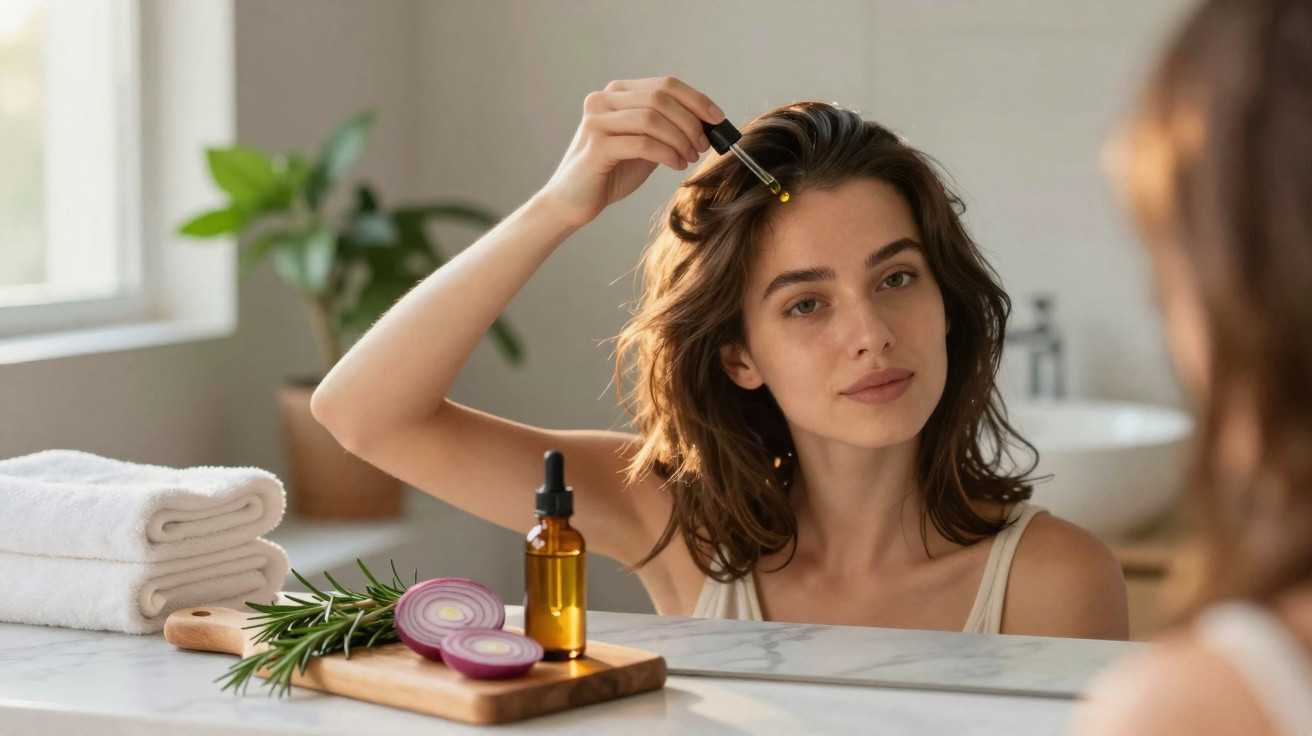
Social media feeds are packed with cupboard-based “cures” for thinning hair, with one combination repeatedly resurfacing: raw onion and rosemary.
Beyond the viral before-and-after clips, this sharp-smelling pairing prompts a legitimate question. Can two everyday ingredients more commonly used in cooking genuinely alter hair loss, or is this simply another online illusion?
Why onion and rosemary are suddenly everywhere
At some stage, hair loss affects about half of adults, ranging from short-term shedding following illness to gradual inherited thinning. Many people feel caught between costly serums, prescription medicines with possible side effects, and doing nothing at all. When frustration is high, inexpensive “natural hacks” can spread quickly.
Onion and rosemary have obvious appeal: they are affordable, widely available and have long featured in traditional remedies. The current interest is partly driven by scientific clues supporting each ingredient, although the evidence is still at an early stage.
Onion juice and rosemary extract both show signals of activity on the scalp: anti‑inflammatory, antioxidant and microcirculation effects.
What science actually says so far
The small onion trial everyone cites
In 2002, researchers published a small study in the Journal of Dermatology. It involved 62 people with alopecia areata, an autoimmune disorder that causes hair to fall out in circular patches. For two months, participants either applied raw onion juice to their scalp twice daily or used plain water as the control.
Hair regrowth was seen in more people using onion juice than in the water group. The researchers suggested that onion’s sulphur compounds and antioxidants could lessen local inflammation and improve circulation around the hair follicles.
Although this seems promising, the research had important shortcomings. It was brief, involved few participants and examined only one very particular form of hair loss. It provides very little insight into hormonal thinning or stress-related shedding, and it certainly does not show that onion works for everybody.
Rosemary versus minoxidil: a more modern trial
Rosemary has a somewhat different evidence base. A 2015 clinical trial followed approximately 100 men with androgenetic alopecia: the familiar “male pattern” hair loss associated with hormones and genetic sensitivity. One group applied a lotion containing rosemary essential oil, while the other used 2% minoxidil, a standard licensed hair-loss medicine.
At the six-month point, hair density had increased in both groups. Those using rosemary also reported less scalp irritation than the minoxidil group. Earlier laboratory research points to several potential actions: anti-inflammatory effects, slight inhibition of 5‑alpha‑reductase-the enzyme involved in making DHT, which causes follicles to shrink-and local vasodilation that may improve circulation.
Rosemary is not a proven replacement for minoxidil, but clinical data place it above the level of pure guesswork or internet rumors.
Even so, this was just one study and it used particular formulations, concentrations and carrier ingredients. DIY preparations seldom reproduce those conditions.
Not all hair loss is the same problem
Saying “My hair is falling out” can describe several very different conditions, and that distinction is crucial when considering any home remedy.
- Androgenetic alopecia: progressive thinning around the hairline or crown, shaped by DHT and genetic sensitivity.
- Alopecia areata: patchy hair loss caused by the immune system attacking follicles.
- Telogen effluvium: widespread shedding occurring weeks or months after a trigger, including childbirth, infection, crash dieting or iron deficiency.
- Traction alopecia: hair loss resulting from tight hairstyles and repeated mechanical strain.
These conditions behave differently and require different approaches. For instance, no kitchen mixture or topical spray can restore scarring alopecia, in which follicles have been permanently damaged. With hormonal thinning, onion and rosemary may at most act as supportive measures around the follicles rather than a complete answer.
How the onion–rosemary method is used at home
The “gentle” onion–rosemary lotion
The most commonly shared online approach mixes diluted onion juice with a rosemary infusion. It is intended to retain some active compounds while reducing the odour and likelihood of irritation.
| Step | What people do | Why it matters |
|---|---|---|
| 1. Rosemary infusion | Place 2–3 fresh sprigs, or 1 tbsp of dried rosemary, in 250 ml of hot water. Cover for about 20 minutes, then strain. | Draws out aromatic molecules and polyphenols without scorching them. |
| 2. Onion juice | Blend half an onion, then strain it through cloth to collect unheated raw juice. | Retains sulphur compounds and flavonoids such as quercetin. |
| 3. Dilution | Combine 1 part onion juice with 3 parts rosemary infusion. | Intended to reduce stinging, redness and a strong odour. |
| 4. Application | Work it into a clean, dry scalp for 10–15 minutes, leave it for 20–30 minutes, then shampoo. | Massage itself can increase microcirculation. |
| 5. Frequency | Use two or three times a week for at least 8–12 weeks before assessing any outcome. | Hair growth cycles are slow, so visible changes take months rather than days. |
Those who attempt this often underestimate both the odour and the potential for irritation. Onion scent may remain on bedding and clothing, while raw juice can cause itching or eczema in sensitive skin. Applying a patch test to the inner arm or behind the ear 24 hours before the first use can help avoid unexpected reactions.
Rosemary oil scalp massage
The other part of the trend uses oil. In this version, rosemary essential oil is highly diluted in a carrier oil, such as jojoba or grapeseed oil, then massaged into the scalp before washing.
Ratios typically recommended by aromatherapists keep rosemary at roughly 1% of the finished mixture. Stronger concentrations can cause burning, flaking and, in some cases, chemical burns. Pregnant or breastfeeding women, children, and people with active scalp conditions are generally advised not to use essential oils without clinical supervision.
The first marker of a reasonable routine is not hair regrowth. It is the absence of increased shedding, burning or persistent redness.
Where this leaves conventional treatments
Why does a kitchen remedy receive such widespread attention when licensed medicines are already available? The answer partly lies in the compromises involved. Minoxidil may cause itching and flaking. Oral finasteride benefits many men, but concerns about sexual side effects remain, even though they are uncommon.
In comparison, onion and rosemary seem inexpensive and low risk. They can restore a sense of control for people who feel their distress has been overlooked by medical care. That emotional factor often attracts more interest than clinical evidence does.
Dermatologists observing this trend tend to take a middle-ground view. For suitable individuals, onion–rosemary mixtures may be used alongside evidence-based approaches rather than in opposition to them. A person with early hormonal thinning, for example, could pair prescription treatment with gentle scalp massage, improved scalp hygiene and nutritional support.
What experts look for before saying “go ahead”
Red flags that require medical input
Kitchen-remedy experimentation is not appropriate for every type of hair loss. Doctors recommend a proper assessment if someone notices:
- sudden, heavy shedding over several weeks
- a painful or intensely itchy scalp
- thick, inflamed scaling or weeping areas
- bald patches that rapidly become larger
- shiny, scarred areas of skin where follicles appear absent
- hair loss alongside severe fatigue, weight changes or other systemic symptoms
Tests for iron, vitamin D, thyroid hormones and, sometimes, sex hormones are often included in the assessment. In certain cases, stopping tight hairstyles or changing medicines is more important than any lotion, whether natural or otherwise.
Why the mechanism makes some sense
Biochemically, onion and rosemary appear to be a plausible match on paper. Onion provides sulphur-containing compounds and quercetin, both investigated for antioxidant and anti-inflammatory properties. Rosemary contributes rosmarinic acid, ursolic acid and terpenes that seem to influence blood flow and mild hormonal pathways in the skin.
Together, they could modestly lower background inflammation around follicles, support microcirculation and create a scalp environment more favourable to growth. This cannot override genetics, but it may improve conditions slightly, particularly when hair loss is reactive rather than strongly hormonal.
Beyond viral recipes: questions that remain open
At present, the greatest uncertainties are practical. How concentrated should these preparations be? How frequently should they be used? Which forms of hair loss respond most favourably? Larger studies, with consistent photography, hair counts and at least a year of follow-up, are needed to answer these questions.
Cosmetic brands are already paying attention. Standardised rosemary extracts are beginning to appear in leave-in tonics and shampoos. Onion presents more difficulties: its active compounds differ according to variety and storage, while its smell creates a commercial obstacle. Laboratories are discreetly testing deodorised onion derivatives and encapsulated active ingredients that may eventually feature in mainstream formulations.
Making the most of a “natural boost” without false hopes
For anyone considering this recipe, it is more helpful to think in terms of “support” than a “cure”. A sensible approach to thinning hair generally combines several modest measures instead of depending on one supposed miracle step.
This may involve a milder shampoo routine and avoiding vigorous scrubbing; regular but gentle scalp massage; adequate dietary protein and iron; stress management; and medical treatment where appropriate. Onion and rosemary can fit into this approach as a low-cost experiment, provided the scalp is monitored carefully and professional advice is not delayed when warning signs develop.
The trend also reflects changing attitudes to personal care. Social platforms have transformed bathrooms into informal testing spaces, where recipes are adjusted and argued over in real time. Some combinations are plainly ill-advised. Others, including this onion–rosemary blend, occupy a grey area: neither fully established nor completely without basis, and perhaps signalling future products that connect traditional practice with formal dermatology.















Comments
No comments yet. Be the first to comment!
Leave a Comment