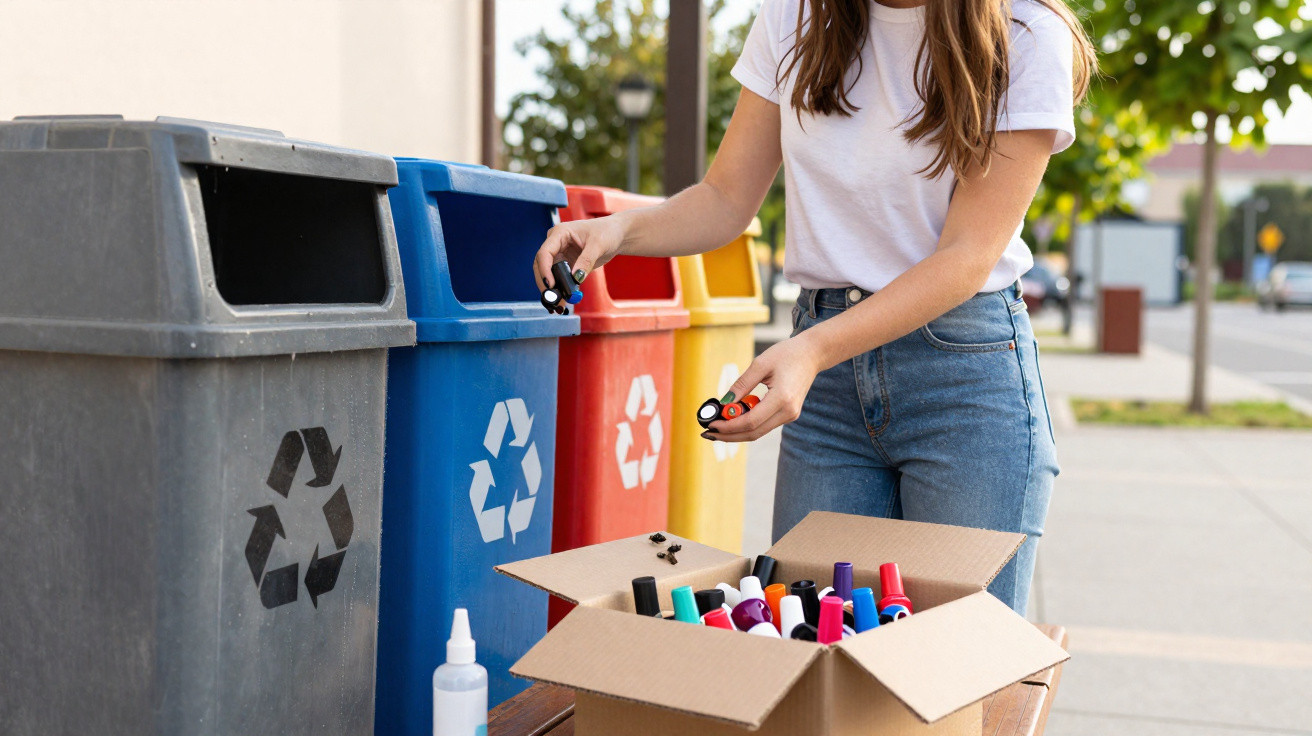
Many people simply throw dried-out or unwanted bottles of nail polish into their general waste bin or the glass recycling bank. It may seem harmless and tidy, yet it can still lead to problems with waste collectors, significant costs and avoidable environmental damage. Behind the attractive coloured varnish is a chemical waste issue with its own disposal rules.
Why nail polish does not belong in the glass recycling bank
The misconception about glass: “Glass can be recycled, can’t it?”
People separating their recycling usually want to do the right thing. Bottles go into the bank, followed by jars – so why not the small bottle of red polish? This is precisely where the difficulty starts. Nail polish bottles may look like ordinary glass, but recycling facilities do not treat them that way.
Cosmetic glass differs from glass food packaging in several respects:
- It is often coloured or frosted.
- Its chemical composition differs from that of wine bottles or jam jars.
- The bottles are extremely small and can easily slip through sorting equipment.
At many facilities, optical scanners cannot consistently identify these miniature containers. The glass may be missed, end up in the wrong stream or interfere with machinery.
“A single incorrectly discarded nail polish bottle can make an entire batch of recycled glass unusable.”
There are also the brush, lid and leftover polish to consider. The brush is generally plastic, and the cap often is too, creating an unsuitable mixture for pure glass recycling. Remaining polish contaminates the glass cullet intended for making new bottles. Hygienic packaging such as jam jars must not contain traces of solvents, colourants or plasticisers.
Why general waste and the yellow bin are also unsuitable
Old nail polish is often put into the bathroom bin, alongside cotton buds, tubes and packaging, before ending up with general household waste. Although this might appear practical, it is problematic both legally and environmentally.
The reason is that nail polish is not classed as ordinary household rubbish but as small quantities of hazardous waste. Its ingredients can cause difficulties during incineration or on landfill sites. Placing a bottle in the yellow bin makes matters worse: plastic and chemicals enter a sorting system that is not designed to deal with them.
The chemistry: what nail polish actually contains
Hazardous ingredients that remain in circulation for a long time
Nail polish combines resins, solvents, plasticisers, colour pigments and additives. Many products – including more modern “Free” formulations – still contain concerning substances, or have replaced them with alternatives that have received little research.
Examples include:
- Solvents such as toluene or similar compounds
- Formaldehyde-releasing substances in older or cheaper products
- Plasticisers such as certain phthalates or their alternatives
When these materials are burned in a standard waste incinerator, they produce gases that require complex filtration systems. Where plants are not operating optimally or experience faults, the risk of pollutants being released increases.
“Nail polish belongs in the same waste category as paints, varnishes or strong adhesives – not with cotton buds and tissues.”
If bottles reach landfill or escape into soil and water through illegal dumping, some components can remain in the environment for a very long time. They accumulate there and are difficult to remove again.
Fire risks in refuse vehicles and treatment facilities
One point is frequently overlooked: nail polish is highly flammable, as are many nail polish removers. Waste is heavily compacted inside refuse collection vehicles. Bottles can break, substances can mix and sparks may occur.
Collection pits and incineration plants operate at high temperatures. If flammable solvent vapours meet other reactive substances, flash fires or explosions can result. In practice, waste-management staff repeatedly have to intervene when they notice suspicious smells or small explosions.
“Incorrectly discarded nail polish is an underestimated danger to the people who handle our waste every day.”
Empty rarely means truly empty: when a bottle becomes hazardous waste
The theoretical exception: a completely clean bottle
A nail polish container is only considered ordinary packaging waste under very strict conditions: it must be entirely empty and genuinely clean inside. That means no coating, no residue at the bottom and no sticky deposit around the rim.
In reality, this is rarely achievable. The neck is narrow, the polish is thick and residues cling stubbornly. Using remover or a specialist cleaner merely transfers the chemicals into another liquid. The issue does not disappear; it simply changes container.
The reality: dried out, thickened or half full
Day-to-day, the situation is different. Nail polish is usually thrown away because it has:
- dried out,
- become too thick,
- or been reduced to an apparently unreachable remainder.
As soon as any product remains in the bottle – whether liquid, lumpy or solid – it is officially small-quantity hazardous waste. Paints, solvents and certain cleaning products are also placed in this category.
“A residual film in the bottle is enough for nail polish to be classified as hazardous waste.”
When waste becomes expensive: possible penalties
Fines for sorting waste incorrectly
Many local authorities are tightening their waste-separation requirements. Refuse collectors and inspectors may open waste bins where there are concerns. If prohibited chemicals are found, this can result in a warning or a fine. Even one incorrectly disposed-of solvent container or several nail polish products may be sufficient.
In many towns and cities, the first level of such penalties is in the tens of euros. Anyone repeatedly identified or unwilling to comply with the rules will pay more. With living costs rising, this is an unnecessary drain on a household budget.
Illegal dumping can become very costly
In the worst cases, leftover nail polish is dumped outdoors, for example at the edge of woodland or beside glass recycling banks. Such illegal dumping is treated as an administrative offence, with increasing fines depending on the federal state and the environmental damage caused. Penalties of several hundred euros are not unusual.
“Anyone who simply leaves old cosmetics in a car park risks more than a warning note on their windscreen.”
Where to take old nail polish: how to dispose of it correctly
The official route: recycling centres and collection points
In Germany, nail polish is categorised as “hazardous household waste” or “small-quantity special waste”. Many municipalities and districts provide dedicated disposal options:
- A recycling centre with a separate area for paints, varnishes and chemicals
- A mobile hazardous-waste collection service that visits neighbourhoods regularly
- In some cases, retail collection points for particular products
Residents can hand in their bottles there free of charge or for a small fee. The contents are destroyed in specialist facilities at high temperatures, while filtration systems clean the exhaust gases.
How to find collection points
Anyone unsure where to take old nail polish should check their local council or district website using the terms “mobile hazardous-waste collection”, “hazardous household waste” or “recycling centre”. Many authorities list specific examples of accepted products, and nail polish often appears directly on those lists.
“A quick look at the local waste calendar prevents lengthy arguments with the refuse collection service.”
Before throwing it away: use nail polish up or repurpose it creatively
Extend its life rather than dispose of it: when polish has only thickened
If a favourite polish has merely become a little thick, it does not have to go straight into the hazardous-waste box. Specialist nail polish thinners can often restore its original consistency. Ordinary remover is unsuitable because it damages the formula and reduces both durability and coverage.
Add a few drops of thinner and gently roll the bottle between your hands rather than shaking it, which helps avoid air bubbles. This approach can noticeably extend the product’s useful life and reduce the amount of waste.
Pass colours on or use them for craft projects
Colours that no longer fit into your own routine may still be useful to someone else. Friends, teenagers in the family or community initiatives may sometimes welcome opened products that remain in good condition – provided hygiene and shelf life are appropriate.
Many crafters use nail polish like miniature enamel paint, for example for:
- colour markings on keys
- decorated stones or small pendants
- colour coding on tools or garden equipment
“Using up old polish creatively saves buying new products and reduces hazardous waste.”
What consumers should remember
Nail polish belongs neither in the glass recycling bank nor in normal household waste. Its combination of glass, plastic components, solvents and colourants makes it a typical hazardous household material. Taking bottles to a recycling centre or mobile collection point protects the environment, waste workers and your household finances.
A simple everyday rule helps: treat nail polish as you would paint or varnish – buy sparingly, use as much as possible, and dispose of leftovers as hazardous waste. Once this becomes a habit, you will not automatically reach for the wrong bin during the next spring clean.

















Comments
No comments yet. Be the first to comment!
Leave a Comment