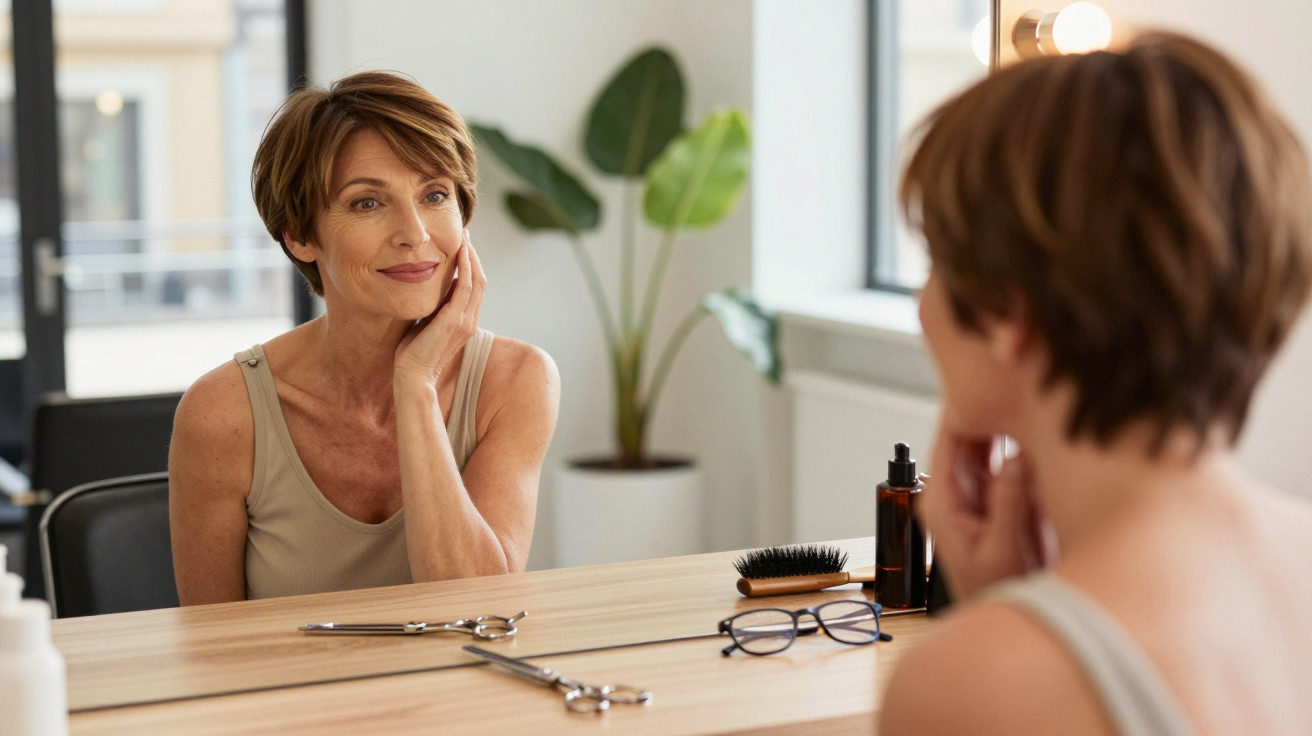
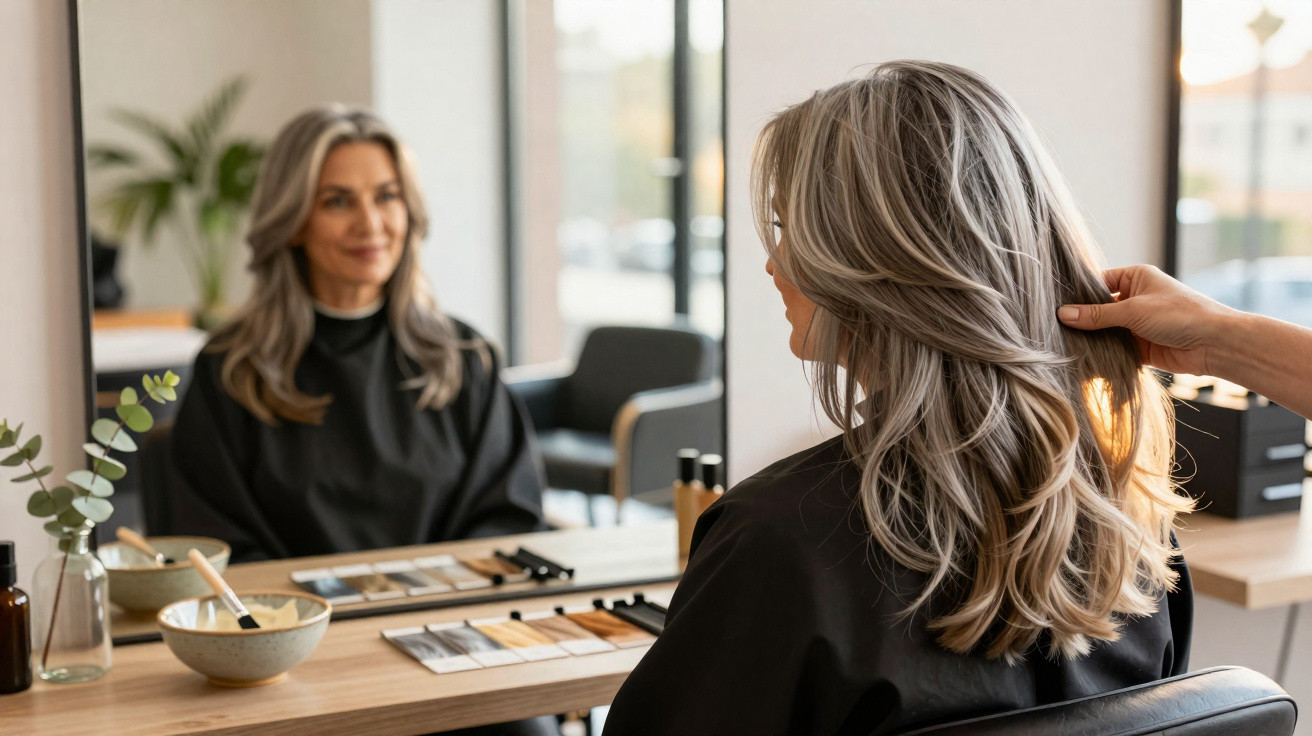
“My hair used to have volume on its own,” she said, half laughing and half apologising. Around us, the salon hummed with hairdryers, someone talking about their grandchildren, and the faint combined scent of coffee and hairspray.
At 56, she had lovely fine hair that simply would not keep its shape any longer. Her old layered style had become dated, as though it belonged to a different stage of her life. She had no interest in trying to “look young” at any cost. She wanted to look like herself, only more defined, lighter and more refreshed.
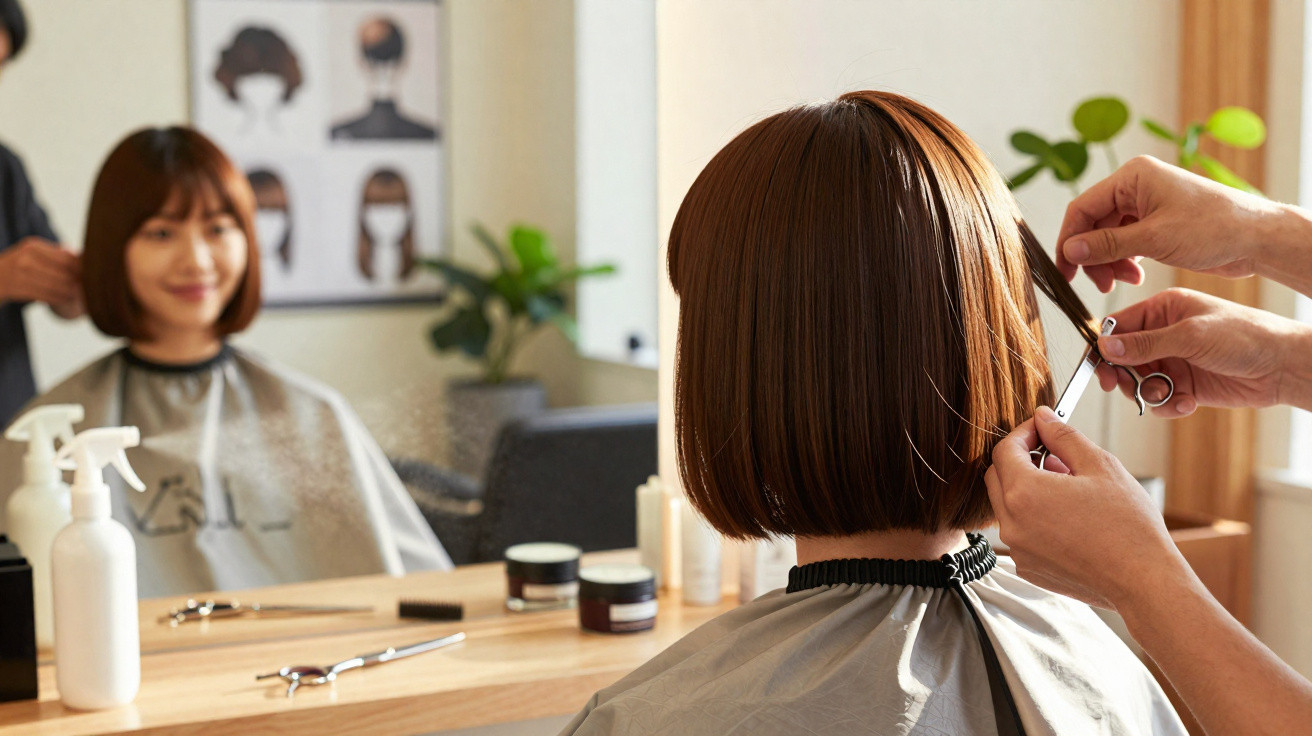
As I reached for my scissors, I explained the short haircut I repeatedly suggest when fine hair begins to change after 50. She lifted an eyebrow. Before I had made the first snip, the change had already begun.
The short haircut that genuinely suits fine hair after 50
For clients over 50 with fine hair, the short haircut I recommend most often is a soft, cropped pixie-bob that follows the nape while adding lift at the crown. It is nothing like the severe 1990s “helmet” style. Instead, it is a contemporary blend: shorter at the back, with a little more length and softness framing the face, plus delicate invisible layers.
Rather than battling fine hair, this style works with it. Taking away excess length immediately creates a fuller appearance, as there is less weight pulling the hair down. The nape looks tidy and shaped, the top has gentle volume that can be lifted with your fingers, and the front can be worn smooth or slightly undone.
For a face over 50, this silhouette brings attention to the eyes, defines the jawline and provides the subtle “lift” many people seek from skincare. In this case, though, the hair creates the effect.
Claire, one of my regular clients, arrived at 62 with wispy, shoulder-length hair that she usually gathered into a loose bun. “It’s just easier this way,” she told me, while sighing at her reflection. Her hair was clean and cared for, but she appeared more weary than she felt.
We spoke for a long time: about work, her wish to travel more, and feeling “invisible” in photographs. I then suggested a cropped pixie-bob. It would not be extremely short or dramatic: just above the jaw, a little shorter at the back, with long, soft layers through the top and a side-swept fringe brushing her cheekbone.
Once I had finished blow-drying, she was silent for several seconds. She tipped her head, felt the back of her neck, then started laughing. “I look like me again,” she said. Three months later, she brought in a holiday photograph: tousled hair, sunglasses, and standing beside the sea. She had stopped concealing herself.
So why does this particular cut suit fine hair after 50 so effectively? Hair naturally becomes finer and less dense as we age, and long, straight styles tend to reveal that change. Each sparse area is easier to see. A shorter shape with a defined outline gives the impression of density because the eye notices the overall form before individual strands.
The cropped pixie-bob also helps prevent the flat, separated effect fine hair can develop at shoulder length. Lifting the hair above clothes and collars allows it to move freely again. Air can travel through it, creating volume, or at least the appearance of it.
There is a psychological element, too. Shorter hair can communicate confidence and clarity; it does not allow you to hide behind it. Whenever a woman over 50 changes from a weary mid-length style to this light, structured cut, I nearly always see her posture shift. She sits more upright and smiles in a new way. The haircut may be short, but its effect is not.
How to style a cropped pixie-bob every day
With fine hair after 50, the secret is not solely in the cut but in how you wear it. For this cropped pixie-bob, I begin with a carefully shaped nape: neat and gently tapered, never shaved. I then create soft layers at the crown to form a natural lift, without needing a teasing brush.
At home, I advise clients to dry their hair upside down for the first minute, using their fingers to raise the roots. After that, stand upright, aim the dryer slightly against the intended fall of the hair, and allow it to cool in position. This setting stage matters more than the brush. Usually, a pea-sized amount of lightweight mousse or volumising spray at the roots will do.
For the final touch, I apply the smallest amount of cream or wax only to the ends, never at the roots. Your fingers should still glide through the hair without encountering product. At its best, this style should look as though you woke up intentionally chic.
Many women over 50 with fine hair tell me they fear short hair because of previous bad experiences: an overly short cut in their twenties, a bowl cut from a rushed stylist, or a fringe that seemed never to grow out. That anxiety is genuine, and I never brush it aside. We have all known that sinking feeling when the reflection in the mirror does not resemble who we feel we are.
That is why we take things gradually. Sometimes, I do not create the full pixie-bob at once. We may shorten the back a little, leave the front longer and softer, and give the client time to adjust. At the next appointment, we raise the nape further. By the third, we might fully reveal the neck. There is no hurry and no pressure. Hair should feel freeing, not like an ordeal.
A frequent mistake is requesting “as many layers as possible for volume”. With fine hair, excessive layering creates empty gaps. The strands separate, the shape collapses and styling becomes a daily struggle. The real magic lies in invisible, strategic layers, rather than a choppy patchwork. And yes, let’s be honest: nobody really recreates those complicated Instagram blow-dries every day.
There is always a point in the chair when I set the scissors down and simply talk. The client studies herself with a mixture of optimism and uncertainty. That is where the most important work takes place.
“After a certain age, people tell you to ‘keep it simple’,” one of my clients told me once. “I don’t want simple. I want alive.” That sentence has stayed with me every time I cut fine hair over 50.
To make the cut truly personal, we adjust four details:
- Length at the front: grazing the chin for softness, or shorter for a bolder feel.
- Parting: a side part for volume, or a softer centre part for balance.
- Texture: lightly tousled for a relaxed finish, or smoother for a polished look.
- Fringe: side-swept to soften lines, or no fringe to fully open the face.
This haircut is not a one-size-fits-all template. It is a starting point that we tailor to your energy, lifestyle and morning patience level, rather than simply to your age.
What this short haircut changes beyond the mirror
When someone over 50 with fine hair chooses this shorter, structured look, it often transforms more than their outline. Friends notice. Strangers say, “that style suits you”. Occasionally, partners need a moment to recognise them - in a good way.
Women have returned to tell me that colleagues asked whether they had been away on holiday or lost weight. Nothing had changed except the way their hair framed their face: light around the cheekbones, a visible neck, and eyes no longer obscured by flat lengths. The impression others receive is of someone awake, present and moving forward.
Hair cannot repair a life. It can, however, function as a small reset button: a quiet reminder that you are not trapped in the same version of yourself from a decade ago. For fine hair, this cropped pixie-bob offers that refresh without demanding that you fight your natural texture every morning.
The feedback that moves me most is not “I love my hair”. It is “I feel like myself again”. Sometimes it arrives in an email weeks later; sometimes it is murmured by the basin during the following appointment. Style at 50, 60 or 70 is not about erasing time. It is about removing the noise so that your face, expression and story show through more clearly.
So, if you are at home tying your fine hair into the same tired ponytail or bun and wondering whether short hair might be “too much” for you, remember this: the right short cut does not shout. It fits.
| Key point | Detail | Benefit for the reader |
|---|---|---|
| The ideal cut | Cropped pixie-bob, tidy nape, soft length around the face | Know what to ask your hairdresser for without technical jargon |
| Styling technique | Drying upside down, setting the roots, lightweight products | Achieve volume without spending an hour in the bathroom |
| Personalisation | Adjust the fringe, parting and front length to suit the face | Have a cut that respects your age, routine and personality |



Comments
No comments yet. Be the first to comment!
Leave a Comment