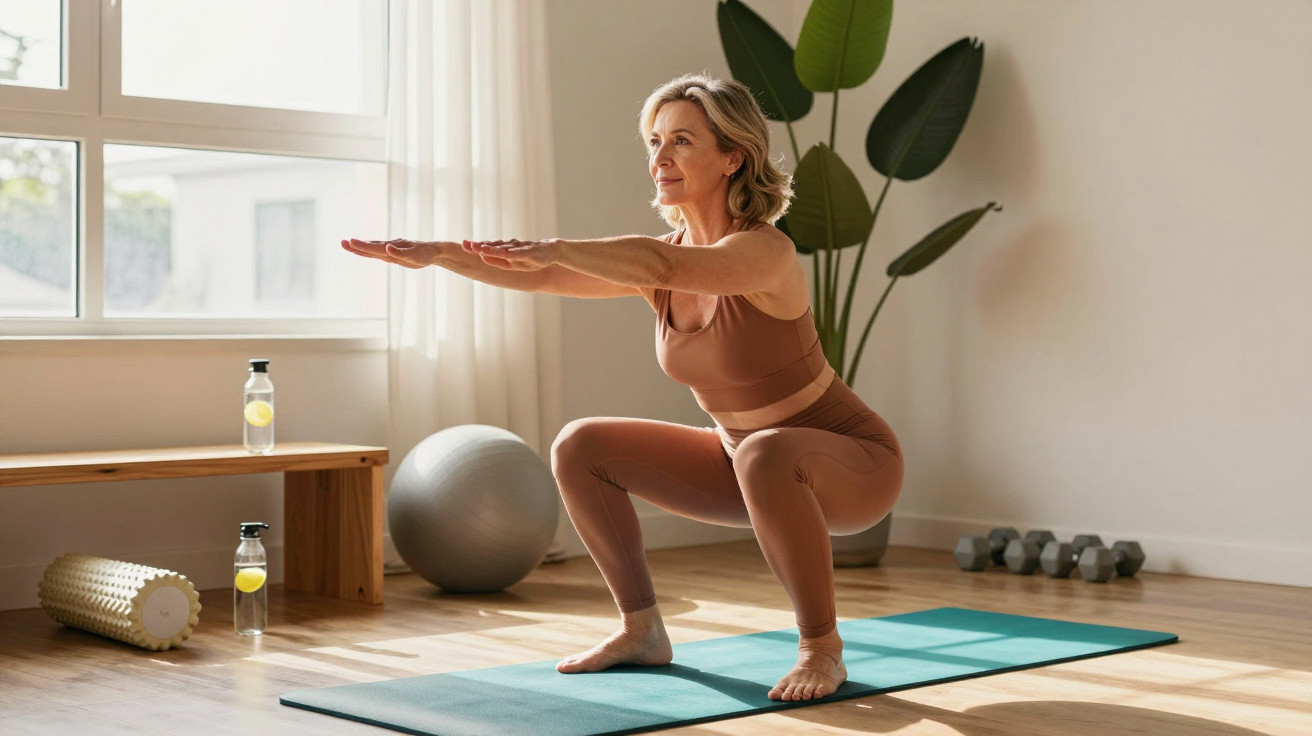
Many people over 50 notice it when getting up from the sofa or climbing into the car: everything suddenly seems more difficult. Muscle mass declines, joints become stiff, and one awkward step can hurt. This is exactly where an understated Pilates exercise comes in: the bodyweight squat. Performed correctly, it acts as a natural anti-ageing workout for muscles, bones and joints.
Why a simple squat can slow ageing
Squats appear throughout daily life, even if we do not call them that. Standing up from the toilet, sitting down at the dining table, or getting in and out of a car all rely on the same movement pattern. Being able to carry out this movement with control and strength helps you remain independent for longer.
The ability to stand up safely using your own strength is regarded as one of the most important indicators of independent living in later life.
From around the age of 50, muscle mass starts to decline measurably without training. Specialists refer to this as sarcopenia. It particularly affects the legs and buttocks, which are precisely the areas needed for every squat. Pilates squats target these areas by training:
- the front thighs (quadriceps), which provide stability when standing up
- the back thighs and buttocks, essential for powerful steps and a secure stance
- the deep core muscles, which support the spine and take pressure off the back
- the feet and ankles, improving balance and sure-footedness
Activating these muscle chains regularly slows age-related losses in strength and offers medium- to long-term protection against falls, painful poor movement patterns and the feeling of “not being able to get back up”.
How the Pilates squat differs from a standard squat
Almost everyone knows the traditional fitness squat: stand, lower yourself, rise again. The Pilates version is far more refined in its detail. Its emphasis is on body awareness, joint alignment and breathing.
Pilates turns an everyday movement into a precise tool for healthy ageing.
Three features stand out in particular:
- Neutral spine: The spine keeps its natural shape, without either arching the lower back excessively or rounding the back.
- Intentional breathing: The movement follows your breathing rhythm, supporting both stability and focus.
- Controlled joint alignment: The knees, hips and ankles move together smoothly, with no uncontrolled collapsing or twisting.
This combination protects the joints while training the body in a practical, everyday way. The movement closely mirrors rising from a chair, but is carried out consciously, at a controlled intensity and repeatedly.
Step by step: the Pilates squat for over-50s
A few minutes and a secure standing position are enough to begin. If you feel unsteady, place a chair behind you or rest a hand lightly on the edge of a table.
1. Starting position
- Stand tall with your feet roughly hip-width apart.
- Distribute your weight evenly through both feet.
- Keep your pelvis and spine in a neutral, relaxed position; do not deliberately exaggerate the arch in your lower back.
- Let your arms hang loosely by your sides to begin with.
- Look ahead rather than down at the floor, as this supports balance.
2. Lowering phase
- First, take a deep breath in and feel length through your upper body.
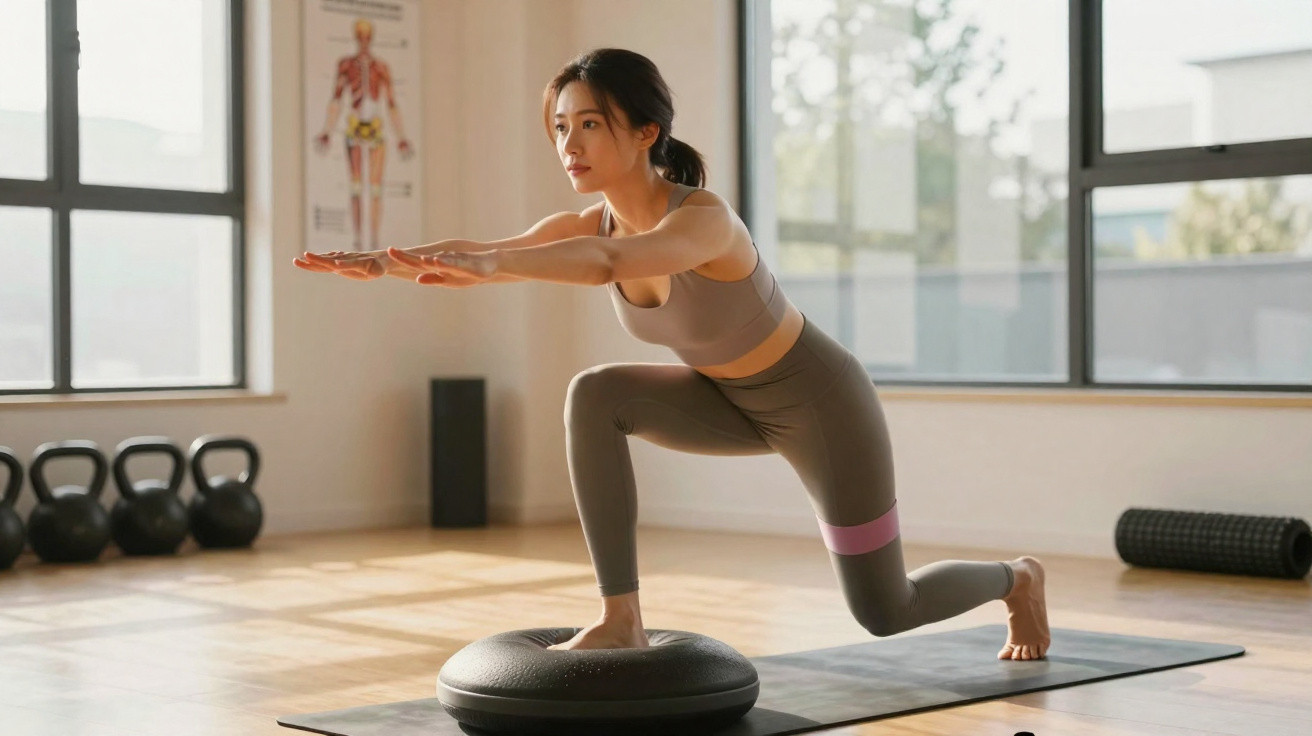
- Start by moving your pelvis backwards, as though you were slowly sitting onto an imaginary chair.
- Bend your knees, keeping them in line with your toes and avoiding a pronounced inward collapse.
- At the same time, your ankles and hips bend, while your upper body leans slightly forwards.
- If required, bring your arms forwards to help maintain your balance.
- Gently engage your abdominal muscles to stabilise the lumbar spine.
3. Rising phase
- Breathe out and press back up through your heels.
- Straighten your knees and hips at the same time, without dropping into an exaggerated lower-back arch.
- Return your arms to your sides with control.
- Pause briefly at the top, maintain your body tension, then begin the next repetition.
A useful everyday guideline is 3 sets of 12 to 15 repetitions, on at least three days each week.
Adapting the Pilates squat to your age and fitness
Not everybody begins from the same starting point. The good news is that the Pilates squat can be easily adapted, including for people with knee or back problems.
Easier version for beginners
- Sit on a sturdy chair.
- Position your feet slightly behind your knees so that you can stand by pressing through your heels.
- Use your breathing as you stand: breathe in while seated and breathe out as you rise.
- Only if necessary, use your hands for light support on your thighs.
Over time, you can remove your hands, choose a slightly lower chair or practise without the chair.
Advanced variation
- Lower a little further, provided the movement still feels comfortable and stable.
- Slow the lowering phase to around three seconds.
- Hold the bottom position for one or two breaths before standing again.
- Those with plenty of practice can place one foot slightly in front of the other to challenge their balance further.
How the Pilates squat protects joints, back and heart
Many older adults avoid squats because they worry about their knees. Often, the reverse is more appropriate: a well-controlled bodyweight movement strengthens the structures surrounding the joint.
Strong muscles reduce strain on the joints; protecting them by avoiding movement does not.
The positive effects at a glance:
- Knees: Strong thigh muscles support the knee joint, allowing the load to be distributed more evenly.
- Hips: Improved mobility and strength make climbing stairs and walking for longer easier.
- Back: The deep core muscles work throughout every repetition, helping to protect the lumbar spine.
- Cardiovascular system: Several consecutive sets raise the heart rate without overwhelming the body.
If you already have osteoarthritis or significant pain, adjust the depth of the squat and reduce the range of movement. Pain is always a warning sign, never a training goal.
How often should you train to stay young?
The good news is that noticeable results do not require a marathon training programme. Short, regular sessions are far more effective than rare, extremely demanding workouts.
| Training level | Frequency | Volume per session |
|---|---|---|
| Beginner | 3 times per week | 2 sets of 8–10 repetitions |
| Intermediate | 3–4 times per week | 3 sets of 12–15 repetitions |
| Advanced | 4–5 times per week | 3–4 sets, sometimes including holds |
More important than rigid figures is this: the exercise should be challenging without leaving you exhausted. If you can still walk a few steps comfortably after training, you are usually getting it right.
Why Pilates is so valuable for people aged 50+
The squat is only one element of the Pilates repertoire. The method consistently follows the same principles: controlled movement, stability from the centre of the body, flowing breathing and concentration. For the 50+ age group, this provides several benefits:
- a gentle return to exercise after a longer break
- a low risk of injury when performed with proper guidance
- easy combination with walking, cycling or swimming
- noticeable improvements in posture and balance
People who set aside a few minutes for Pilates in the morning often find after only a few weeks that simple everyday journeys feel easier. Stairs, carrying shopping and gardening all become less strenuous.
Practical tips for getting started in the next few days
To stop good intentions ending at the sofa, clear and manageable steps can help:
- Choose a fixed time, such as straight after brushing your teeth.
- Begin with so few repetitions that you are certain you will not stop halfway through.
- Write down the date and your number of squats; progress is motivating.
- If you are unsure, arrange a short introduction with a physiotherapist or a Pilates studio.
If you already walk regularly or jog gently, it is easy to add the Pilates squat: use it as a warm-up before your walk or as strengthening work afterwards. Combining endurance exercise with functional strength acts like a double shield against the typical effects of ageing - slowly, but remarkably reliably.

Comments
No comments yet. Be the first to comment!
Leave a Comment