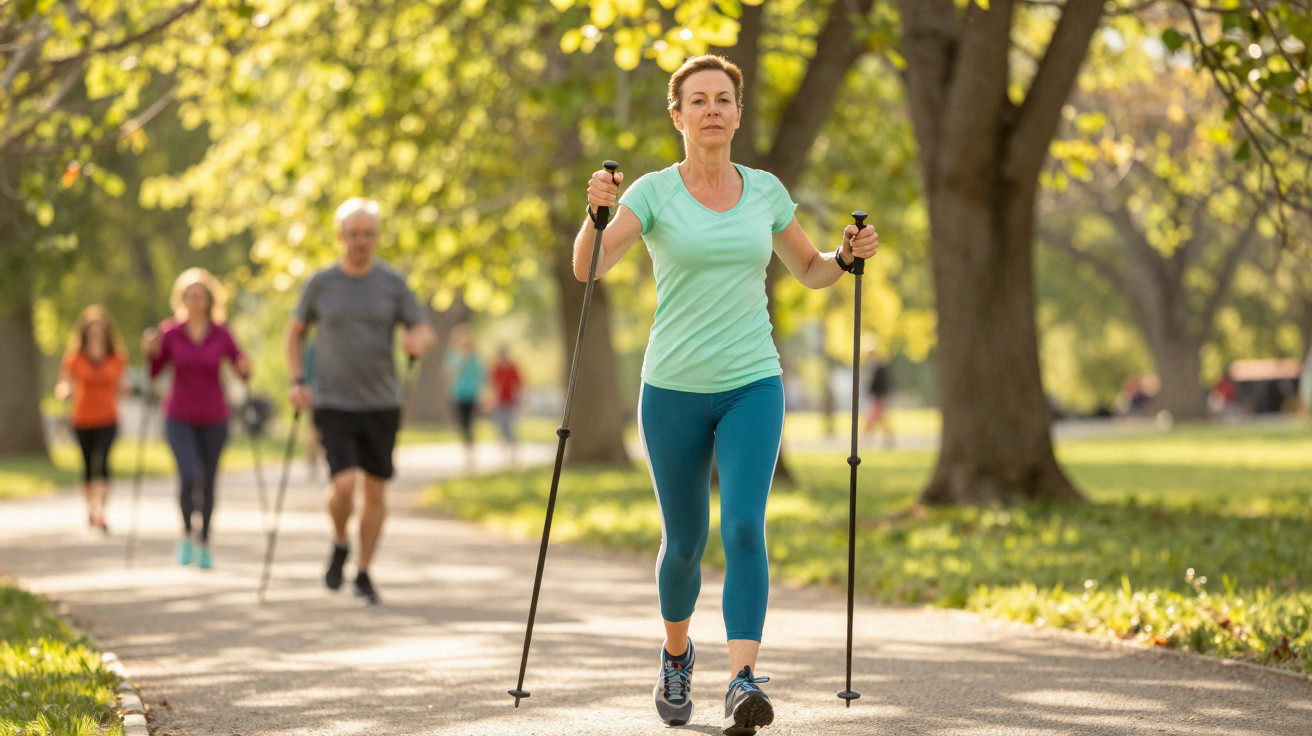
Many Nordic Walking enthusiasts, however, barely make full use of what this sport can offer.
At first glance, Nordic Walking looks straightforward: two poles, comfortable shoes and a trip to the park – job done. Yet in reality, countless walkers move along with slumped shoulders, incorrectly adjusted poles and virtually no useful muscle engagement. Anyone who has not mastered the technique not only misses out on training benefits, but may also risk tension and stress on the joints.
Why Nordic Walking is so popular
Nordic Walking is far more than a brisk walk. When performed correctly, it engages around 80 per cent of the body's muscles. The legs, glutes, abdominal muscles, back, shoulders and arms all contribute, as the poles bring the upper body into the movement.
The activity is considered especially kind to the joints because some of the load is transferred through the poles. This allows older people, those who are overweight and people with knee or hip issues to stay active without overloading their bodies.
- Trains the cardiovascular system and endurance
- Strengthens the core and back muscles
- Improves posture and balance
- Helps with weight management
- Supports the prevention of diabetes and heart disease
“Anyone who practises Nordic Walking with sound technique turns a relaxed walk into a proper full-body workout.”
The three most common Nordic Walking mistakes
Many walkers think: “As long as I keep moving, the rest will sort itself out.” It is precisely this attitude that often turns a health-focused activity into little more than a walk carrying poles. The same three mistakes appear time and again.
Mistake 1: The poles are just decoration
The classic error is poles lightly touching down somewhere beside the feet while providing almost no propulsion. Some people practically carry them along, while others plant them in front of their body as though they need support.
The central principle of Nordic Walking is to place the pole diagonally behind you and use it to drive the body forwards. The arm should swing freely from the shoulder, while the hand opens during the rear part of the movement. This ensures the power comes not from a clenched hand, but from the full pull of the arm.
“Without a strong pole action, Nordic Walking remains a walk with accessories – the upper body simply is not properly involved.”
Mistake 2: A rounded back and eyes on the ground
Many people walk with their shoulders drooping, hips bent and eyes fixed rigidly on their feet. This can create tension in the neck, lower back and shoulders.
A more effective starting position looks like this:
- Lean the upper body slightly forwards, without bending at the hips
- Keep the shoulders relaxed rather than raised
- Look ahead instead of at the ground
- Gently engage the abdominal muscles to stabilise the lumbar spine
Walking this way encourages deeper breathing, makes you look more alert and noticeably reduces strain on the spine.
Mistake 3: No coordination between arms and legs
Even the best equipment is of no use without rhythm. Some people swing their arms and legs on the same side together, while others move only their legs and drag the poles behind them with minimal effort.
The aim is cross-coordination: left foot with right arm, then right foot with left arm. This natural walking pattern provides stability, works the core muscles and makes the stride feel more relaxed.
“When steps and pole use are out of rhythm, much of the training stimulus disappears – and the flow of movement is lost.”
How to get started properly
Anyone who has previously been out walking with poles in any old way can correct a great deal. A complete change in technique rarely happens in a single day, but a few steps can make training much more effective.
Courses and groups: why guidance pays off
Beginners benefit greatly from technique coaching. Many sports clubs, adult education centres, rehabilitation centres and mountain sports shops offer introductory courses. Trainers can correct arm action, stride length, pole adjustment and posture directly on site.
Walking in a group is particularly useful: the shared rhythm, clear instructions and immediate feedback reduce uncertainty and build routine. Anyone with health limitations should briefly speak to their GP or an orthopaedic specialist beforehand.
The right equipment: more than just two poles
It is worth carrying out a quick equipment check before setting off:
| Item | What to look for |
|---|---|
| Poles | Length of around 65–70% of body height, hand straps secure but not restrictive, tips suited to the surface |
| Shoes | Good cushioning, a flexible forefoot area and enough room for the toes |
| Clothing | Breathable layers, with reflective details in the dark |
| Surface | Park paths, forest ground or tracks through fields; choose flat routes rather than steep ones at first |
If you hire poles or buy them second-hand, pay particular attention to their length and to sturdy straps. Poles that are too short can cause a hunched back, while poles that are too long may lead to tense shoulders.
Nordic Walking technique step by step
Use this straightforward exercise to learn the movement pattern:
- Start walking without poles and notice your natural arm swing.
- Next, hold the poles loosely without planting them, keeping the arm swing unchanged.
- Then place the pole tip diagonally behind your body as the opposite foot comes forwards.
- Actively push backwards through the pole tip, opening the hand at the end of the movement.
- Maintain a steady pace and do not rush – technique first, speed afterwards.
“Those who practise the basic technique slowly will save energy later, increase their speed and remain free from discomfort for longer.”
How often should you do Nordic Walking?
For most recreational walkers, two or three sessions a week of 30 to 60 minutes each are enough. It is important to build up gradually, especially after a lengthy break from exercise.
This schedule can be useful:
- Weeks 1–2: 2 sessions of 20–30 minutes, focusing on technique
- Weeks 3–4: 2–3 sessions of 30–40 minutes, at an easy pace
- From week 5: Gradually increase duration and introduce the first uphill sections
Those who later want to train more ambitiously can use intervals, alternating short, faster sections with gentler stretches. This challenges the heart and muscles much more without overloading the joints.











Comments
No comments yet. Be the first to comment!
Leave a Comment