If you are stuck in traffic after work or jostling for the last available machine at the gym, you soon realise that the real stress often starts before the workout itself. That is why more and more people are turning away from the gym and exercising at home – with remarkably good results. What matters is not the equipment, but a smart plan built around simple, functional movements.
Why home workouts in the living room can work better than the gym
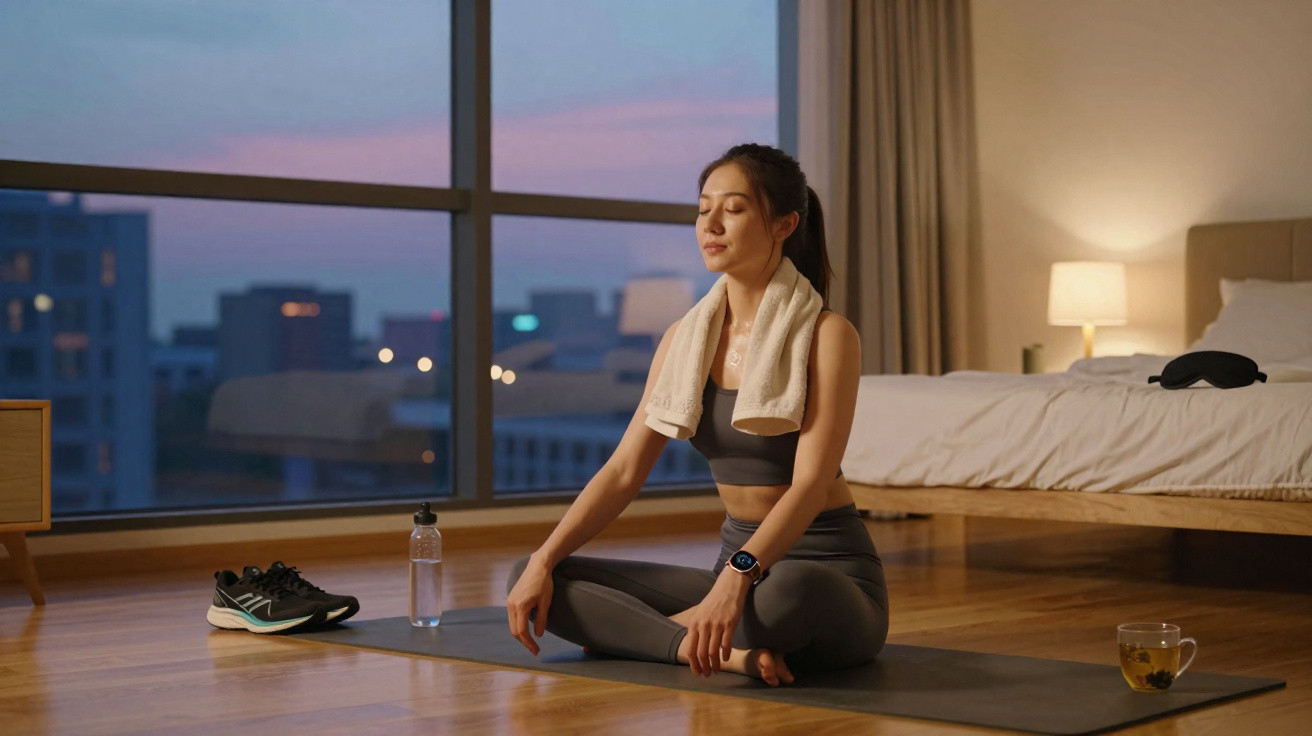
The greatest benefit of home workouts is how easy they are to start. There is no journey, no changing-room display and no waiting for equipment. You can begin whenever it suits you – in a T-shirt, barefoot, between two appointments. This accessibility is precisely what makes regular exercise far more likely.
“The body does not change through isolated acts of heroism, but through lots of small, unremarkable sessions that you genuinely stick to.”
Rather than putting yourself through one enormous gym session each month, 10 to 20 minutes of movement on five days a week will take you much further. The barrier is tiny: move the table aside, roll out a mat and get started. That is how a habit develops – and habit beats motivation every time.
Less pressure, better body awareness
At home, there are no other people watching. Nobody is comparing weights or abs, and nobody is staring from the treadmill beside you. That removes pressure and gives you room to experiment. You can adjust your pace, rest periods and difficulty level without embarrassment.
There is another advantage: without machines, your body has to stabilise itself. This improves body awareness and works not only the muscles you can see, but entire muscle chains that matter in everyday life – such as when lifting, carrying or climbing stairs.
Training with your own body weight – functional strength rather than show muscles
Many people still associate progress with heavy dumbbells. Yet your own body weight is entirely sufficient to become stronger, more stable and more mobile. The focus shifts from “How much can I lift?” to “How controlled is my movement?”
- Multi-joint movements instead of isolated machine exercises
- Strength, coordination and balance trained at the same time
- Easier on the joints when performed with good technique
- Ideal for everyday tasks: carrying, bending down and standing up
The 10 exercises in this programme work the whole body: legs, glutes, core, back, shoulders, arms and cardiovascular system.
The 10-exercise circuit: turn your living room into a mini workout space
You need roughly two square metres of space, a firm surface and the edge of a sturdy chair. The principle is simple: complete an easy circuit one to three times, depending on your fitness level.
“Basic rule: it is better to train cleanly and with control than as quickly and frantically as possible.”
Block 1: Get your legs, glutes and circulation moving
This opening block lays the foundation. It gets your heart working while strengthening your lower body and glutes.
1. Squats
Stand with your feet roughly hip- to shoulder-width apart. Push your glutes backwards as though you were about to sit on an invisible chair. Keep your chest slightly lifted, look forwards and place your weight through your heels. Then drive powerfully back up.
- Works: thighs, glutes and core
- Common mistakes: rounding the back and allowing the knees to fall inwards
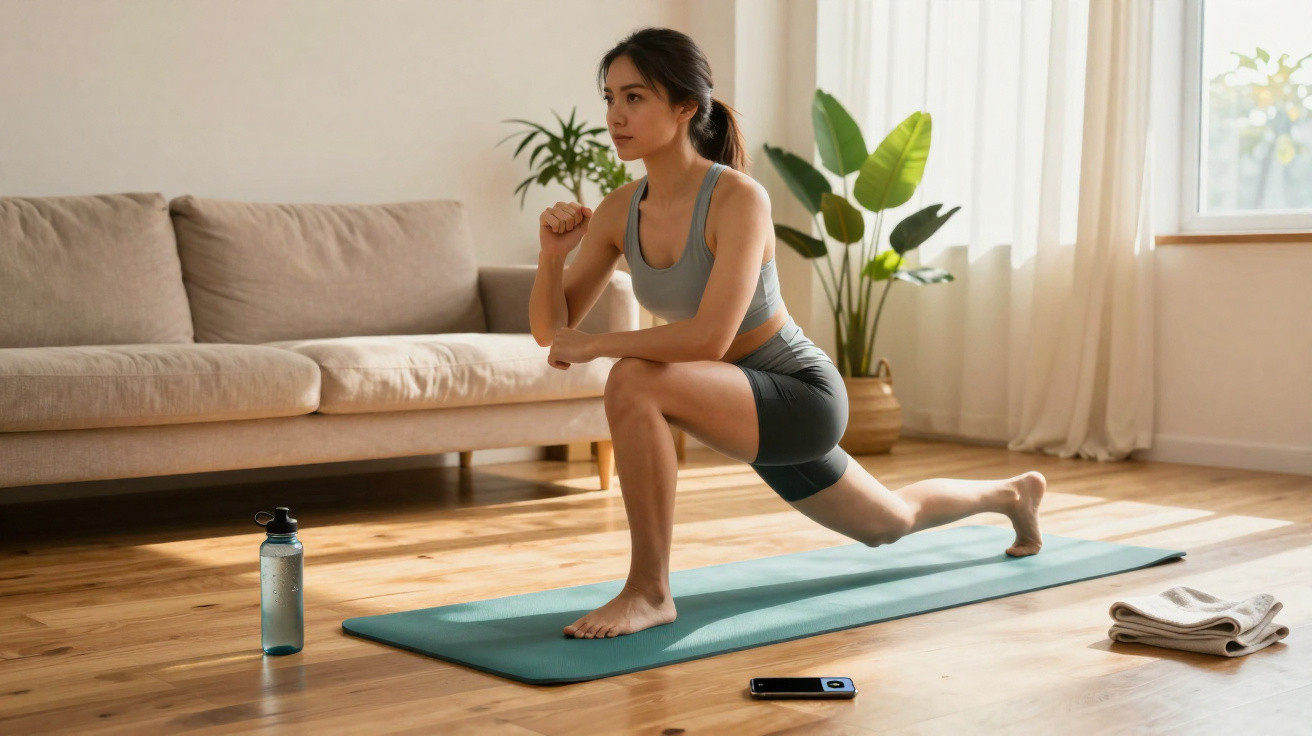
2. Reverse lunges
Stand tall, take a large step backwards with one leg and lower the back knee towards the floor. Keep the front knee roughly above the ankle. Push yourself back up, then change sides.
Stepping backwards is kinder to the joints than stepping forwards because it gives you greater control over the load.
3. High knees on the spot
March on the spot, lifting your knees clearly upwards in turn. Use your arms actively as well. If you are fitter, turn it into a light sprint on the spot.
This noticeably raises your heart rate and breathing – ideal for burning calories and preparing the muscles.
4. Glute bridge
Lie on your back with your feet hip-width apart and your arms beside your body. Raise your hips until your knees, hips and shoulders form a straight line. Hold the tension in your glutes briefly at the top, then lower yourself with control.
This exercise helps counter the typical “desk back” because it activates the posterior chain, which is constantly switched off while sitting.
5. Side steps or jumping jacks
For a gentler option, take quick side steps with your knees slightly bent while swinging your arms. If you consider your joints and fitness robust enough, perform classic jumping jacks.
This gives your breathing another proper workout and ends Block 1 with a noticeable cardiovascular boost.
Block 2: A strong core and powerful upper body
The second part focuses on the abs, back, chest, shoulders and arms. This is where you develop the stability that supports you in daily life – particularly in the lower back.
6. Forearm plank
Move into a supported position on your forearms and toes. Keep your elbows beneath your shoulders and form a straight line with your body. Brace your abs actively, without letting your glutes sag or pushing them too high.
Begin with short holds of 15–20 seconds, then build up gradually. Quality comes before duration.
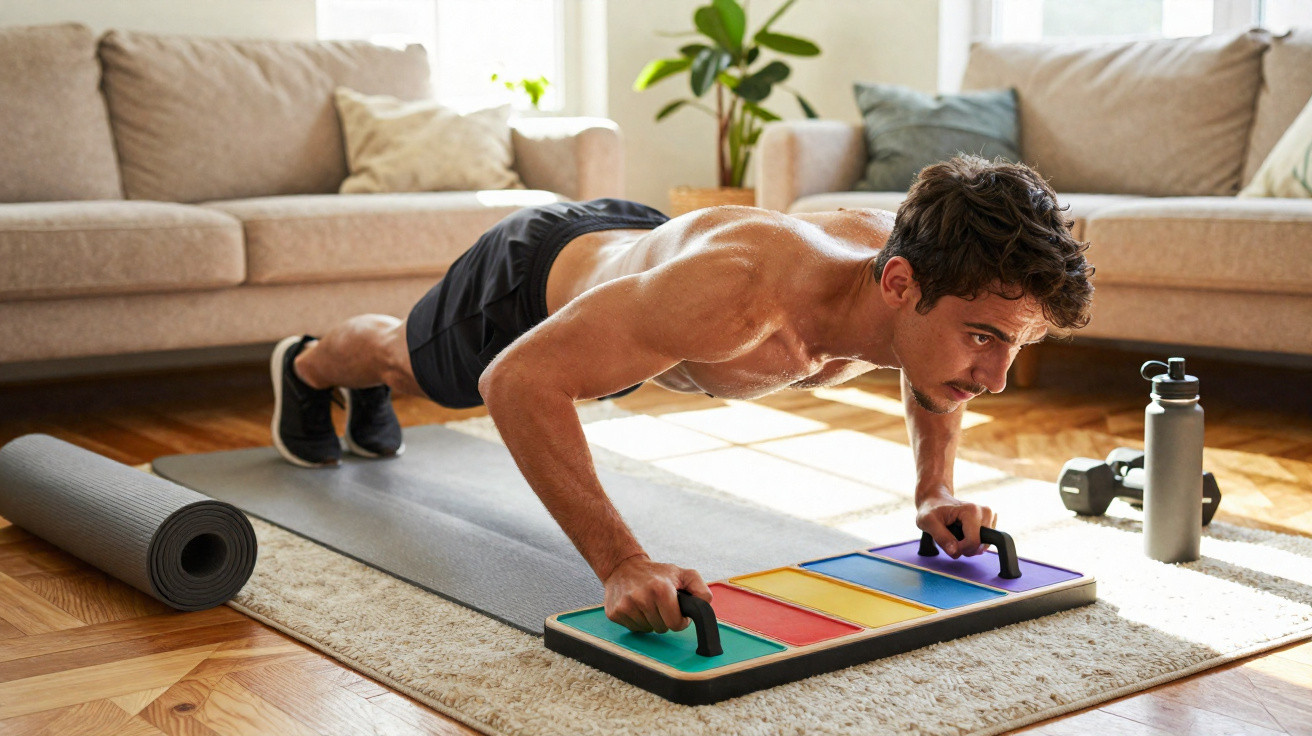
7. Press-ups
Perform them traditionally on your hands and toes or – if you are a beginner – with your knees on the floor or standing against a wall. Place your hands slightly wider than shoulder width and guide your elbows slightly diagonally backwards. Lower your chest towards the floor, then push back up.
Press-ups train your chest, shoulders, arms and core at once – making them one of the most effective full-body exercises available.
8. Prone back extension (“Superman”)
Lie on your front, with your arms forwards or out to the sides. Lift your upper body and legs a small distance from the floor, keep your gaze down and relax your neck. Hold briefly before lowering down.
This movement strengthens the entire back extensor chain and balances out long periods of sitting, without requiring any machines.
9. Chair-edge dips
Sit on the edge of a sturdy chair, with your hands braced beside your hips. Lift your glutes off the seat and slide forwards in front of the chair, keeping your legs slightly bent. Bend your elbows to lower your body, then push yourself upwards again.
The emphasis here is on the backs of the upper arms. A short range of movement is entirely enough to challenge the muscles.
10. Mountain climbers
Start in a high plank on your hands. Alternately draw your knees towards your chest, as if you were running horizontally on the spot. You can vary the speed, from slow and controlled knee drives to a fast cardio finish.
“With this final movement, you combine core stability and fitness – a finish that wakes up the whole system.”
How to turn the exercises into an everyday routine
These 10 movements are only the building blocks. The real game changer is how you fit them into your daily life. One possible starting point is:
| Workout duration | Recommended structure |
|---|---|
| 15 minutes | 1 round of all 10 exercises: 30 seconds of work, 20 seconds of rest for each |
| 20–25 minutes | 2 rounds, with a short water break between rounds |
| 30 minutes | 3 rounds, adjusting the intensity as needed |
Ideally, schedule three to five sessions each week. Set times can help: for example, in the morning immediately after getting up or in the evening as soon as you get home, before you sink into the sofa.
Variations for a greater challenge – without extra equipment
To avoid reaching a plateau, you can easily adjust the difficulty without buying anything.
- Change the tempo: Lower slowly and rise explosively – for instance, during squats or press-ups.
- Add pauses: Hold the bottom of a squat for two seconds before standing up.
- Use single-leg variations: Perform a glute bridge with one foot in the air to challenge the glutes and posterior chain more intensely.
- Increase instability: During the plank, lift one arm or one leg alternately to involve the obliques more strongly.
Increase only one factor at a time – either speed, duration, repetitions or complexity. This keeps the risk of injury low and gives your body time to adapt.
How to maintain motivation over the long term
Even the best routine is pointless if it fizzles out after two weeks. Psychologically, it helps to shift your focus: away from a “summer body in six weeks” and towards small, noticeable improvements in everyday life.
- Climbing stairs becomes easier
- Back pain occurs less often
- You sleep more deeply
- You feel more alert in the office
Feel free to write down observations like these. Many people are more likely to keep going when they can see their progress in black and white – even if the scales barely change.
Common questions: pain, rest and combining this with other sports
A mild burning sensation in the muscle is normal; sharp pain is not. If that happens, stop the exercise and check your technique. One or two rest days per week are usually enough, during which you can go for a walk or stretch instead.
If you already run, cycle or swim, you can add this 10-move circuit twice a week. Runners in particular benefit greatly from strong legs and a stable core – less overuse and more control on the route.
Over time, you can create your own system: perhaps a short “Monday circuit” before work and a slightly longer session at the weekend. What matters is that it fits your life – not the other way round.









Comments
No comments yet. Be the first to comment!
Leave a Comment