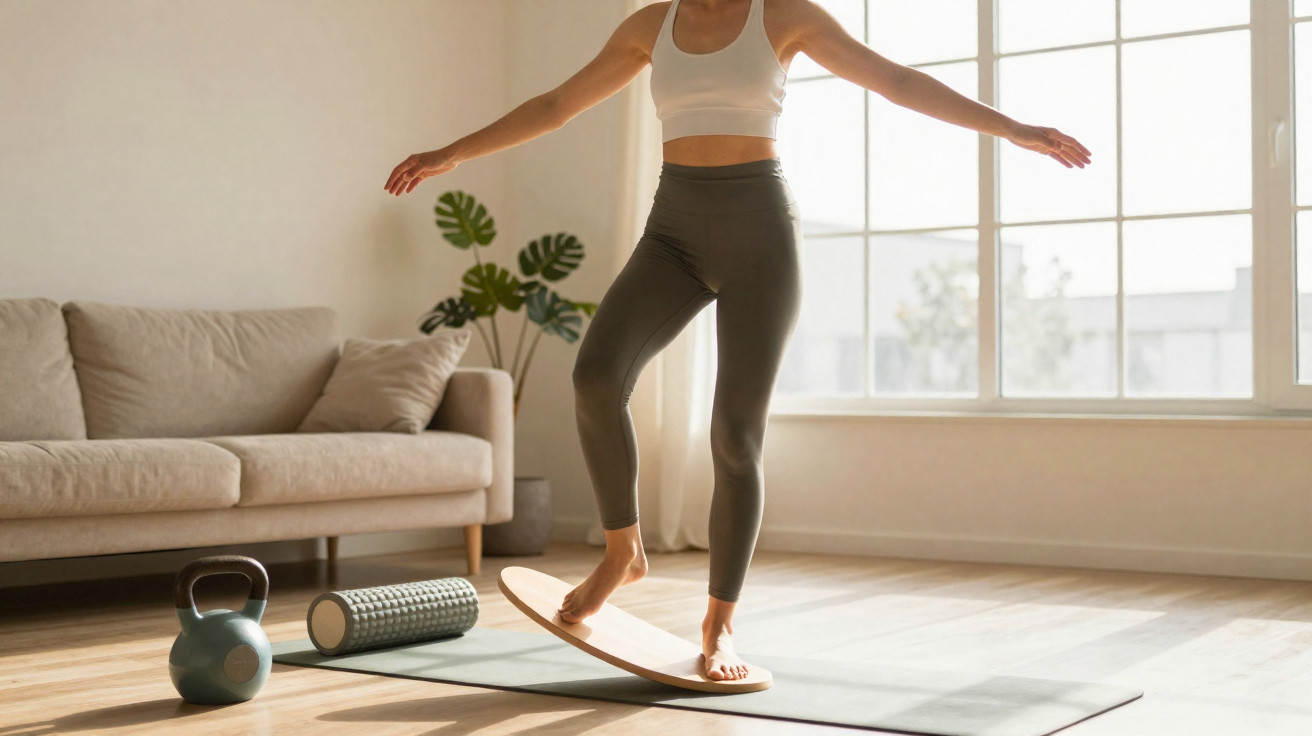
Screens flash in the gym, dumbbells clatter, and two blokes race each other on the treadmill – while you are standing in the middle of it all on a balance pad, trying not to topple over. The trainer calls out: “Hold it! Ten more seconds!” Nearby, people grunt, press and pump iron. Your only battle is avoiding the look of a flamingo on black ice. It sits somewhere between embarrassing and liberating.
We all know the feeling: anything that trains “invisible” muscles seems less exciting than bench pressing heavy plates. Yet those unsteady moments are doing far more for your body than you might initially realise. This is often where the real progress happens.
Why balance trains quietly – yet sets the standard
Open a typical workout plan and the categories quickly appear: chest, back, legs, abs. Clear muscle groups, clear weights and clear repetitions. Balance? If it appears at all, it is tucked away near the bottom, somewhere between “cool-down” and “optional”. Plenty of people quietly skip it, much as others ignore the washing-up after cooking. Let’s be honest: nobody arrives at the gym thinking, “I can’t wait to practise standing on one leg and using a wobble board today.”
The strange thing is that your balance is at work constantly, even when it is not written into your programme. It is involved in every squat, every walk to the Underground, and every trip upstairs while carrying a shopping bag in one hand and a phone in the other. Think of it as a quiet director behind the scenes, deciding whether everything stays stable – or whether you fall.
A PE teacher recently told me about her Year 10 class. When asked to balance along a simple line on the floor, almost half the pupils stepped off it within seconds. This was not a tightrope or narrow beam – just a line marked on the ground. At the same time, those same teenagers show off pull-ups and planks on social media. The picture reflects figures that crop up in many studies: more and more people have enough strength, but fewer and fewer have control over their bodies.
You can spot it in everyday life as well. There is the colleague who can squat 100 kg but starts swaying when the bus brakes sharply. Or the recreational runner with no endurance issues who is constantly struggling with an ankle. Balance training has no Instagram “wow” factor and offers no dramatic before-and-after pictures. Its value appears when you do NOT fall, do NOT twist your ankle and do NOT lose control. That may not sell well, but it makes all the difference.
The plain truth is that our nervous system loves routine and dislikes surprises. Conventional strength training often provides precisely that: predictable movements, repeated paths and neatly guided machines. Balance exercises introduce chaos to the system. Tiny shifts, uncertain stimuli and micro-adjustments force your body to coordinate everything afresh: muscles, tendons, joints and vision. That is exactly why they are so demanding – and so effective.
Balance training is not a “nice-to-have”; it is the software that makes all your hardware usable in the first place. If you train only your muscles without learning to control them in space, you remain a step behind your potential. Or you stumble sooner than you would like.
How to add balance exercises without overhauling your whole workout
The easiest starting point is more ordinary than most people expect: stand on one leg while brushing your teeth. It may sound like a TikTok challenge, but it is a small laboratory for your nervous system. Begin on solid flooring, then progress to a folded towel or cushion. After that, try it with your eyes closed. Do 30 seconds on each side. No equipment, no additional trip to the gym – just you, a sink and the willingness to put up with the wobbling.
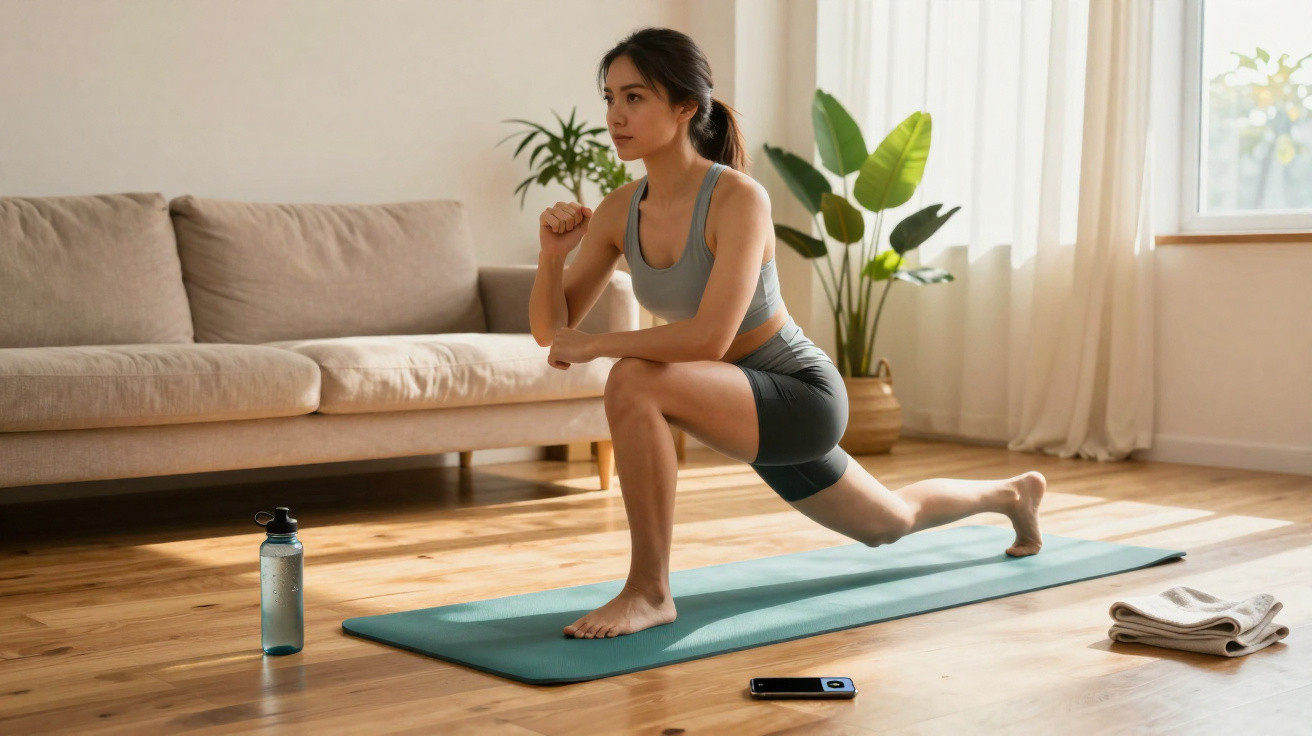
At the gym, balance challenges can be worked neatly into exercises you already do: turn a standard shoulder press into a shoulder press in a lunge position. Replace seated rowing with rowing from a slight single-leg squat stance. Small adjustments can have a major effect. You do not need to switch immediately to a Bosu ball ballet routine. Just one unstable element per session is enough to wake up your system.
Many people do not struggle with the “how”, but with feeling clumsy while doing it. You may find yourself trembling on one leg, thinking: “Everyone is staring at me.” In reality, most people are far too occupied with themselves. And the few who do look often understand perfectly that you are training something they would not dare to try themselves.
Another common mistake is progressing too much, too soon. Balance exercises are deceptive because they look harmless. One leg and one cushion – what could possibly happen? Your muscles may cope, but your coordination can lag behind. The result can be frustration, ankle overload and sometimes even dizziness. A sensible approach helps here: build the foundation on stable ground first, then move to an unstable surface. Start slowly, then become more dynamic. Step by step, quite literally.
There is no need to be embarrassed if, in your first session, you stand with your arms stretched out like a beginner tightrope walker. That slight loss of control is exactly the point. It shows there is still unused potential waiting to be developed. And yes, at first it feels strange to get to know your own body again. It is a little like riding a bike without stabilisers – only years later.
“Balance training is like a good early-warning system: it speaks up before something breaks – not only once you are already injured.”
To stop this becoming another “I really ought to do that” resolution, keep this short list of key principles in mind:
- Always begin with stability: get secure on the floor first, then gradually make the surface less stable.
- Short sessions are enough: 5–10 minutes per workout is a strong starting point.
- Wobbling is part of it: shaking is not failure; it is a learning signal.
- Quality over showing off: perform simple exercises properly rather than attempting risky stunts on unstable equipment.
- Link it to routines: brushing your teeth, warming up or resting between strength sets – balance fits perfectly into all of them.
What changes when we take balance seriously
Balance training becomes interesting once you stop viewing it as an extra task and start seeing it as a lens through which to view daily life. Suddenly, you notice that you stand differently on the bus: no longer rigid with your feet wide apart, but relaxed, soft through the knees and ready to respond to any movement. You become aware of the small compensatory movements your body makes automatically while tying your shoes or stepping up a high kerb. Training leaves the room of mirrors and enters real life.
After a few weeks of balance training, many people describe an unexpected side effect: a calmer mind. When you focus completely for 20 seconds on not falling over, there is no mental room for to-do lists or your Instagram feed. Your body forces your brain to remain in the present. It is one of the rare fitness practices in which physical and mental presence are almost inseparable.
Then there is the subject that hardly anyone enjoys discussing: getting older. Nobody plans their 70th birthday by saying, “I’m looking forward to hip surgery and a walking frame.” This is where balance plays its quietest yet most powerful part. Every missed step avoided, every stumble caught and every slip cushioned is an invisible success. You will not receive a medal for it. But you may gain a few more years in which you still walk up stairs rather than merely look at them.
Balance training is the uncomfortable friend who tells you what you have long suspected: strength alone is not enough. Coordination, reaction and stability in chaos are the abilities you notice when life suddenly becomes unpredictable. And honestly, is that not where life usually takes place?
| Key point | Detail | Benefit for the reader |
|---|---|---|
| Balance as an “invisible muscle” | Works quietly in the background during every everyday movement | Understands why balance training can help prevent injuries |
| Easy integration into an existing workout | Short, focused exercises such as standing on one leg or unstable versions of familiar movements | Can start immediately without rebuilding an entire workout plan |
| Long-term impact on everyday life | More stable walking, fewer stumbles and better body awareness | Experiences tangible benefits well beyond the gym |







Comments
No comments yet. Be the first to comment!
Leave a Comment