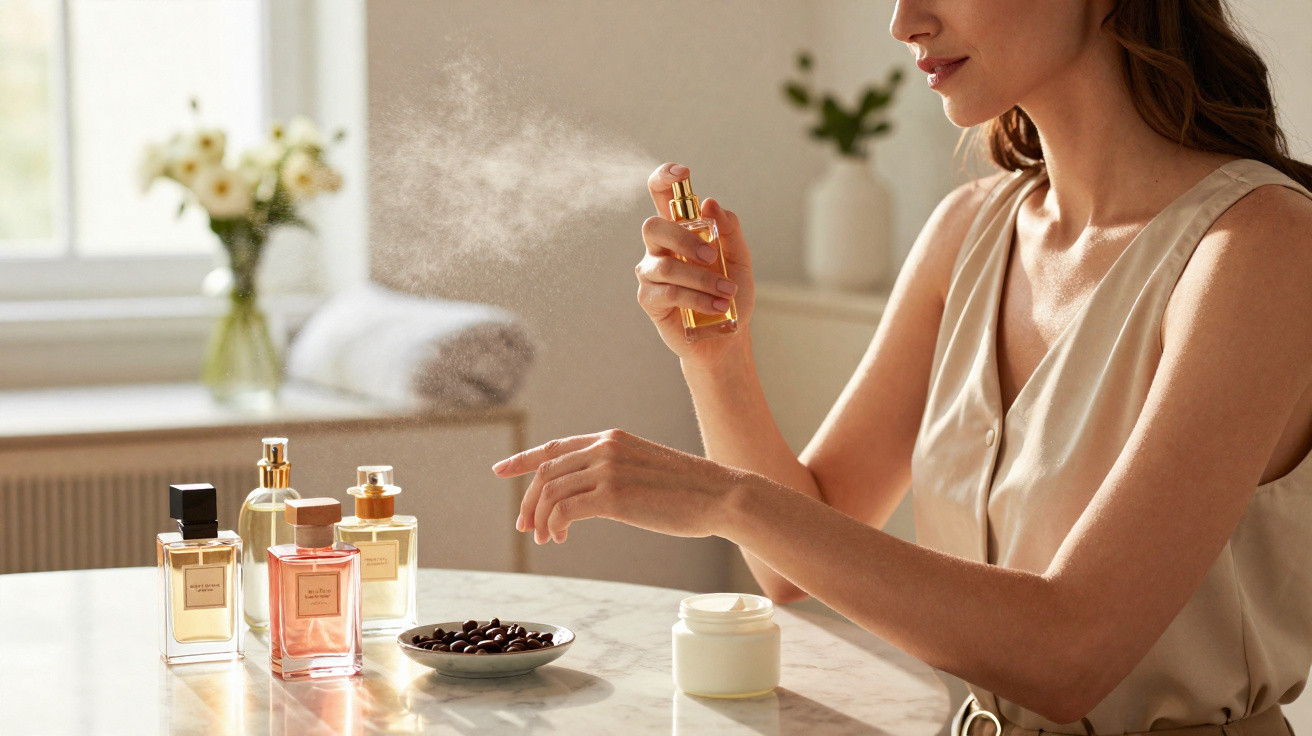
More and more people are layering several fragrances to create a completely personal scent signature. Perfume layering may sound like a creative luxury pastime, yet in practice it often results in a dense cloud of fragrance. With some understanding of notes, order and dosage, that is quite easy to prevent.
Why everyone is suddenly layering perfume
Personalisation has long extended beyond trainers and phone cases. When it comes to fragrance, many people no longer want to “smell like everyone else”. Social media is full of countless “scent recipes”, while Pinterest is seeing sharply rising searches related to combining fragrances.
The principle is simple: by skilfully layering several perfumes, body lotions or scented oils, you can build a distinctive scent signature that nobody else wears. It fits perfectly with the Millennial and Gen Z desire to set themselves apart from mass-market products.
Perfume layering is like a personal scent recipe: brilliant when it is balanced – exhausting when everything shouts at once.
It appears straightforward on paper: choose two or three favourite fragrances and spray them on one after the other. In reality, notes can clash, overpower one another or develop completely differently after an hour than expected. Mixing without a plan is essentially an olfactory lottery.
Creativity, not chance: how perfume layering works
Layering has much in common with cooking. Nobody would throw three extremely hot sauces, sugar and garlic into one pan and call it a “recipe”. Fragrance follows the same rule: harmony comes from balance, not quantity.
The key principle is to use no more than two or three scents at once. Every fragrance needs room to breathe. Structure matters too: light, fresh fragrances should sit closer to the skin, while bold and intense compositions work better on clothing or pulse points.
- Start with light notes: apply fresh, citrus or “clean” fragrances as your base.
- Add character afterwards: finish with a more complex, heavier scent, applied sparingly.
- Pause between sprays: 30–60 seconds is enough for the first layer to settle.
- Do not spray everywhere: choose a few areas rather than scenting your entire body.
Fragrance combinations that almost always work
Certain notes work together so well that they are considered reliable choices for layering. Beginners in particular benefit from starting with these pairings rather than spraying freely without a plan.
Vanilla and woods – sweet, yet grown-up
Vanilla feels soft, gourmand and often especially cosy. On its own, however, it can quickly come across as too youthful or overly dessert-like. Woody notes such as sandalwood or cedarwood provide the answer.
- Vanilla adds warmth and sweetness.
- Woods bring structure and depth.
- Together, the fragrance feels sensual without becoming cloying.
Practical tip: first apply a subtle sandalwood perfume to pulse points, then mist a vanilla scent very lightly over clothing.
Rose with gentle oud – an oriental touch without becoming overwhelming
Rose is a classic, while oud is a fashionable ingredient in opulent fragrances. Together, they can smell breathtakingly elegant, provided the oud element does not become too dominant.
A light oud fragrance that adds only a discreet, smoky-woody veil is ideal. It removes the soapy quality from rose and gives it depth. Choosing an extremely strong oud, by contrast, will completely overwhelm the floral note.
Amber and musk – the “my skin but better” effect
Amber and musk are among the classic “skin notes”. They remain close to the skin, feeling warm, enveloping and slightly powdery. In layering, they are particularly well suited as a base for other fragrances.
A delicate musk fragrance beneath a floral perfume makes the flowers smell more realistic and less “perfumed”.
White flowers and citrus – summer in a bottle
Neroli, jasmine and orange blossom can be very intense and top-heavy. Paired with bergamot or other citrus notes, they become airier and fresher.
Strategy: apply a fresh citrus fragrance as the first layer, then follow with a soft floral scent. This creates a sunny yet wearable everyday fragrance.
These combinations can quickly create fragrance chaos
Some fragrance pairings sound exciting in theory but are often challenging in reality. Unless you know exactly what you are doing, it is best to proceed cautiously here.
Watery freshness meets glowing spice
Aquatic scents evoke the sea, swimming pools and fresh laundry. Sharp spice notes such as cinnamon, clove or pepper bring heat and heaviness. Together, they often collide mercilessly: cold against hot, clean against spicy. The nose reads this as restlessness.
Sugar shock: too many gourmand notes
Caramel, chocolate, praline and sweet vanilla can each smell delicious individually. Layering several of them, however, soon becomes sticky and tiring. Particularly in enclosed spaces, this can easily trigger headaches or nausea.
A better option is one gourmand fragrance with a clear, dry partner, such as a gentle woody scent. This takes away the excessive sweetness.
Patchouli, leather and incense in a trio
Each of these notes has a powerful personality. Patchouli is earthy, leather is raw, and incense is smoky and mysterious. Combining all of them can quickly produce an overpowering wall of scent. If you want to layer in this direction, use no more than two of these elements very sparingly and test them on a blotter first.
Citrus and strong oud – a stark contrast
Here, the fresh lift of citrus meets the extreme depth of oud. The contrast can be exciting, but it often turns strident or discordant. This blend is especially risky in high temperatures or warm indoor spaces.
The golden rules for successful perfume layering
| Rule | What it means |
|---|---|
| Less is more | Use a maximum of two to three fragrances at once, and spray sparingly. |
| From light to heavy | Keep fresh fragrances close to the skin; apply stronger ones only selectively on top. |
| Mix similar moods | For example, combine only warm fragrances or only fresh ones. |
| Test before going out | Try the blend on blotters or at home to see how it develops. |
| Keep some distance | Do not spray every centimetre of your body; select specific areas. |
How to test new fragrance combinations without regrets
Before a blend causes puzzled looks at the office, on a date or in a meeting, it is worth carrying out a small test at home. Two simple methods can help avoid mistakes.
- Paper test: spray one perfume onto each of two blotters, hold them together, wait a few minutes, then smell them.
- Skin spot test: apply one scent to your left wrist and the other to your right, then bring both areas together and smell them as one.
Importantly, fragrances change over time. A mix that seems exciting in the first minute may become too heavy after an hour. To be certain, assess a combination over several hours before it becomes your “daily signature”.
Body lotion, shower gel and more: how skincare products alter fragrance
Layering does not work only with perfume bottles. Scented body lotions, shower gels and body oils are often quietly part of the equation too – and can either intensify a fragrance or distort it completely.
Neutral or lightly powdery body care makes a good base because it does not mask the main scent. Highly fragranced lotions combined with an intense perfume, on the other hand, can quickly lead to overload.
A practical approach is to choose the matching product line for a fragrance you love – shower gel, lotion and perfume – so that you stay within the same scent accord. Then add just one distinctly lighter perfume on top for an individual twist.
Skin type, temperature and occasion: why your blend does not smell the same every day
One factor many people underestimate is that fragrances behave differently on every type of skin. Oily skin retains scent for longer, while dry skin allows it to fade more quickly. Temperature, humidity and clothing also play a role. A layered fragrance that feels cosy in winter can become oppressive on a high-summer day.
Anyone wishing to use layering over the long term is best served by creating several different “recipes”: one blend for the office and everyday wear, a lighter one for hot days, and a more intense option for evenings and special occasions. This keeps your personal scent signature recognisable without overwhelming those around you.














Comments
No comments yet. Be the first to comment!
Leave a Comment