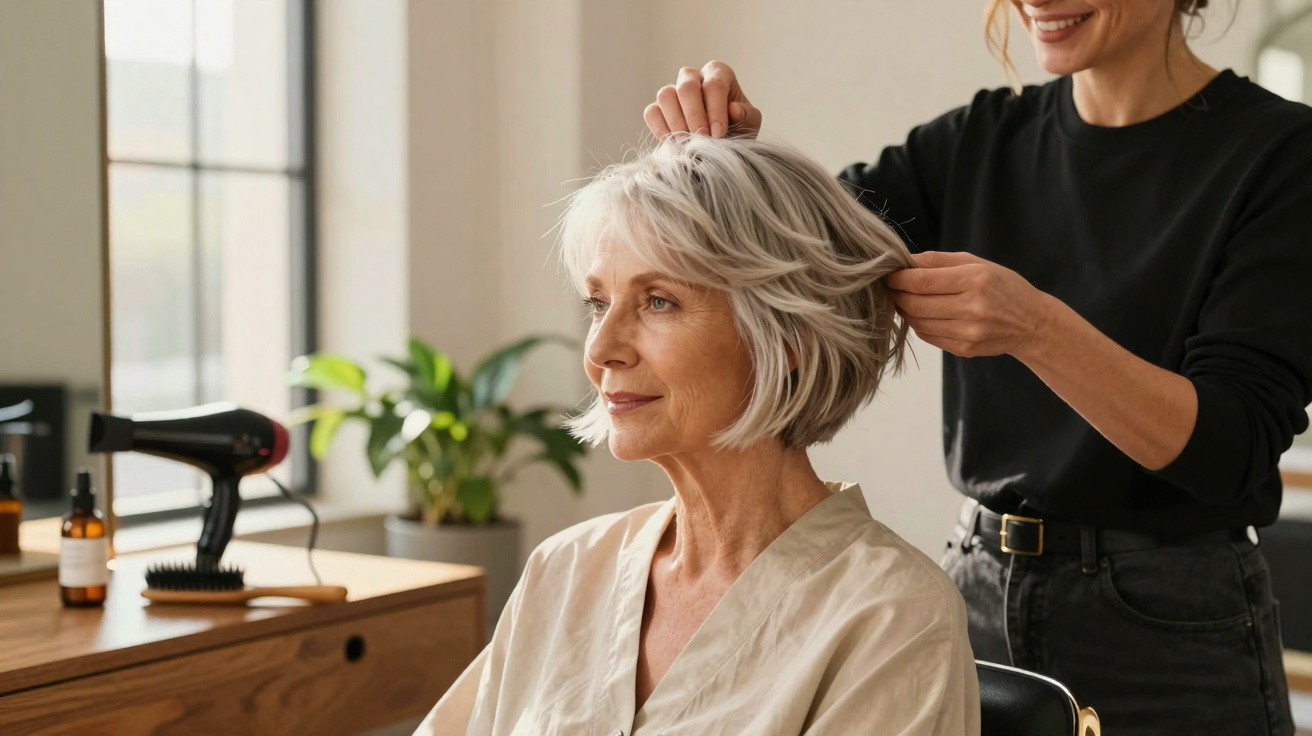
Her bob used to be thick and bouncy; now it lies against her head like a courteous guest who has overstayed their welcome. She chats and laughs with the hairdresser, but keeps glancing at the flat crown and translucent ends. Her phone, resting on the chair beside her, lights up with pictures of her grandchildren, a medical appointment reminder and an old wedding-day photograph: hair piled high, full and unapologetically big.
She has no wish to look younger. She simply wants to look like herself, only… less flattened. The stylist raises sections of hair, pinches at the roots and discusses layers, texture and shorter silhouettes. “Volume is a cut, not a product,” she says, and the atmosphere in the room suddenly shifts.
A tiny alteration at the nape can make the entire face look more awake.
The quiet power of going shorter after 60
There is something about reaching 60 that few people prepare you for. Fine hair does more than appear flatter: it can alter the way you enter a room. You tie it back “just for today”, and before you know it, three months have passed and that dispiriting low ponytail is your everyday look.
A skilfully cut short style changes the story. It lifts hair from the scalp, suggests greater density and frames the face rather than pulling it downwards. The right short cut can soften the jawline, bring attention to the eyes and make glasses appear deliberate rather than incidental.
The essential change is this: instead of battling your hair, you work with what remains. For fine hair over 60, volume does not suddenly come from mousse or volumising shampoo. It is created through structure - deciding where the hair should be shortest, where extra length should remain and where weight can be subtly removed to let it rise rather than fall. Just a few millimetres can separate “flat” from “full”.
Any experienced stylist who works with women over 60 will tend to mention the same four short styles: the modern pixie with soft layers, the voluminous cropped bob, the feathered shaggy crop and the layered French-inspired cut that falls between a bob and a pixie. These are reliable volume-boosters for fine hair, not passing crazes but tried-and-tested small miracles.
They succeed because they make use of your hair’s natural behaviour. Fine hair frequently hangs straight and limp when it is long, but strategic layers and a shorter length can suddenly give it definition. Picture delicate cloth: as one large drape it droops, but when tailored into a carefully made jacket it holds its form. Hair responds in much the same way. With less distance between root and tip, it has less opportunity to sink beneath its own weight.
1. The soft pixie: a small cut with major lift
The soft pixie bears little resemblance to the severe, very short styles you may recall from the 1990s. Its current form is soft around the hairline, a little longer through the top, and shaped with invisible layers that encourage upward movement. At the back, it follows the nape closely, immediately suggesting a longer neck and extra crown height.
For fine hair over 60, this style can be quietly transformative. Taking weight away from the ends allows the roots to lift instead of resting flat. Side-swept bangs brush across the forehead without becoming heavy, concealing thinning at the hairline while softening forehead lines. The overall effect is feminine, light and airy.
Imagine Margaret, 72, arriving at her local Leeds salon with a chin-length bob that had gradually become triangular: flat on top and broad at the bottom. Her stylist proposed a soft pixie, retaining a little more length on top and adding gentle crown layers. That first snip seemed risky. Yet, by the time the hairdryer was switched off, Margaret was sitting more upright.
At her following appointment, she shared something small but revealing: “I’ve stopped checking store windows to avoid my reflection. Now I actually look.” That is the impact a few centimetres of hair can have. It is not magic or anti-ageing, merely a shape that finally works with the hair you have now.
The soft pixie is so successful because it has built-in support. Fine hair does not respond well to weighty layers, which can leave it looking stringy. Micro-layers, however - minute and almost undetectable - let the hair settle gently over itself. This layering creates the appearance of fullness. Keeping the nape and sides tidy ensures that the volume above takes centre stage instead of disappearing into a mass of hair.
There is a psychological aspect as well. Choosing shorter hair after 60 conveys a subtle message: “I’m not clinging to what used to be.” It is not about cutting your hair because you have reached a particular age; it is about letting go of styles that only suit the density of a 25-year-old. A soft pixie suggests a considered choice, not surrender.
2. The cropped bob: classic with a hidden push-up
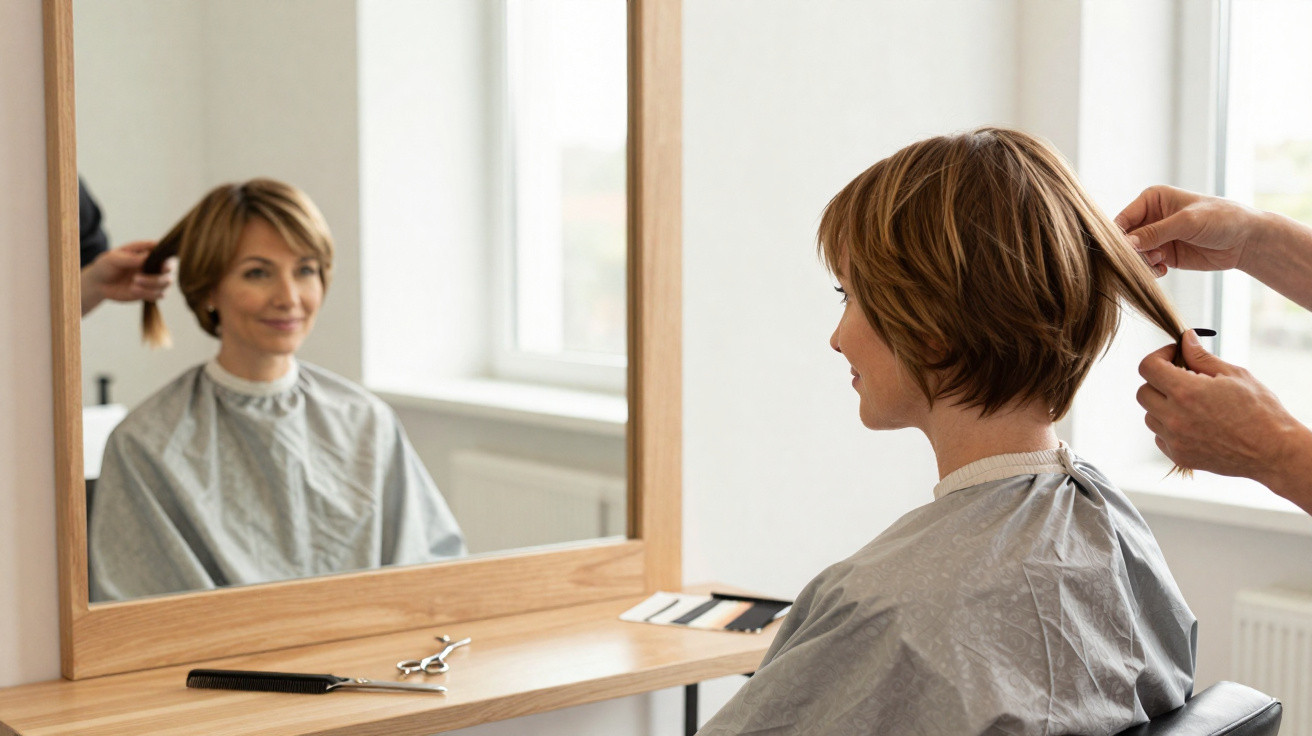
The cropped bob is a middle-ground cut that never feels like settling. It falls between the ear and jawline, grazing the neck while lifting away from the face. Its secret lies at the back: it is a touch shorter at the nape, with softly stacked layers that encourage the hair upwards rather than allowing it to hang.
For fine hair, that modest graduation at the back works like a built-in push-up bra for the crown. Seen from the front, the result remains soft and timeless. From the side, however, there is a discreet swell of volume that makes the whole head of hair appear denser. It suits straight hair, a light bend or the faintest wave.
A recent UK survey by L’Oréal Professional found that women over 60 considered “flat, lifeless hair” a greater frustration than greys. When these same women viewed before-and-after images, however, it was shape and volume - rather than colour - that they noticed most.
Stylists hear a familiar account every week. A woman in her early 60s with hair halfway down her back says that it “just hangs there now”. She believes long hair makes her seem more youthful. Her stylist persuades her to try a cropped bob with slight stacking at the back. The added volume highlights her cheekbones, makes her jawline appear firmer and elongates her neck. The length has disappeared, but the vitality has returned.
That understated stacking works in a cropped bob because it takes weight away from the ends and places it nearer the roots. Consider a bookshelf: pile every book at one end and the shelf bows; distribute them sensibly and it holds more firmly. Fine hair is like that shelf. Graduated layers provide small supports that maintain the shape across the back of the head.
The cropped bob is forgiving too. If exposing much of your neck does not appeal, leave the front a little longer so it curves towards the chin in a protective frame. Glasses, hearing aids and even slightly thinner areas at the temples blend more naturally when the hair has this gentle lift and curve.
3. The feathered shaggy crop: movement that creates the impression of thickness
For anyone who finds the pixie too short and the traditional bob overly polished, the feathered shaggy crop offers a comfortable middle option. This short style uses soft, wispy layers around the face to suggest much more hair than is actually there. Its outline is blurred rather than sharp, with marginally longer front pieces and a lighter crown.
Fine hair suits this cut because movement acts as camouflage. Small feathered ends interrupt the scalp line, avoiding the dreaded “see-through” appearance at the top. Rather than falling as one heavy block, the hair appears to be made up of many small strands moving together.
On a Tuesday morning at a busy Manchester salon, a 64-year-old client removes her hat with a sigh, revealing thin, shoulder-length hair that has spent its days in a bun. “I’m tired of pretending I ‘like it up’,” she confesses. Her stylist recommends a feathered shaggy crop, including a soft fringe and playful side pieces that skim the cheekbones.
Once it is finished, she hardly recognises herself - in the best possible sense. Short, uneven crown layers create height without rigidity. The feathered sides make her glasses look stylish rather than necessary. She passes her fingers through her hair, then laughs: “I look like me, but slept.” It is a modest, human moment that communicates more than any glossy campaign could.
The principle behind the shaggy crop is straightforward: disrupting the outline of the hair makes it more difficult for the eye to determine precisely how thick or thin it is. When every strand is the same length, they fall together, exposing the scalp and losing their shape. When light, air-cut layers introduce varied lengths, the hair reflects light in different ways and appears fuller.
This cut is also kind to slight root regrowth and blends grey hair beautifully. Feathered edges scatter light, allowing colour variations to soften together. It is an excellent choice if you are drawn to short hair but still want some movement and character around the front.
4. The French-inspired crop: face-framing and understated chic
The French-inspired crop looks effortlessly “done” even when you have done very little. Longer than a pixie but shorter than a bob, it sits around the cheekbones, with soft crown layers and a wispy, broken fringe. Think of it as a shortcut to the appearance of having just stepped out of a café in Lyon.
For fine hair over 60, this cut provides an intelligent compromise. Length around the face delivers softness and coverage, while a shorter back and crown add volume where it counts. It is particularly flattering with natural texture - a trace of wave or a soft bend - because it lets hair expand just enough to look fuller without becoming large.
The exact technique is important. The back is cut shorter, almost close to the head, which gently raises the layers on top. Around the face, hair is snipped into small, uneven sections. These pieces settle differently from one day to the next, and that is precisely why the style rarely appears flat.
When it comes to bangs, the French crop is adaptable. A short, piecey fringe can conceal a mildly thinning hairline, while a longer side-swept option can brush the eyebrows. Both direct focus towards the eyes and away from the crown, often the area that concerns women with fine hair most.
This style does not require a flawless blow-dry. A quick blast of the hairdryer, a scrunch of lightweight mousse or a pea-sized amount of styling cream makes it “good enough” for most days. Let’s be honest: nobody really does that every day with a round brush and hairdryer.
As London stylist Carly M. puts it:
“Women over 60 often apologise for their hair before they even sit down. With the right short cut, they stop apologising and start playing again. That’s the real volume boost.”
The key is not to weigh these short styles down with rich products. Heavy serums and oils can make fine hair collapse almost immediately. Choose a lightweight mousse, root spray or texturising powder, applying it sparingly. Keep the ends slightly airy too - blunt, weighty ends are the fastest route to a helmet-like effect.
Common mistakes become simple to avoid once you recognise them. Playing it “too safe” with no layers can leave a short style flat and boxy. At the opposite extreme, too much layering may make the lower lengths wispy and thin. Be clear in your consultation: say “I want volume and softness, not spikes or chunks.” A capable stylist will understand exactly what you mean.
If a stylist speaks only of cutting the hair shorter and says nothing about texture or layers, consider that a mild warning sign. Volume in fine hair is designed, not guessed at. Take photographs with you, but remain flexible: your face shape, cowlicks and lifestyle matter more than copying a celebrity exactly. Remember the familiar emotional reality: on a hectic morning, you need hair that behaves when you have five minutes rather than forty.
- Ask for soft, invisible layers at the crown - not choppy steps.
- Keep the nape and sides tidy, so volume on top stands out.
- Use light, buildable products; stop as soon as the hair feels slightly “grippy”.
- Plan a trim every 6–8 weeks to hold the shape that gives you volume.
Living with short, voluminous hair after 60
Hair after 60 is not solely about fashion. It concerns mornings, energy levels, arthritis in your fingers and how long you are able to stand before a mirror. A well-cut short style builds volume into its shape, meaning you do not need an arm workout and three products every time you wash your hair.
The four cuts that offer immediate volume - the soft pixie, cropped bob, feathered shaggy crop and French-inspired crop - share one quality. They acknowledge the reality of fine hair. They do not demand that it become something else. Instead, they use length, layering and thoughtful shaping to make the most of every strand you have.
A quiet social change is happening too. Increasingly, women over 60 enter salons armed with screenshots, firm opinions and little desire to be told to “act their age”. Short, voluminous hair is becoming less about being “sensible” and more about saying “this is me, today”. The reflection in the mirror appears alert, seen and unhidden - and that can matter more than any promise of “looking ten years younger”.
You may choose one of these cuts and find that you love feeling air on your neck. Or you may retain a little extra length at the front because it helps you feel grounded. You might even let one style grow into another, moving from a cropped bob to a French-inspired crop as your confidence builds. After all, hair is one of the few things that continually gives you another chance to experiment.
The next time you find yourself studying that flat, weary crown in the bathroom mirror, perhaps a new shampoo is not what you need. It may be a shorter, braver shape that finally suits the woman you are today. That choice can resonate well beyond the salon door.
| Key point | Detail | Benefit for the reader |
|---|---|---|
| Soft pixie | Short back and sides, longer top with micro-layers | Creates instant lift at the crown without heavy styling |
| Cropped bob | Graduated back, chin-to-jaw length with subtle stacking | Makes fine hair look thicker while staying classic and easy to wear |
| Shaggy & French crops | Feathered layers and face-framing fringe, slightly longer front | Add movement, disguise thin areas and flatter glasses and facial features |












Comments
No comments yet. Be the first to comment!
Leave a Comment