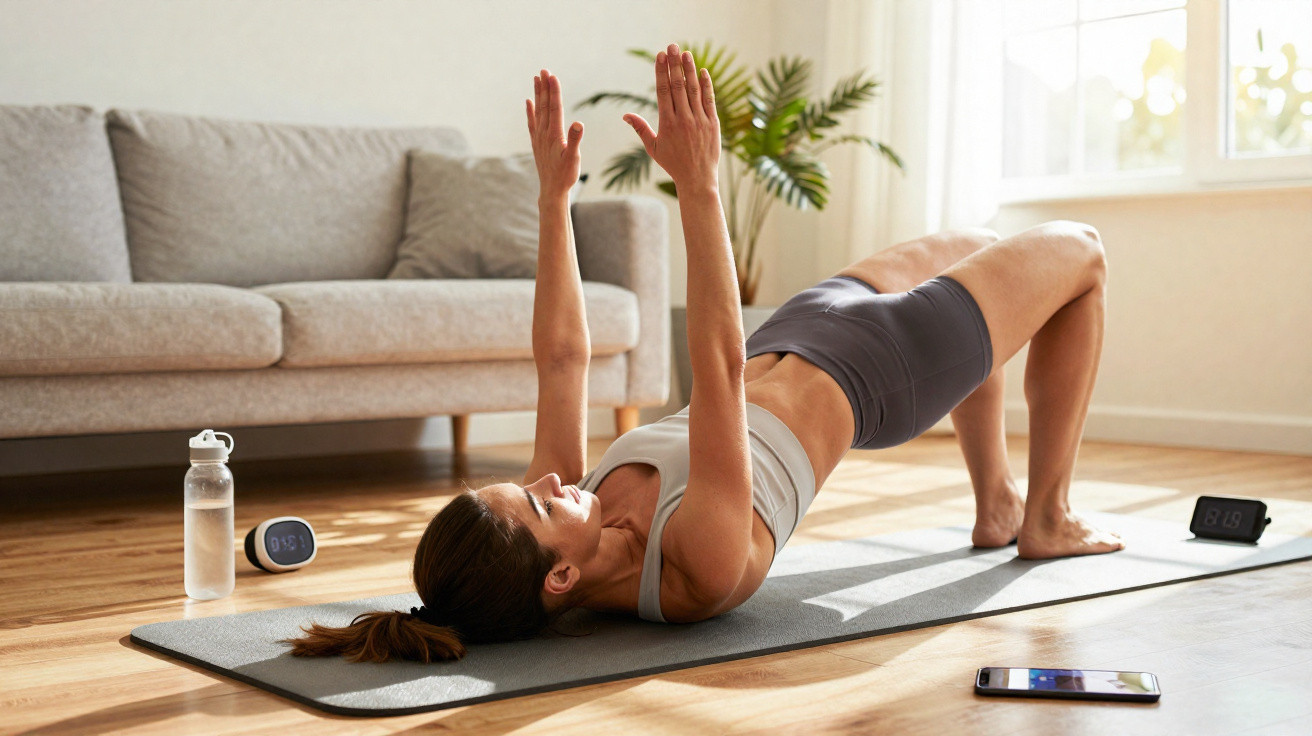
Although crunches continue to feature in many abdominal workouts, trainers are increasingly directing clients towards a tougher movement that activates the whole core and may help tackle stubborn belly fat more effectively.
Why belly fat can be difficult to lose
Belly fat is more than a cosmetic concern. Hormones, genetics, age, stress and disrupted sleep can all affect how much fat the body holds around the abdomen. It is also an area that can be particularly slow to change.
Visceral fat, which surrounds the internal organs, has particularly strong links with health concerns including type 2 diabetes and cardiovascular disease. Subcutaneous fat is the softer layer beneath the skin; while it carries less risk, it can be equally difficult to lose.
Targeted exercises alone will not “melt” belly fat, but the right moves can strengthen the core, boost energy expenditure and support long-term fat loss.
Coaches now favour an overall strategy that includes a balanced diet, adequate sleep, stress management and regular exercise combining cardio with strength training. Within this approach, one bodyweight exercise stands out: the v-up.
What is a v-up and why coaches prefer it to crunches
Also known as a jackknife, a v-up is a bodyweight exercise in which your body creates a letter “V” at the highest point of the movement. Rather than focusing mainly on the upper abs, as traditional crunches do, it works the full abdominal wall.
A v-up recruits several important muscle groups at the same time:
- Rectus abdominis (the “six-pack” muscles)
- Obliques along the sides of the waist
- Deep core muscles including the transverse abdominis
- Hip flexors, which assist with lifting the legs
The v-up challenges the entire core in one movement, combining strength, coordination and mobility without any equipment.
Coaches such as US trainer Tatiana Lampa often rank v-ups above crunches in their programmes because a single repetition recruits more muscle fibres and demands more control. In time, that greater challenge can support improved muscle tone and increased calorie expenditure.
How to perform a proper v-up
You only need a mat or a comfortable section of floor for the standard version. Follow these steps:
- Lie on your back with your legs straight and together, and extend your arms behind your head.
- Brace your core as though preparing for a gentle punch to the stomach.
- Raise your legs and upper body together, keeping both as straight as you can.
- Reach your hands towards your toes so that your body forms a “V” shape.
- Hold briefly at the top, balancing on your tailbone.
- Bring your legs and upper body down slowly and with control, without allowing your feet or shoulders to relax fully onto the floor.
Lampa advises beginning with 2 sets of 12 repetitions. As the exercise becomes easier to manage, raise the volume:
- Intermediate: 3 sets of 15 repetitions
- Time-based option: 3 sets of 45 seconds, completing as many controlled repetitions as possible
Slow and controlled reps are more effective than fast, jerky movements. Quality beats quantity for core results.
Common mistakes that undermine the exercise
As the v-up is challenging, fatigue can quickly lead to poor technique. Trainers commonly notice the following errors:
- Pulling at the neck or excessively rounding the shoulders
- Swinging the legs upwards with momentum rather than muscular control
- Allowing the lower back to lift into a pronounced arch from the floor
- Letting the legs and shoulders drop heavily between repetitions
To protect your spine and gain the full value of the movement, lightly draw your belly button towards your spine, breathe out as you lift, and do not jerk through your lower back.
Beginner-friendly variations and progressions
The complete v-up is not the only choice. Beginners, people returning to exercise after time away, and those with lower-back concerns can adapt the movement while still giving their abs a demanding workout.
| Variation | How it works | For whom |
|---|---|---|
| Tuck v-up | Bring bent knees towards the chest rather than keeping the legs straight. | Beginners or anyone with limited hamstring flexibility. |
| Single-leg v-up | Raise one leg at a time, switching sides with every repetition. | People developing strength or dealing with hip discomfort. |
| Supported v-up | Grip a stable object behind your head to lessen the strain. | Those with less-developed cores or recovering from injury (with medical approval). |
| Weighted v-up | Hold a light dumbbell or weight plate for added resistance. | Advanced users wanting an additional challenge. |
Beginning with simpler variations before progressing gradually lowers the chance of injury and helps establish consistency, which is more valuable than one punishing workout each week.
Three other bodyweight exercises that help flatten the stomach
Although v-ups are highly effective, trainers seldom depend on one exercise alone. A straightforward home routine can pair v-ups with three other bodyweight movements that address different elements of core strength and fat loss.
1. Plank variations for deep-core strength
The standard plank works the transverse abdominis, a deep muscle that encircles the waist like a natural corset. It stabilises the spine and can help the stomach look flatter.
For a basic forearm plank, start face down before lifting yourself onto your forearms and toes. Form a straight line from your head to your heels, engage your abs and glutes, and position your shoulders above your elbows.
When this becomes comfortable, make it more difficult with the following options:
- Dynamic plank: shift from your forearms to your hands and back down while keeping your hips still.
- Side plank: turn onto one forearm and stack your feet to place greater focus on the obliques.
Planks build the foundation that supports every other abdominal exercise, from v-ups to running and weight lifting.
2. Mountain climbers for cardio and core work
Mountain climbers bring together core training and a cardio component that raises the heart rate and calorie expenditure. Begin in a high plank, drive one knee towards your chest, then rapidly switch legs in a running-style action.
The exercise engages the abs, shoulders and legs simultaneously. Performed as intervals - such as 30 seconds of mountain climbers followed by 30 seconds of rest - it supports overall fat loss, including fat around the abdomen.
3. Reverse crunches to target the lower abs
Reverse crunches put slightly more focus on the lower section of the rectus abdominis. Lie on your back with your knees bent at 90 degrees and your feet raised off the floor. Contract your abs to gently roll your hips towards your rib cage, lifting your tailbone slightly, then lower back down with control.
Combined with v-ups, reverse crunches create a thorough challenge for the front of the torso without requiring heavy equipment.
How to create an effective “v-up” core routine
Completed three times a week, this simple circuit can support belly-fat reduction when it is combined with a healthy diet and enough daily movement.
- V-ups: 2–3 sets of 12–15 reps
- Forearm plank: 3 sets of 30–45 seconds
- Mountain climbers: 3 sets of 30–40 seconds
- Reverse crunches: 2–3 sets of 12–15 reps
Rest 30 to 45 seconds between sets. The goal is consistent effort, not exhaustion after the first round.
Those who already exercise regularly can add this circuit at the end of a workout, once the core is warmed up and engaged.
What “burning belly fat” really involves
Spot reduction - the belief that training one body part can remove fat specifically from that area - is not supported by scientific evidence. Genetics and hormones determine where the body sheds fat.
V-ups can nevertheless be useful. They develop muscle through the midsection, raise total calorie expenditure and improve posture. As body fat gradually falls through a combination of nutrition, cardio and strength training, the newly strengthened muscles become easier to see.
Two coach-used terms are worth defining:
- Core: this includes more than the front abdominal muscles; it also covers the lower back, obliques, diaphragm and pelvic floor.
- Metabolism: the body’s overall energy use for essential functions and movement; exercises that build muscle can increase it slightly over time.
Risks, benefits and who should take care with v-ups
The v-up is demanding, and its traditional form is not right for everyone. Anyone with previous lower-back pain, herniated discs, hip issues or recent abdominal surgery should obtain medical or physiotherapy guidance before trying it.
For healthy people, the advantages are clear:
- A stronger, more stable trunk
- Improved posture when seated or standing
- Better performance in sport and everyday activities
- Support for long-term fat-loss efforts
Consider someone who spends every day at a desk, experiences an aching lower back and notices weight accumulating around their middle. Introducing a brief programme of v-ups, or easier v-up variations, planks and mountain climbers three times weekly - alongside regular walks and fewer ultra-processed snacks - can gradually improve both body shape and comfort.
When used sensibly, the v-up is less of a showy social-media exercise and more of a useful training tool: a difficult, efficient movement that can strengthen the core and gradually reduce stubborn abdominal fat over the weeks.












Comments
No comments yet. Be the first to comment!
Leave a Comment