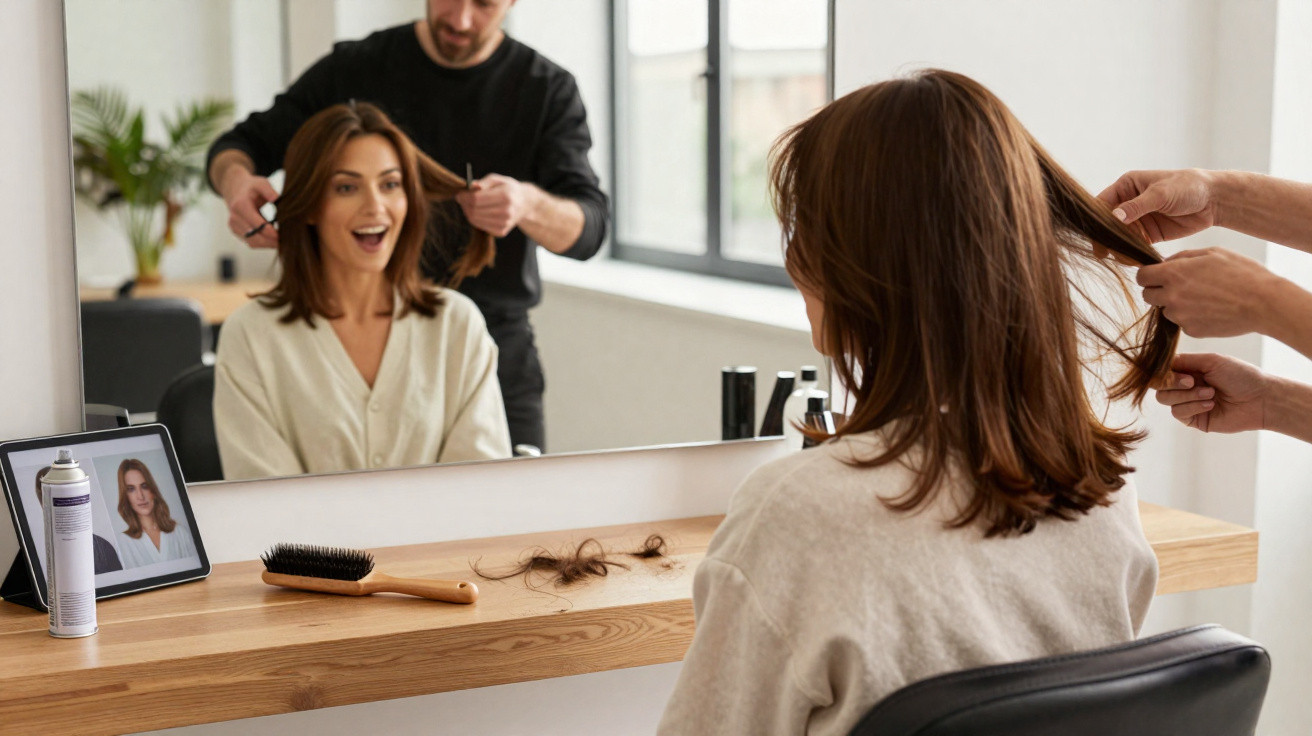
When the hairdresser turned the chair towards the mirror, Lena felt her stomach sink. Technically, the cut was “perfect”: crisp layers, exact angles and a sleek blow-dry. But within less than an hour, the woman in the reflection seemed to have gone from fresh-faced at thirty-two to weary at forty-two. The colour appeared more severe. Her jaw looked weightier. The playfulness had vanished from her face.
She stepped out into the street carrying an odd contradiction: the haircut was expertly executed, yet it did not feel like her. People looked at her, though not with a “wow” reaction; instead, there was that brief pause people make when they are trying to place somebody older.
What happened in that salon chair?
Why some haircuts add ten years in a single blow-dry
Certain haircuts age you not because the scissors were used badly, but because the style clashes with the person beneath it. If the length, volume, colour and parting work against your features, the result does not look timeless or polished. It simply makes you look… tired.
A crown with too little lift can visually pull the face downwards. Weighty ends may drag at the jawline. A sharply defined centre parting can emphasise every line across the forehead. On a good day, it reads as “serious”. On a bad one, you can look like your own older cousin.
The style magnifies the features you may already feel slightly self-conscious about. Once the mirror shows you that, it is difficult to stop seeing it.
Consider Clara, 28, who chose to “go chic” with a smooth, one-length bob ending precisely at her jaw. On Pinterest, it had looked French and effortless. Yet on her rounder face and with her softer features, it made her cheeks appear fuller and her neck seem shorter. When she arrived at work on Monday, she heard the comment everyone dreads: “Wow, you look… different.”
Or take Mark, 45, who requested a close fade “like the guys on Instagram”. His barber copied the reference photograph to the millimetre. What was the outcome? Every thinning patch at his crown became the main focus. Friends asked whether he had been working too hard because he looked “a bit stressed”. He had not. His hair had simply been cut too closely.
The wrong haircut alters more than your hair. It changes how others interpret fatigue, strain and age in your face.
There is a straightforward reason for this. A haircut works in relation to three major factors: bone structure, hair density and skin tone. A cut that visually shortens the neck, broadens the cheeks or flattens the cheekbones can age you. The same can happen when colour or a fringe casts shadows beneath the eyes or around the mouth.
Severe straight lines beside gentle features can create a contrast that appears older rather than more defined. An intensely dark, solid colour against pale skin can make every fine line look harder. Equally, an all-over ultra-light blonde on darker skin can leave the complexion looking muted rather than radiant.
Hair either lifts the face or pulls it down. Viewed that way, the mystery of the “aging haircut” starts to feel more like physics than bad luck.
How to dodge the “older overnight” trap at your next appointment
Before having any haircut, the safest choice is not picking a photograph; it is deciding on an overall direction. Rather than arriving with “I want Hailey Bieber’s bob”, say “I want my face to look more lifted and open”. That small change can reshape the entire consultation.
Put three direct questions to your stylist:
“What length makes my neck look longer?”
“Where should volume sit to lift my features?”
“What kind of fringe or parting looks soft on my face?”
This gives you a shared aim: creating a cut that works with your bone structure rather than copying somebody else. That is where aging cuts quietly disappear.
Many people sit down in the chair and become hesitant. They politely agree, say “do whatever you think”, and hope the finished look will somehow match what they had imagined. Then they return home and search for “how to grow out a bad haircut fast”.
There is also the panic-change haircut. After a break-up, birthday or difficult period, we can ask for an extreme change: a very short pixie after waist-length hair, jet black after sunny caramel, or tiny straight micro-bangs across a tired forehead. The emotional impulse is genuine, but the reflection can be unforgiving.
Honestly, no one carries out an in-depth hair consultation every day. Still, an extra five minutes spent discussing your face rather than only your hair could prevent months of growing it out.
Professionals tend to repeat the same quiet mantra in the back room: “Soft where the face is angular, structure where the face is soft.”
“Harsh cuts age people because they freeze the face in one expression,” explains Julia, a colorist in London. “When hair is too stiff, too flat, or too sharp, the person loses movement. And movement is what reads as young.”
To prevent that fixed effect, look out for three warning signs:
- One-length cuts hitting exactly at the widest part of your face
- Extremely dark or extremely light block color with no dimension
- Ultra-thin, over-layered lengths that collapse around the mouth
These points may sound technical, but their effect is immediate in the mirror. Your face either has room to breathe, or it does not.
Finding the haircut that grows with you, not against you
The most flattering haircut is seldom the boldest one. It is the style people cannot quite identify, the one that makes them say, “You look rested,” even when you have slept for five hours and survived on coffee. A haircut like that does not fight your age; it evolves alongside it.
Ask yourself whether you want to erase your age or look like the finest version of the age you really are. Once you choose the latter, the discussion with your hairdresser changes. You will seek softness around the hairline, brightness near the eyes and movement by the cheeks, rather than simply following the latest TikTok trend.
Hair grows back, but the feeling a haircut leaves in your chest can outlast the inches.
| Key point | Detail | Value for the reader |
|---|---|---|
| Face-supporting lengths | Steer clear of cuts ending at the widest point of your face or visually shortening the neck | Avoids the “fuller, heavier” appearance that can read as older |
| Soft structure vs. harsh lines | Use balanced layers and texture to lift features rather than locking them in place | Creates a fresher, more expressive appearance every day |
| Consultation, not copying | Talk through bone structure, volume placement and colour depth with your stylist | Lowers the chance of shock cuts that add 10 years at the first blow-dry |
FAQ:
- Question 1 Which haircut tends to age people the most?
- Question 2 Does very short hair always make you look older?
- Question 3 Can color really change how old I look?
- Question 4 What should I tell my hairdresser to avoid an aging cut?
- Question 5 How long does it take to recover from a bad, aging haircut?










Comments
No comments yet. Be the first to comment!
Leave a Comment