The first time you properly notice your salt and pepper hair is seldom under kind lighting. It is usually late at night, in the bathroom mirror, when you lean closer and discover that the “few white strands” have quietly become a complete landscape. You tip your head, raise a section of hair, and one thought arrives: “Maybe I just need a fresh cut. Something younger. Sharper.”
You reach for your phone and browse images of stylish silver bobs and striking grey pixie cuts. They all seem effortlessly cool and self-assured. Then you shut the app, face your own reflection again, and uncertainty takes over.
What if the wrong cut makes me look older rather than refreshed?
The first major mistake: picking a “young” cut that clashes with your salt and pepper hair
Any hairdresser who regularly works with grey and white hair will recognise the pattern. Throughout the week, clients in their 40s, 50s and sometimes 60s arrive with a screenshot of a 25-year-old influencer sporting icy highlights and a sharply cut bob. They want an identical look. “I need something that makes me look ten years younger,” they say.
The wish is lovely, but the pitfall can be unforgiving. Copying a cut without adjusting it for salt and pepper texture may make the face appear harder, emphasise signs of tiredness and draw attention to every trace of dryness.
Consider Sophie, 53, who had gradually allowed her roots to grow out during lockdown. Her natural blend of white, silver and darker strands looked beautiful… on the days she styled it. At other times, she felt “washed out” and slightly tired.
She went to her appointment carrying a picture of a blunt, chin-length bob worn by a considerably younger woman. It had the same length, straight edges and centre parting. Initially, the style looked contemporary. Yet two weeks later, she told her stylist she felt more stern and severe, while people kept asking whether she was “more tired than usual”.
That response is not accidental. Salt and pepper hair catches light differently from coloured hair. The ends may be more matte, the roots brighter, and the texture can be drier or more prone to frizz. On this type of hair, an extremely blunt and rigid cut can create a harsh outline around the face.
The eye is then drawn to the contrast between crisp edges and metallic highlights. This is not especially forgiving of fine lines, dark circles or a less defined jawline. A supposedly “young” style that looks brilliant on glossy, even-toned brunette hair can become a magnifying glass for every little sign of time when grey and white strands are involved.
The second major mistake: overlooking volume, movement and the neckline
With salt and pepper hair, the real route to a more youthful look is not length but movement. Once you have embraced your silver, choosing a style that sits flat around the face and neck is one of the biggest mistakes you can make.
A limp bob, an overly long mid-length cut without layers, or an undefined pixie cut that grows out like a helmet can pull the features downwards. When hair lies against the jaw and neck without air or texture, the face can seem heavier, expressions less animated and the natural luminosity of grey and white strands can disappear.
Take Marcela, 61, whose wavy silver hair reached the middle of her back. Fed up with lengthy drying sessions, she asked for “something practical, short enough, not too complicated.” Her stylist gave her a straight bob just below the jaw, with no layers, then thinned the ends to “lighten” it.
For the first few days, the salon blow-dry made it appear soft. However, after she washed it at home, the shape completely fell away. The weight of the salt and pepper hair at the bottom, the lack of lift at the roots and the thinning had removed her natural wave. Her hair sat around her face and neck like a curtain. She felt she had aged five years in a month.
There is a straightforward explanation. Grey and white hair often loses fullness exactly where it is needed most: at the roots and around the crown. If a cut removes still more density from those areas while keeping the ends heavy, it turns the visual triangle of youth upside down.
A youthful impression lifts upwards, with volume by the cheekbones, movement at the temples and a neckline that has room to breathe. By contrast, a “heavy” style pushes everything down and focuses attention on the neck and jawline, where skin is often less firm. The plain reality is this: a cut that ages you is almost always a cut that suffocates your silhouette.
How to make a salt and pepper haircut genuinely rejuvenating (without fooling yourself)
A truly rejuvenating haircut for grey and white hair begins with one principle: lift the face. This does not mean cutting everything very short. It means building support and lightness where your features benefit from them most.
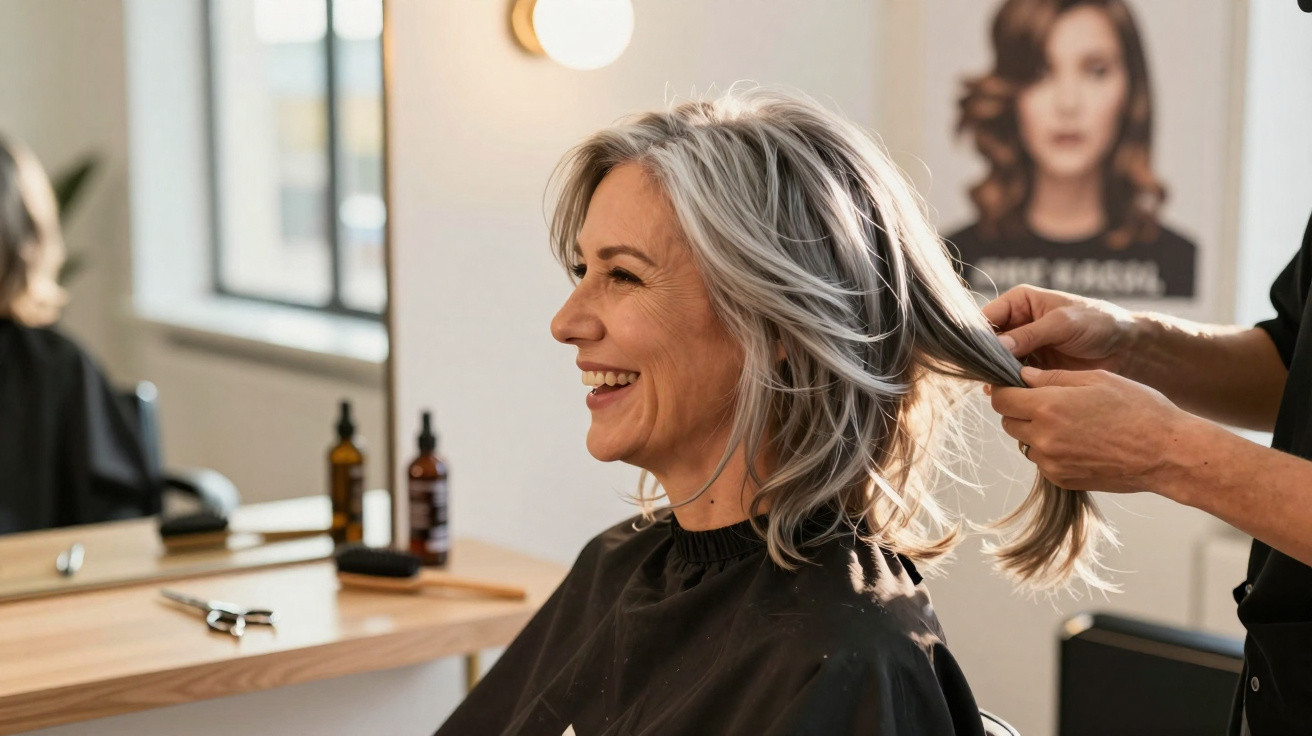
Ask your hairdresser for gentle layers around the cheekbones, a curtain fringe or softly tapered bangs if they suit you, and a neckline that does not place weight over the fullest area of your hair. Even a medium-length style can feel exceptionally fresh when the face-framing sections are shaped into subtle pieces that move as you speak or smile.
Many people enter the salon with a single request: “I don’t want something complicated.” Beneath that is often the worry that they will need to blow-dry or style their hair daily. Honestly, hardly anyone does that every single day.
The real aim is a cut that settles back into shape by itself. In practice, that means working with your natural texture rather than fighting it. If your grey hair is wavy, make the most of the wave through layered lengths and a drying method that supports it. If it is straight, choose a lighter, more graphic shape with softened outlines. A good test: if you have to style it excessively to like it, the cut isn’t really tailored to you.
“With salt and pepper hair, it’s not about erasing the years,” says Claire, a Paris-based stylist who specializes in gray transformations. “It’s about drawing the eye to what’s alive in your face: your eyes, your smile, your posture. The haircut should be the frame, not the main character.”
- Request soft layers towards the face rather than indiscriminate thinning at the ends.
- Retain some fullness at the crown to create the visual effect of lifted features.
- Make the neckline slightly lighter so the hair does not cling to the neck.
- Try a side parting or flexible fringe to soften severe lines.
- Always check the cut from the side and the back, not just the front mirror.
Wearing your salt and pepper haircut: attitude matters more than age
After the scissors have done their work, the way you wear your salt and pepper hair can transform the result. A subtly layered bob paired with upright posture, a little texturising spray and a touch of lip colour creates a very different effect from the same cut being held at the nape in an old hair elastic for weeks.
The two mistakes that age people most are not grey hair itself, but fighting the wrong battle: choosing a “young” cut copied from someone with entirely different hair, and neglecting volume and movement as hair changes over time. Avoid those traps and the salt and pepper blend becomes an advantage. It catches the light, adds dimension to uncomplicated cuts and tells a story rather than attempting to conceal one.
There is something quietly powerful about someone entering a room with beautifully cut grey, silver and white hair without apologising for it. It is not rigidly fixed in place or frantically straightened; it simply looks alive. We have all faced that moment of hesitation between another round of colouring and the courage to accept what the mirror already reveals.
Perhaps genuine rejuvenation is not about removing ten visual years, but about gaining freer movement, simpler mornings, a cleaner neckline and a style that moves with you instead of holding you back. It is the sort of hair that makes people say: “You changed something… you look rested.”
| Key point | Detail | Value for the reader |
|---|---|---|
| Adapt the cut to salt and pepper texture | Soften lines, work with the natural wave and avoid overly blunt shapes | Lowers the risk of a harsh, ageing effect |
| Prioritise volume in the right places | Create support at the crown and around the cheekbones, while keeping the neck area lighter | Lifts the features and brightens the face |
| Focus on movement rather than length | Choose contours that move when you talk and smile, with an airy neckline | Produces a fresher, more dynamic silhouette |
















Comments
No comments yet. Be the first to comment!
Leave a Comment