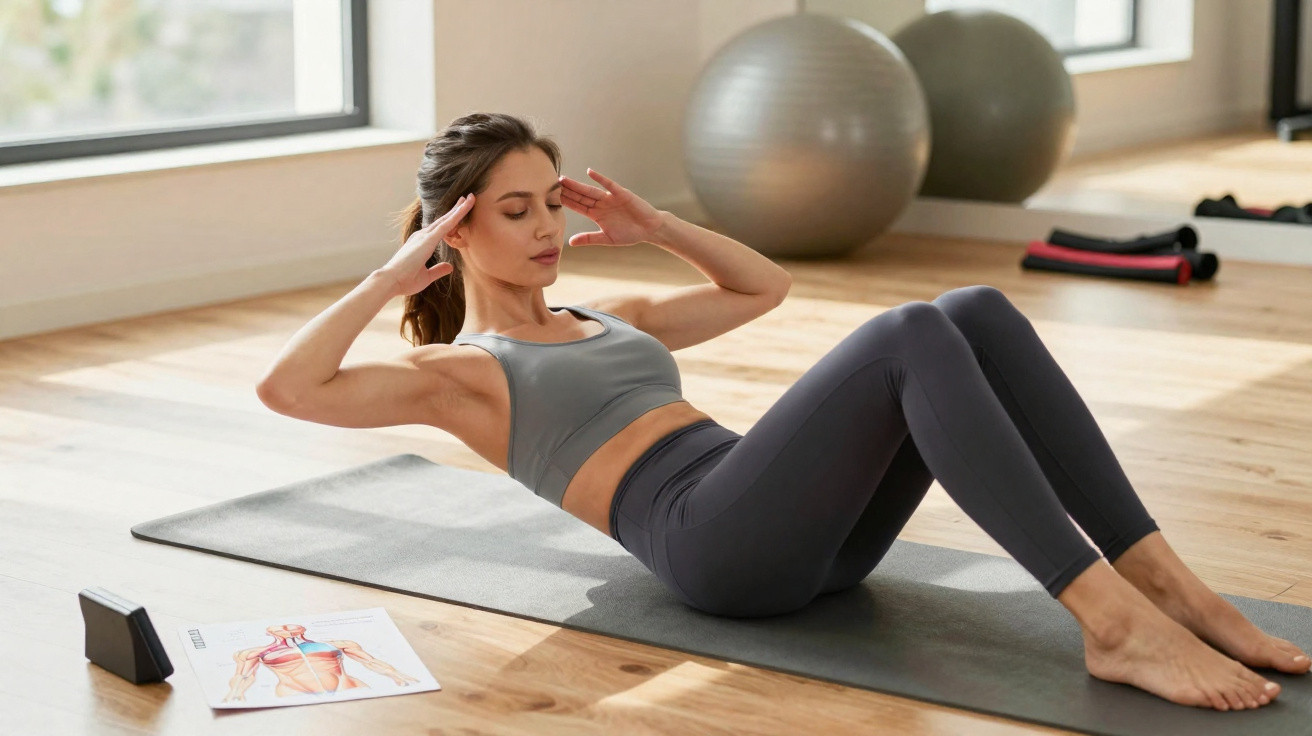
The music is pumping in the studio, the instructor calls out, “Brace your core!”, yet it looks more like breakdancing than crunches. The hips swing backwards and forwards, the feet bounce, while the ribcage barely moves. A few metres away, a young woman drives her feet into the floor so forcefully during sit-ups that her mat creases – but her abs remain remarkably still. We all know that moment when you realise that something is working, just not what is supposed to be working. Suddenly, it becomes clear why so many people say after months of abdominal training: “I can’t feel anything there.” Perhaps the answer is not in the six-pack – but in the hips.
Why your abdominal training secretly becomes a hip workout
Anyone who watches closely in a gym or during a home workout will spot the pattern. During crunches, people pull their necks forwards, bounce their legs and rock their pelvis back and forth as though their hips are counting the repetitions. Their abs? They are involved, but they are rarely directing the movement. It looks committed, strenuous and like someone is determined to see it through. Yet it often ends with that oddly hollow feeling: as though you tried hard, but in entirely the wrong place.
Picture a typical evening: a YouTube workout called “10-minute six-pack quick fix”. The instructor smiles and the stopwatch starts. You lie on your back with your knees bent and begin crunching. After 20 seconds, it is not your abdominal muscles that burn, but your hip flexors and lower back. So you cheat a little. You pull your knees slightly closer, use your pelvis for momentum and let your legs bounce. It suddenly feels “easier” – not because your abs have become stronger, but because your hips have stolen the work. Later, many people pay for it with a pulling sensation in the lumbar area and frustration in front of the mirror.
From an anatomical perspective, this is almost an inevitable disaster. Hip flexors are naturally strong and used continually: when sitting, walking and climbing stairs, they are always on duty. The rectus abdominis, by contrast, must be consciously activated for a controlled crunch; left to its own devices, it is the less eager worker. As soon as you rely heavily on your legs or sharply tilt your pelvis, the hip flexors take charge. The brain loves shortcuts, so it delegates the task to the strongest available muscle group. At precisely that point, your abdominal training loses its real target.
How to target your abs properly – without letting your hips cheat
The simplest adjustment is to slow everything down radically. Lie on your back with your feet flat on the floor and your knees roughly hip-width apart. Breathe out before lifting, then roll up only until your shoulder blades rise slightly from the floor. Imagine gently drawing your navel towards your spine, as if you were fastening a tight zip. Do not yank your neck or pull through your legs. A well-executed crunch often feels smaller than your ego would prefer – and that is exactly where its power lies.
Many people do not notice how much they escape into their hips until someone points it out. Wanting to “feel more”, they unconsciously add momentum, cross their feet or pull their knees too close to their torso. It seems productive; mentally, it counts as effort. Let’s be honest: hardly anyone performs every repetition correctly each day, particularly after a long day at a desk. It is in this tired state that people slip into patterns that take the load away from the abs and overload the hips. That is not laziness so much as the body’s protective mechanism – with a little impatience from the mind thrown in.
“Abdominal training is not a battle against the body, but a negotiation with it. If you constantly let your hips scream, you will never hear your abs whisper.”
To correct this imbalance, use a brief mental checklist before every exercise:
- Does my lower back feel steady and still, or is it rocking?
- Is the movement genuinely coming from my upper body rather than my legs?
- Am I consciously breathing out when my abs should be working?
- Are my hip joints staying relatively “quiet” instead of swaying?
- Would I rather do 8 clean repetitions than 30 rushed ones?
What changes when your hips return to their proper role
When you deliberately take the strain off your hips and put your abs in charge, it changes more than your training – it changes how your body feels in daily life. When you simply roll up from the sofa, you may suddenly notice your core taking over instead of your lower back. You might realise that, while brushing your teeth, you automatically tilt your pelvis just to “stand as usual” – and you can correct it. The divide between abdominal training and ordinary life becomes less distinct. An exercise on a mat turns into a new way of holding and moving your body.
| Key point | Detail | Benefit for the reader |
|---|---|---|
| Hips take over during abdominal training | Strong hip flexors compensate for weak or poorly activated abdominal muscles | Understands why their abs “feel nothing” and their back complains |
| Clean technique before repetition count | Slow, small movements with still hips target the abs more precisely | Learns to create more effective stimulus with less effort |
| Everyday carry-over | Better core activation eases the load on the back and hips when sitting, walking and lifting | Benefits not only visually, but throughout everyday movement |
FAQ
Question 1: How can I tell specifically during training that my hips are doing too much work?
Typical signs include a pulling feeling around the groin, an exaggerated arch in the lower back during abdominal exercises, and the urge to bounce your legs or pelvis to lift yourself up.Question 2: Are leg-raise exercises generally bad for the abs?
No, they can be highly effective if your lower back stays on the floor and you begin the movement with control, rather than dropping your legs abruptly or swinging them upwards.Question 3: How often should I train my abs without slipping into hip compensation?
2–3 sessions per week with a focus on quality are usually enough, provided that you work deliberately slowly and stop early when the pulling sensation moves into your hips.Question 4: Does a strong core automatically help with back pain?
It can help considerably if the muscles can actually be activated and work together with the glutes and back muscles, rather than simply looking defined.Question 5: Can I deliberately relax my hip flexors to feel my abs more clearly?
Yes. Gentle stretches before training, short lying breaks with deep exhalations and a consciously neutral pelvic position can make the hip flexors “quieter”, allowing the abs to engage more easily.















Comments
No comments yet. Be the first to comment!
Leave a Comment