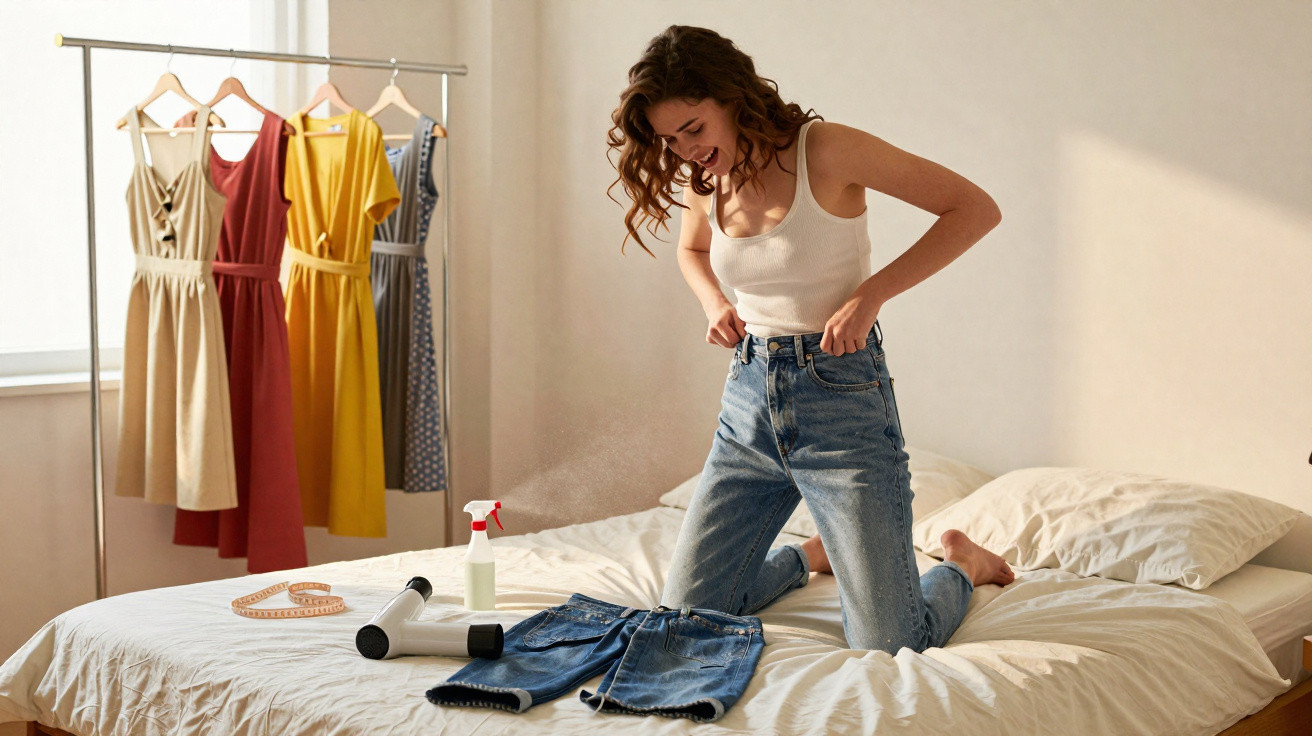
With a simple trick, it is often possible to gain a whole extra size after all.
Many fans of second-hand and flea-market fashion will recognise the situation: an item looks like a perfect find on the hanger, but feels like a straitjacket once it is on. Your body shape is rarely to blame; more often, it is the cut of past decades. With a little background knowledge and a quick but remarkably effective technique, you can noticeably increase the room in a vintage garment without ruining it.
Why old sizes can be misleading today
Anyone who picks up a dress or pair of jeans from the 1960s or 1970s soon encounters a problem: the number on the label has only limited relevance to modern sizing. A vintage size 40 skirt often corresponds more closely to a current size 36, or sometimes even smaller. Many shoppers underestimate this, then wonder why the garment fits so tightly.
There is another factor, too: everyday clothing used to be cut much closer to the body. There was less stretch, more firm woven fabric and a greater focus on narrow waists. The strain is therefore concentrated mainly at the side seams. Wearing an item that is regularly too tight can damage the material, causing fibres to stretch out or tear.
“The good news is that a slightly too-small vintage piece does not have to disappear into the wardrobe. With a little sensitivity, it is often possible to fit in an extra ‘in-between’ size.”
The key is to establish how much extra room you genuinely need, as well as the fabric from which the piece is made. Gentle stretching methods are possible in many cases with pure cotton and firmly woven textiles.
What gaining “one size” means in practical terms
When dressmakers talk about gaining “one size”, they generally mean around four centimetres of additional circumference at a key point: the waist, hips or bust. That may not sound like much, but in a tight area it can make the difference between something that will not fasten at all and something that is comfortable to wear.
In practical terms, the increase is divided between two sides: roughly two centimetres on each side of the body or at each seam. If you need more than four centimetres, pulling at the fabric alone is not enough; the garment’s construction will need altering, perhaps with inserted panels or professional tailoring.
- Up to around 2 cm: gentle stretching through wearing, ironing or dampening is often enough.
- Up to around 4 cm: a combination of fabric stretching and minor sewing work is sensible.
- More than 4 cm: this is usually only realistic with an obvious alteration or a different size.
The 5-minute trick for tight vintage jeans
A quick technique is particularly useful for jeans made from 100% cotton: classic denim with no elastane, or very little of it. This type of fabric responds clearly to water, warmth and tension.
How to quickly stretch denim
The method is straightforward and does not require any sewing skills:
- Generously dampen the waistband and upper hip area of the jeans with lukewarm water. A spray bottle works best; the fabric should be clearly damp but not soaking wet.
- Put the jeans on while they are still damp. It may feel unusual briefly, but it is worthwhile.
- Keep moving for three to five minutes: do gentle squats, lunges and torso twists. This spreads the tension evenly and helps the fabric adapt to your shape.
If the idea of putting on wet jeans does not appeal at all, stretch the waistband over the widest possible wooden hanger instead. The hanger should visibly pull the waistband apart without distorting it. Leave the jeans to dry in this position.
“This simple procedure can create up to around three centimetres of extra room at the waistband in stiff cotton denim – often exactly what was missing for a comfortable fit.”
Afterwards, let the jeans air-dry rather than using a tumble dryer. The intense heat of a dryer can cause cotton to shrink again. If you are curious, measure the garment before and after treatment to see the change in black and white.
When jeans and other garments still pinch after stretching
If the additional ease is not enough, or the trousers remain especially tight across the hips and bottom, a proper alteration is hard to avoid. This effort is almost always worthwhile for high-quality vintage pieces, particularly when the fabric is rare or the cut is distinctive.
A classic dressmaking solution is to add a so-called gusset or stretch panel, ideally where the greatest tension occurs: often at the back of the waistband or in a side seam. If you do not own a sewing machine, take the garment to an alterations service and specifically ask for discreet inserts.
More room in skirts and dresses with an invisible insert
A similar method works at the side seam of waist-fitted skirts and dresses. The principle is simple: a small triangle of fabric adds width at the side without completely changing the silhouette.
Step by step: extra breathing room in a favourite dress
Anyone with some sewing experience can try this themselves:
- Unpick the side seam where the garment pulls, usually at the waist or hip. An opening of five to seven centimetres is sufficient.
- Cut a small rectangle measuring roughly six by eight centimetres from suitable fabric, ideally similar in both colour and weight.
- Fold the piece lengthways to form a triangle. The closed edge will become the new outer edge, while the point faces downwards.
- Place the triangle point-first into the opening, creating a V-shaped gap that is now filled by the insert.
- Close both sides with narrow, strong seams. If you are unsure, pin or tack everything in place first, then try on the dress.
Adding one insert on each side distributes the extra width more evenly. Together, they can easily provide a few additional centimetres of freedom of movement without making the skirt look completely different.
“Small, well-positioned inserts rescue many supposed bad purchases – and make a too-tight collector’s piece suitable for everyday wear again.”
Tips for helping vintage clothing last
Retro fashion depends on its materials and workmanship, which is precisely why a little care is worthwhile:
- Never force a fastening: zips and old seams tear more easily than modern ones.
- Stretch tight areas while damp rather than forcing yourself into them when dry.
- For valuable pieces, pin every alteration from the inside first and try the garment on.
- Make elastic inserts wide and flat so that they do not roll up.
- Do not soak and pull pure wool or delicate silk; for these fabrics, it is better to consult a professional.
When a visit to a dressmaker is genuinely worthwhile
Many people avoid alterations services because they fear high costs or visible changes. With vintage clothing, however, a professional assessment can pay off. Often, half an hour’s work is enough: the waistband can be let out slightly, darts moved, a zip repositioned or an elastic band discreetly concealed at the back of the waistband.
Anyone who buys second-hand regularly will gradually become better at judging which pieces still have some room for adjustment. Jeans with wide inner and outer seams often offer spare fabric. Skirts with an attached waistband are easier to alter than styles without a clearly defined waist finish.
How to avoid disappointment on your next vintage shopping trip
A few simple checks during a fitting can reduce the risk of a frustrating purchase later:
- Move deliberately: sit down, bend over and climb stairs. If the fabric already hurts in the shop, it will not become more comfortable at home.
- Check the seam allowance at the side seams. If there is still one centimetre or more of fabric on the inside, letting the garment out is more likely to be possible.
- With denim, consider whether you want to wear the jeans fitted or loose. Cotton jeans give slightly with everyday wear, but not by two sizes.
- Avoid radical stretching attempts with very old pieces that have brittle fibres, as the material is more likely to break.
Keeping these points in mind, and knowing the 5-minute trick for cotton jeans, means you will have to make fewer compromises at your next flea market. A pencil skirt, high-waisted jeans or a vintage dress can then become part of everyday life rather than wardrobe decoration, with a fit that feels good and allows freedom of movement.













Comments
No comments yet. Be the first to comment!
Leave a Comment