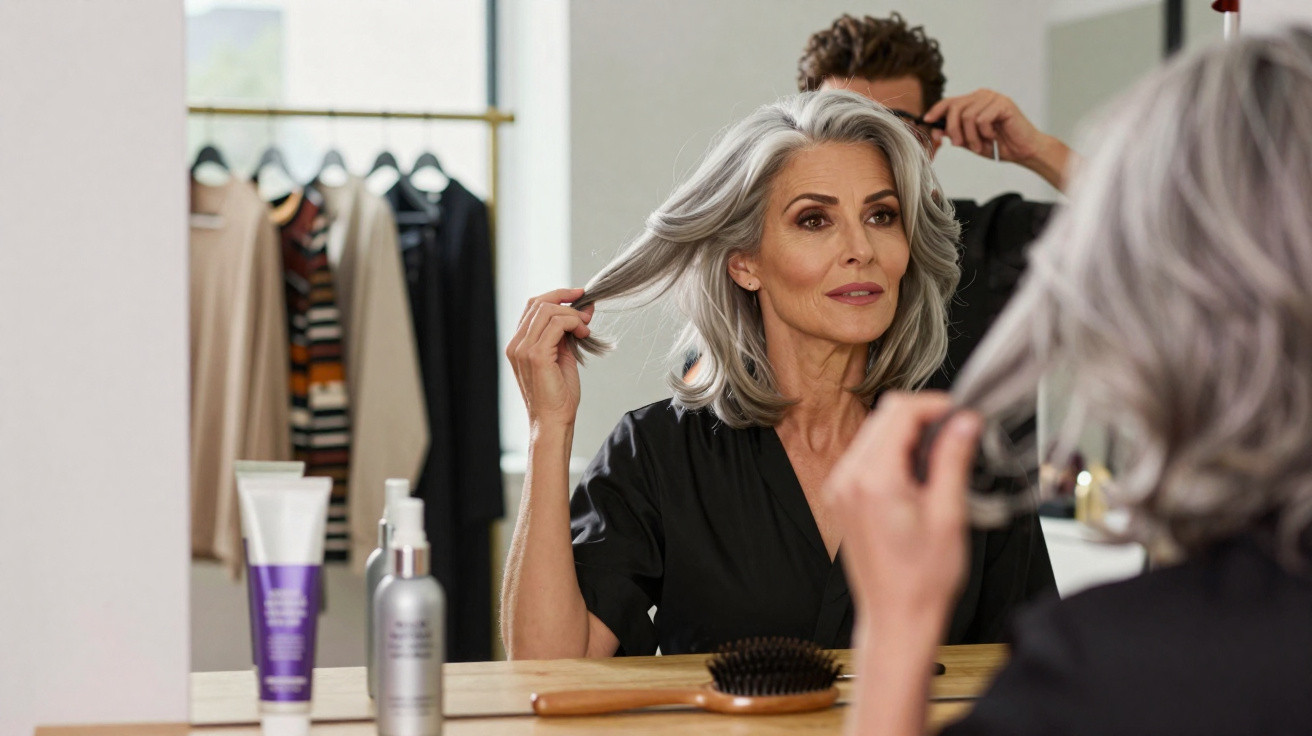
The first white hair tends to show up on an ordinary Tuesday you never saw coming. You spot it in the lift mirror beneath a harsh strip of fluorescent light: one silver strand gleaming as though it belongs there. You press it flat, wind it round a finger and question whether anybody else can see it from that angle. Suddenly, that single hair feels heavier than the laptop in your tote bag.
A few years later, it is no longer an isolated gatecrasher. Instead, a gentle salt-and-pepper haze frames your face. On a good day, it feels chic and French; on another, you see yourself in a reflection and wonder, “Since when did I start looking like my old primary school teacher?” It is not about looking “young at all costs”. You simply do not want to be assigned the automatic “granny” label whenever a silver strand catches the sunshine.
That push and pull is exactly where the real magic begins.
1. Cut with purpose: the anti-“granny” shortcut
“Gray doesn’t age you. The haircut does,” says Paris-based hairstylist Léa Moretti, combing through a client’s steel-toned highlights. In her chair is a 52-year-old solicitor wearing cheekbone-skimming salt-and-pepper hair with a leather biker jacket. As she checks her emails, nobody in the salon is thinking “granny”. They are wondering who she is and what her story might be.
In reality, long, unstructured grey hair can pull the face downwards and emphasise signs of tiredness. Clean edges, weightless layers or a confident bob can instead make every silver strand seem intentional. That is the role of a great haircut: it shifts grey from a “sign of age” into a deliberate style signal.
Imagine two women on the Tube. On one seat sits someone with chest-length hair that has become thin, yellowed at the ends and grey at the roots, with a centre parting kept simply because “that’s how it’s always been”. Her hair gives the impression that she is apologising for occupying visual space.
On the seat beside her is a woman of the same age, with a blunt bob cut at jaw level, natural salt and pepper allowed to gleam and a little movement through the ends. The colours are the same, but the effect could not be more different. One disappears into the crowd; the other has the understated impact of a street-style photograph in a magazine. Age is not the distinction - structure is. The right cut shapes the face, lifts the jawline and lets the brightness in the eyes echo the shine in the hair.
Technically, white and grey hair bounce light in a different way. It is often slightly more porous and coarser, and it reveals every aspect of a haircut - whether favourable or not. A weighty, dated style can look ten times more “old-fashioned” on silver hair than it would on brown hair. For that reason, stylists frequently advise clearer contours, volume at the crown and necklines that do not slump onto the shoulders.
A contemporary cut makes the visual message unmistakable: this grey is chosen, not evidence that you have stopped trying. Face-framing layers create movement, while a micro-fringe can make glasses seem artistic rather than “sensible”. When the shape feels current, people see a fashion choice rather than a date of birth.
2. Shine and tone: making dull grey into silver armour
If the cut provides the frame, shine creates the filter. Much of the “granny” effect comes from grey hair that appears flat, dull or faintly yellow, rather than the polished silver seen on Instagram. Fortunately, grey hair responds beautifully to light when it receives the right care.
Hairstylists tend to rely on the same three-part approach: hydration, protection and gentle toning. Consider sulphate-free shampoos, nourishing yet lightweight conditioners, and purple or blue treatments once a week to counter brassiness. The objective is not violet hair; it is maintaining a clean, icy depth. Healthy gray catches light like a silk scarf; neglected gray swallows it like a cotton sweatshirt.
Léa recalls a 60-year-old client who arrived prepared to colour everything brown again. “I’m tired of looking washed out,” she said. Her salt-and-pepper hair had taken on a beige tinge, the ends had the feel of straw, and she used her hairdryer on its highest heat setting “to go faster”.
They did not colour her hair at all. They detoxified it instead: clarifying shampoo removed built-up residue, a soft gloss delivered transparent shine, and a cool toner eliminated yellowing. By the end, the very same grey resembled liquid chrome. The client applied red lipstick, reached for her phone and whispered: “I can’t believe this is still my hair.” Brown was unnecessary; all she needed was a more intelligent routine and less harsh treatment.
The reason is straightforward. Grey hair produces fewer natural oils, meaning its cuticle can open and become frizzy more easily. Heat, sunshine and pollution make this worse, roughening the surface so that light reflects unevenly. Regular masks, heat protection before styling and a cooler hairdryer setting help smooth the surface once more. A smooth surface reflects light, and reflected light makes hair appear luxurious.
Léa repeats one blunt truth throughout the day:
“Yellowed gray ages you. Shiny silver lifts you. It’s the same head, just a different care story.”
- Use a mild hydrating shampoo and conditioner two to three times weekly.
- Introduce a purple conditioner or mask once a week to neutralise yellow tones.
- Apply heat protectant every time before blow-drying or straightening.
- Complete your styling with a very small drop of serum through the mid-lengths and ends for shine.
- Avoid excessively hot settings: warm air will generally provide sufficient smoothness.
3. Style your grey hair: clothes, brows and attitude
The final consideration is not the hair alone, but everything surrounding it. Salt and pepper hair looks immediately editorial when accompanied by crisp clothing, shaped brows and a little contrast around the face. This does not require full glamour every morning, only several intentional decisions.
Stylists often refer to “visual anchors”: details that draw the eye and communicate “I’m here, present, awake”. With grey hair, that could mean boldly framed glasses, a tailored blazer, clean-lined white trainers or a strong tinted lip balm that adds life to the mouth. Gray loves contrast. A colourful scarf, darker brows or a navy jumper can avoid the washed-out, all-beige look that suggests “retirement home”, even on a 40-year-old.
Most of us know the moment when we realise we have worn the same loose cardigan for three winters because “it’s comfy”. Alongside newly grey hair, that cardigan can look like surrender, regardless of how vibrant you feel. Léa says a major change occurs when clients give themselves permission to wear bolder, more defined shapes: straight-leg jeans rather than sagging pairs, a crisp shirt rather than a limp T-shirt, or ankle boots rather than worn-out flats.
She is equally firm about brows. As hair becomes lighter, eyebrows often fade as well, leaving the whole face less defined. A little tint - or simply an effective pencil and brush - restores that framework. Hair can be entirely silver while the expression remains alive, focused and present.
There is also a psychological element that no shampoo can provide. Women whose grey hair looks especially magnetic usually describe it in the present tense, rather than treating it as a remnant of their younger selves. They call it “my silver” or “my white streak”, not “what’s left of my color”. That small change in language affects how they hold their head when they enter a room.
Léa captures this idea in a sentence she gives clients who are uncertain about the transition:
“Gray hair tells your story. My job is to cut and style it so the story reads as power, not as permission to dismiss you.”
- Pick one strong feature for every outfit: glasses, shoes, a jacket or lipstick.
- Renew your eyebrow shape and colour to complement lighter hair.
- Choose clean, defined clothing lines rather than droopy, over-worn pieces.
- Try shades that make silver hair glow: navy, black, white, fuchsia and emerald.
- Refer to your grey as a feature rather than a flaw. Your posture will reflect it.
4. Five daily habits to improve grey hair without the “granny” effect
Every enviable salt-and-pepper head of hair involves less mystery than it might appear. It is largely the result of quiet, repeated habits. These are the five practices hairstylists come back to every day for clients who want grey hair without the stereotype.
First, book a regular modern haircut every 6 to 10 weeks. This should not be a trim only if you happen to have time, but a proper appointment to refresh the silhouette, tidy the neckline and rebalance the length. Untended grey hair can quickly look “tired”, while a neat outline instantly signals intention.
Second, build a manageable care routine into everyday life: one gentle cleanse, one conditioner, one weekly mask and one heat-protection product. Realistically, nobody follows this perfectly every day. Consistency matters more than perfection. Simply avoiding aggressive shampoo and harsh towel-drying can alter the texture within a month.
Third, include a rapid toning treatment. This might be purple conditioner left on in the shower while you shave your legs, or a salon gloss once every few months. The purpose is to keep silver tones cool instead of allowing them to become nicotine yellow. That one adjustment removes a large part of the “granny” feeling.
Fourth, spend 30 seconds upgrading your style in the mirror before leaving home. You could tuck your hair behind one ear to reveal earrings, switch your parting to add lift, or work a pea-sized amount of volumising mousse into the roots. A messy finish is perfectly acceptable; deliberately messy is chic.
Fifth, connect your grey hair to one visible style choice elsewhere. It could be a bright lipstick, a structured jacket, or a piece of jewelry you actually love. Grey hair is visually powerful, so it benefits from one companion detail on the rest of your body that tells people, “Yes, I did this on purpose.” These tiny rituals do not require an hour; they only require a few moments of attention for the person you see in the mirror.
Grey hair as a style choice, not a surrender
Grey hair once represented a dividing line: before, when you were permitted to be visible, and after, when you were quietly expected to tone everything down. That boundary is shifting. Silver buns now appear in yoga classes, cropped white hair at concerts and salt-and-pepper pixie cuts in boardrooms. The more often we see them, the more the old “granny” category begins to break apart.
Everything changes when grey is treated as a material rather than a problem. You can cut it, gloss it, style it and frame it. It can be contrasted, supported and, at times, openly celebrated. There will still be days when you miss your previous colour, just as you might miss a city where you once lived. But there are also mornings when your reflection feels unexpectedly like the most truthful version of yourself. That is when grey hair stops being a deadline and becomes a choice worth sharing.
| Key point | Detail | Value for the reader |
|---|---|---|
| Modern haircut | Structured bob, layers or a short cut that lifts the face | Makes grey look intentional and stylish rather than neglected |
| Shine and toning | Hydrating care, heat protection, purple products | Turns dull grey into luminous silver that catches the light |
| Style balance | Defined brows, clean clothes, one bold accessory | Removes the “granny” effect and strengthens personal presence |














Comments
No comments yet. Be the first to comment!
Leave a Comment