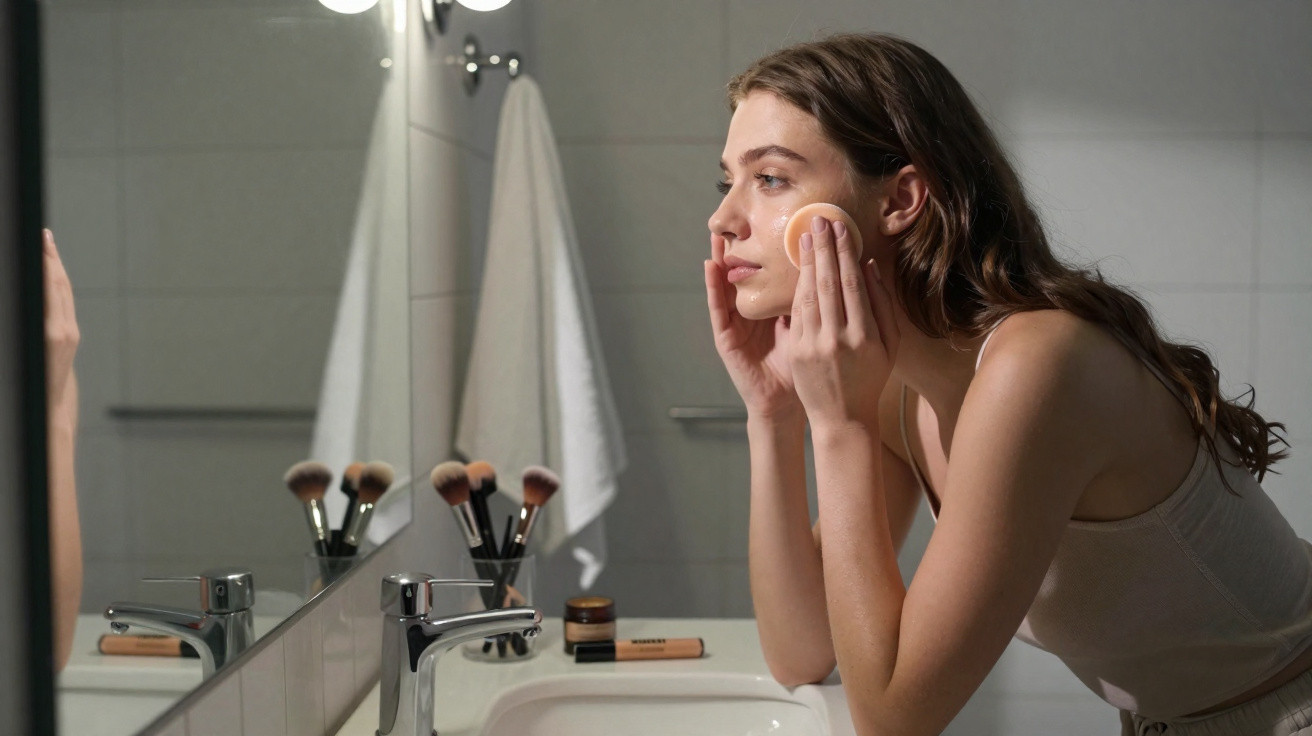
The bathroom lighting is unforgiving.
It has no sympathy for the four hours of sleep you managed, the meetings filling your diary or the effort you genuinely put in this morning. You move closer to the mirror and narrow your eyes. There it is: your under-eye area is dry, uneven and oddly textured. The concealer you carefully blended 10 minutes earlier has settled into heavy lines, catching on every fine crease you never realised was there.
Your phone vibrates, you are already running late and you are looking at your reflection wondering, “How did this get so… cakey?” You pat it with a fingertip. It starts to pill. You sweep at it, and it smears. Every attempt to fix it makes it look worse. The formula that promised a “flawless second-skin finish” is now announcing “tired and overdone.”
Then an unexpectedly small step changes the result completely. It takes barely 10 seconds.
Why concealer becomes cakey in the first place
It is easy to blame the concealer itself, but the skin beneath it is usually the real issue. Concealer works like a magnifying glass, highlighting what is already going on across your face. Dry areas, fine lines, traces of eye cream and even mascara left from the night before can quickly combine to ruin your makeup.
The skin around the eyes is thin and contains very few oil glands. It is delicate and constantly in motion while you speak, laugh, scroll through your phone or squint. Putting a thick layer of pigment over that thirsty, moving surface is an obvious route to creasing and caking. The concealer may not be the problem; it is simply being expected to do an impossible job without any support.
You can watch this happen on a packed train during a hectic Monday morning. A woman checks her reflection in her phone and lightly pats beneath one eye. On one side, her concealer has split into tiny cracked patches. The other side appears softer and more blended, almost indistinguishable from skin.
She later explains that she rushed her skincare, missed out eye cream because she “didn’t have time”, and applied a heavy, full-coverage concealer directly with the doe-foot applicator. By 10 a.m., it had already settled into lines. At lunchtime, she recalled a makeup artist’s TikTok tip: warm the concealer with your fingertips, then press rather than drag. Ten seconds later, one side was fixed. The other still resembled dried paint.
Research from beauty brands quietly confirms what mirrors show every day: a large proportion of people apply far too much concealer, too quickly, onto skin that has not been prepared. Caking starts with the disconnect between skin condition, product texture and the amount used.
Cakey concealer is seldom only a question of shade or brand. It comes down to texture and balance. A formula that is too dry grabs onto rough skin. One that is too creamy can slip into lines and collect there. Apply too much and it remains on the surface rather than melding with it. Put it over unprepared, mildly flaky skin and every tiny dry patch becomes impossible to ignore.
Body heat, facial movement and humidity all affect the way concealer performs. Picture it as a soft wax: it warms, shifts and sets in layers. When those layers are uneven, too thick or incompatible with an oily eye cream underneath, the product will nearly always crack or bunch up. In essence, cakey concealer is makeup that never properly bonded with the skin.
The frustrating part is that trying to repair it throughout the day by layering on more product only builds more texture. Usually, you do not need additional concealer at all. You need warmth, contact and a quick reset.
The 10-second fix for smoothing cakey concealer
The quickest solution is almost comically straightforward: press with clean, warm fingers. There is no need for extra product or elaborate tools, only heat and gentle pressure. Your fingertip is slightly warmer than your skin, and that warmth helps soften concealer sitting on the surface and inside fine lines.
Try it like this: tilt your gaze down towards a mirror so the under-eye area is slightly stretched. Rest the pad of your ring finger on the cakey area, count to three, then softly press and roll rather than swipe. You are encouraging the product back into the skin and redistributing it, not scraping it away.
Do this beneath both eyes, concentrating on areas where product has collected by the inner corner or outer crease. In roughly 10 seconds altogether, the finish looks more skin-like and less obviously made-up. Often, that is all you need.
During a shoot with a beauty editor who had been awake since 4 a.m., her concealer began to crack midway through the day. There was no opportunity to redo her entire base: no powder, no beauty blender and no ring-light wizardry. She only had a compact mirror, a tissue and her hands.
First, she blotted beneath her eye with a tissue to lift excess oil. She then tapped her ring finger against the back of her hand to warm it slightly and pressed beneath one eye. You could visibly watch the product soften and blur. The lines remained, but the heavy appearance disappeared. The photographer briefly lowered his camera and said, “Whatever you just did, do it again on the other side.”
The same motion works at your desk, in a toilet cubicle or in the back of a taxi. Nobody has to notice that you are adjusting your concealer. It simply looks as though you are touching your face while lost in thought. In a sense, you are: you are considering how to work with your skin rather than battle it with more layers.
There are several common mistakes when people attempt to repair cakey concealer. The first is applying more product straight over creased makeup. This generally creates two layers: fresh cream on top and dry cracks underneath. It may appear improved for five minutes, before everything breaks down again.
The second mistake is panic-powdering. An excessive amount of powder, particularly if it is not finely milled, sits over creased concealer and draws attention to every line of texture. A light dusting works only when the concealer is already smooth. Reset the product first, then set it lightly.
Skincare can be another pitfall. Applying too much rich balm or oily cream directly beneath the eyes may cause concealer to slip and gather. Too little hydration makes it grip and crack. The ideal balance is a thin layer that has absorbed properly, given a few minutes to sink in before makeup. Let’s be honest: nobody really does that every single day. That is why the 10-second finger press can be such a lifesaver when real life does not match the perfect routine.
“Makeup looks the way the skin feels,” a senior makeup artist once told me backstage at fashion week. “If the skin is thirsty or overloaded, the concealer will tell on you. Your job isn’t to hide the skin. It’s to negotiate with it.”
Those words stay with you when you try the 10-second fix for the first time and see that it genuinely works. You understand that you do not need to remove everything and begin again whenever your concealer misbehaves. What you need is a tiny negotiation: a gentle press, a quick reset and perhaps the sheerest veil of powder only where you crease most.
- If your skin is oily, begin with a tissue: press rather than rub to absorb shine before smoothing the concealer.
- Warm your fingers: rub your ring fingers together for two seconds to enhance the softening effect.
- Set only the necessary areas: pat a rice-grain amount of loose powder over the inner corner or smile line, rather than the whole under-eye area.
- Avoid adding more product: if darkness remains after lunch, correct the shadow only, not the entire area.
Rethinking “perfect” concealer for real life
Once you have seen how dramatically a small touch can improve cakey concealer, the idea of pursuing a “bulletproof” base begins to seem questionable. Perhaps the aim is not makeup that never shifts, but makeup that can be revived, softened and reset as the day unfolds.
That perspective removes some of the pressure. Rather than searching for a mythical formula that will never crease, choose products with flexibility: ones that respond well to warmth, tapping and an occasional midday mirror check. Skin has texture, fine lines are real and under-eyes crumple when you laugh at a friend’s message. None of that needs to be erased for you to look fresh.
We have all caught our reflection at 3 p.m. and thought, “Wow, I looked better at 7 a.m. than I do now.” That feeling is real. Yet it becomes easier when you know a minor reset is only seconds away. Not a complete redo or a 20-step routine, just a brief press, perhaps a tissue and possibly the faintest touch of powder.
The 10-second fix is really a way of thinking dressed up as a makeup trick. It suggests that your makeup can move alongside you rather than cracking in resistance. It means you do not have to choose between “full glam” and “bare face” to feel like yourself. You can keep one small gesture ready whenever it is needed: on a date, in a meeting or in a wedding bathroom with brutally honest lighting.
When you begin to see concealer as something you can edit throughout the day, rather than something that must remain frozen in place, your reflection feels far less consequential. A crease stops being a catastrophe. It is simply evidence that your face has been living. And living can be gently smoothed in under 10 seconds.
| Key point | Detail | Benefit for the reader |
|---|---|---|
| Prepare the skin, do not hide it | Apply a thin layer of moisturiser that has absorbed properly before concealer | Reduces dry patches and creates a smoother finish |
| The 10-second gesture | Use pressure from a warm finger to soften and redistribute the product | Fixes a cakey finish without removing all your makeup |
| Correct, do not layer | Remove excess, smooth the product, then apply powder only where needed | Avoids a mask-like effect and keeps the finish natural all day |
















Comments
No comments yet. Be the first to comment!
Leave a Comment