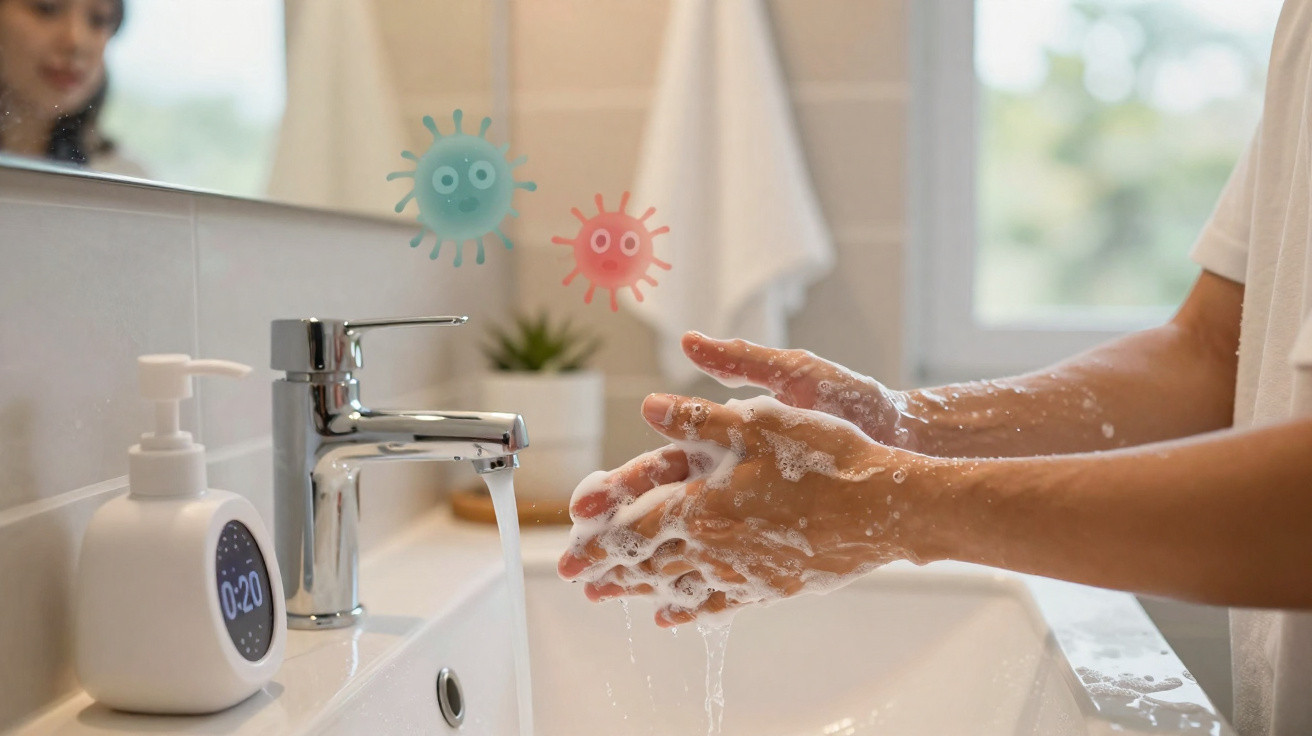
There is a small, slightly awkward scene played out in almost every public loo in Britain.
You approach the basin, turn the tap on with your elbow because you are being “hygienic”, run your hands under the water, perhaps use a blob of soap if you are feeling virtuous, rub briefly, rinse, shake and leave. Twenty people may have done precisely that before you. Everyone heads out believing the job is finished: hands clean, halo polished.
The trouble is, your hands are unlikely to be clean in the way you assume. Most of us have created a routine based on speed rather than results. We spend five seconds and move on because there is a queue, we are running late, or we simply cannot be bothered. The frustrating part is that the gap between a “quick rinse” and genuinely protecting yourself from the germ soup on your skin is almost ridiculously short. It is roughly 20 seconds. What matters is how you use those 20 seconds, and that is where things become rather uncomfortable.
The Story We Tell Ourselves at the Sink
We all imagine an ideal version of ourselves. That person eats properly, gets eight hours’ sleep and always washes their hands correctly. Then there is the real person at a motorway service station sink, doing a three-second rinse and describing it as hygiene. Honestly, nobody gets this right every day, every time.
Because the consequences are not instantly visible, we persuade ourselves they are not there. You cannot feel a germ entering your body. You do not hear bacteria celebrating when you miss the soap. Instead, you dry your hands on your jeans, pick up your phone and carry on. That silent space between what you do and what happens afterwards is where our confidence sits – and it is misplaced.
There is also a peculiarly British politeness around communal sinks. You look sideways, see how long the person beside you is washing, and automatically avoid seeming as though you are trying too hard. Nobody wants to be the odd one still scrubbing while the other person’s hand dryer has finished. As a result, our hygiene habits are dictated by embarrassment and routine rather than science.
Why “A Quick Rinse” Does Little for Germs
Here is the mildly unpleasant reality: your hands do a lot. Every door handle, card machine, lift button, phone screen and train handrail you have touched today has left something on them. Bacteria, viruses, skin cells and fragments of other people’s lives. Most pose no danger, but some do. They will not simply drop away because you held your hands under lukewarm water for five seconds.
On its own, water is remarkably poor at cleaning. It may shift a little surface debris, but more persistent germs stick to oils and the tiny folds in your skin. This is where soap matters. Soap molecules work like miniature double agents: one end bonds with grease and dirt, while the other is attracted to water. Given enough scrubbing time, they encase grime and germs, lift them away from your skin and allow the running water to carry them off.
Rush the process and the soap never has the chance to work. It is like paying for a complete wash cycle, then stopping it straight after the pre-rinse. Infection-control studies repeatedly find the same thing: washing for about 5 to 10 seconds makes barely any difference to germ levels. Washing with soap for around 20 seconds can remove up to 99.9% of the nasties on your hands. That “point nine nine” may sound dull on a label, but it helps explain why fewer children fall ill in winter, fewer stomach bugs circulate through offices and fewer vulnerable people are admitted to hospital.
The Unpleasant Truth: You Are Likely Missing the Worst Areas
Ask people whether they wash their hands properly and most will say yes immediately. Watch closely – not creepily, just in passing – and you will see a familiar routine: palms, a swift rub, fingers together, rinse. It resembles handwashing, but misses the key places where germs tend to linger.
Consider how you use your hands all day. You pinch, tap, scroll and twist. Your fingertips, thumbs and the backs of your hands therefore take the greatest contact, rather than your palms alone. Yet when washing, we concentrate on the easiest and flattest areas, hoping everything else will take care of itself. It will not. Germs thrive in warm, faintly sticky skin creases: around the thumbs, in the folds beside the nails and between fingers, where water will not properly reach unless you make it.
The “Hurry Up” Wash and the Proper Version
We have all had the experience of finishing in a café toilet and noticing someone waiting outside. You feel observed before the door has even opened. So you give your hands the quickest socially acceptable version of being clean, then leave. That is the “hurry up” wash: a rapid splash, half a rub and perhaps a symbolic swirl of soap.
By comparison, a proper 20-second wash that actually removes germs can seem almost theatrical. There is rubbing, twisting, interlacing of fingers and scrubbing of thumbs. It can feel overdone, even faintly silly, because you cannot see the germs disappearing. Under a microscope, though, the contrast is striking. It is the difference between “probably fine” and “safely clean”.
The 20-Second Handwashing Method That Works
Let us remove the faff. No laboratory coat or sermon, only a straightforward routine your brain can recall when you are tired and irritable. The important figure is 20 seconds of actively scrubbing with soap. That does not mean 20 seconds standing by the basin. It means 20 seconds of friction, which is what loosens germs so they cannot hold on.
A Straightforward Routine for Real Life
This is broadly how those 20 seconds should go:
First, wet your hands thoroughly. Add enough soap to create a proper lather, rather than a miserable smear. Spend a few seconds rubbing your palms together until they feel slippery and foamy, rather than merely wet.
Then interlace your fingers and scrub in both directions, so that soap reaches the narrow channels between each finger. Next, place the backs of your fingers into the opposite palm and rub them – that awkward action you may have seen on hospital posters but never actually used. Then grip your opposite thumb with one hand and twist it as though gently wringing it out, before changing sides.
Remember your fingertips: push them into the opposite palm and make small circular scrubbing movements, as if removing ink. Your nails are tiny shelves for dirt, so give them some attention. Quickly rub your wrists too – germs do not politely stop at the bottom of your hands. Rinse under clean, running water and let the soap take the germs down the drain. That is the genuine 20 seconds, separating “feels clean” from “actually clean”.
“20 Seconds” Need Not Feel Endless
Counting “one Mississippi, two Mississippi” at a sink can make you feel as though you are in detention rather than living your life. Nobody enjoys that. People cut corners not necessarily because they are careless, but because the process seems boring and slow. The answer is to link the habit to something that feels neither clinical nor forced.
Some parents encourage children to hum “Happy Birthday” twice. It does the job, but an adult singing alone in a packed office loo may feel like social suicide. You do not require a nursery rhyme; you simply need a rough sense of how long 20 seconds lasts. Use the chorus of a song lodged in your head, read the soap label once, or look at your reflection, take one unhurried breath and carry on.
A small change in perspective can help. Rather than treating those 20 seconds as wasted time, think of them as a brief pause. For one moment, nobody can email you, message you or demand anything from you. It is just you, water and soap, switching off for a tiny part of the day. It may sound a little daft, but turning it into a small ritual rather than a task makes you far more likely to stick with it.
The Invisible Chain Between Your Hands and Everyone You Love
The slightly harsh truth is that your hands affect more than just you. They affect everyone you touch, every surface you use together and every sandwich you prepare. One careless wash after using the loo can turn into your child’s stomach bug, your partner taking a week off work or your gran developing a chest infection. Suddenly, that “can’t be bothered” moment looks rather different.
Germs travel through quiet, everyday actions. You scratch your nose, tap your phone, take a biscuit, touch the kettle and pass it on to another person. The path cannot be seen, but it is real. Think of that colleague who arrives coughing throughout winter, sniffs, touches everything and is followed by everyone else becoming ill in apparent slow motion. Much of that spread comes through the air, but shared surfaces play a major part too. Shared hands. Shared shortcuts.
A 20-second wash is, in effect, your way of breaking that chain. It stops a whole sequence of “might-have-happened” infections before it begins. Nobody applauds you and no one says thank you. Yet your family, colleagues and the stranger beside you on the train all benefit quietly, without knowing why.
A Truthful Moment: Nobody Gets It Right Every Time
Here is what hygiene campaigns seldom acknowledge: you will not complete the full, perfect 20-second routine every time you use a tap. Sometimes you will be racing for a train. Sometimes the soap dispenser will be empty. Sometimes it will simply slip your mind. Beating yourself up over it helps nobody.
What matters is your average rather than perfection. Moving from a “quick splash most days” to a proper 20-second wash most of the time has a substantial effect. There are fewer colds that drag on, fewer “dodgy tummy” days and fewer children lying grey-faced on the sofa, watching cartoons while holding a bowl.
You don’t need to become a germ-obsessed robot; you just need to stop kidding yourself that what you’re already doing is enough. That is the difficult part. For years, we have told ourselves a five-second rinse qualifies as hygiene. It does not. Changing that belief does not need a personality transplant, only a little honesty and 20 calm seconds.
From an Awkward Habit to a Quiet Superpower
There is something unexpectedly empowering in realising that such a small, mundane action can make a significant difference. You will not fix the NHS, and you cannot make every circulating virus disappear. You can, however, stand at a sink, feel warm water on your skin, build a proper lather and know that you are disarming 99.9% of the germs that had come along for the journey.
The next time you stand at a public sink and feel that old urge – the fast rinse, the “no one’s watching, I’ll be fine” shrug – stop briefly. Think about the lift buttons, shared keyboards and little clouds of sneeze spray that may be on your hands from the day. Then allow yourself those 20 seconds. Not because you must be perfect, but because it is responsible.
That is all the 20-second method amounts to: a small act of care, repeated quietly again and again, when there is no applause and nobody is watching. It is an ordinary habit that safeguards the people you love far more than it protects your image. Once you understand what handwashing really means, returning to the three-second lie becomes very difficult.














Comments
No comments yet. Be the first to comment!
Leave a Comment