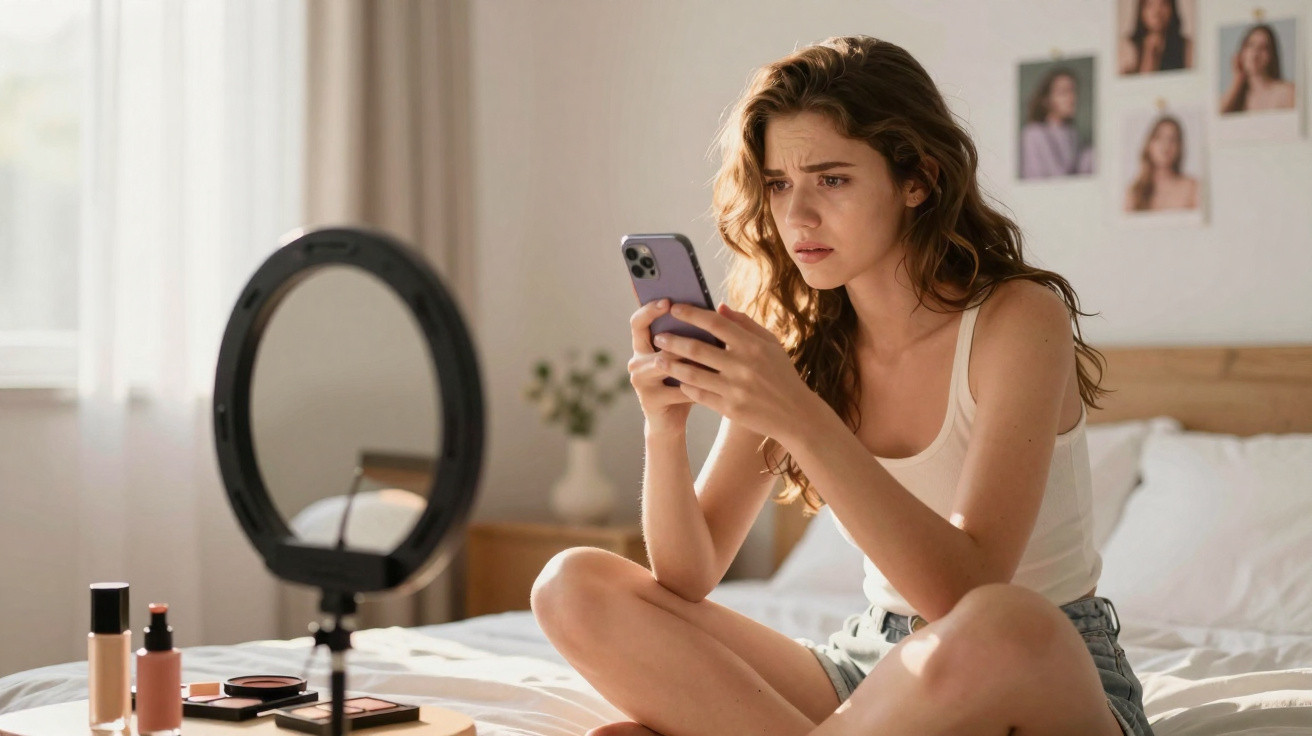
Almost half of young Australians are unhappy with their physical appearance.
For young people, social media has intensified body-image concerns, encouraging comparisons with others and pursuit of beauty ideals that are frequently unrealistic – and damaging to health.
TikTok, a platform for making and viewing short-form videos, now has more than 1 billion users. Content that can cause harm, including clips that romanticise disordered eating and very thin bodies, spreads easily across the app.
As TikTok’s audience is largely young, we examined the impact this material can have on young women’s body image. Our latest research found that viewing only eight minutes of TikTok videos about dieting, losing weight and exercise immediately reduced body-image satisfaction.
Body image and beauty standards
We enrolled 273 TikTok users who identified as female and were aged between 18 and 28, then randomly assigned them to one of two groups. Anyone with a current or previous diagnosis of an eating disorder was not included.
Those in the experimental group watched a 7–8 minute compilation of "pro-anorexia" and "fitspiration" material sourced directly from TikTok. The clips showed young women limiting their food intake, as well as offering exercise guidance and diet advice, including accounts of juice cleanses intended for weight loss.
The control group viewed a 7–8 minute compilation of TikTok videos with "neutral" subjects, including nature, cooking and animals.
We used several questionnaires to assess body-image satisfaction and views on beauty standards both before and after the participants viewed the TikTok material.
Body-image satisfaction fell after watching the videos in both groups. However, the reduction was largest among participants shown pro-anorexia content. They also showed greater internalisation of beauty standards.
Internalisation refers to accepting external beauty ideals and identifying with them. Seeing harmful content on social media does not inevitably cause harm – body image is more likely to be affected when the material is internalised.
Before the video experiment, participants answered broader questions about how they used TikTok. We also assessed their preoccupation with "healthy" eating and signs of disordered eating.
Participants who spent more than two hours daily on TikTok reported more disordered eating behaviours than those who used it less often. However, the difference was not statistically significant. In other words, it did not reach the level needed to establish that it was unlikely to have occurred by chance.
On a scale that assesses eating-disorder symptoms, participants reporting high (2–3 hours a day) or extreme (more than 3 hours a day) TikTok use recorded average scores just below the threshold for clinically significant eating-disorder symptoms.
This indicates that exposure to TikTok content for over two hours daily may be associated with disordered eating, although more research is required to investigate the link.
Harmful TikTok content is widespread
The material shown to the experimental group circulates widely on TikTok, rather than appearing solely in "pro-ana" communities. Trends around "clean" eating, detoxes and diets with limited ingredients can disguise disordered eating, enabling diet culture to be repackaged as "wellness" and "self-care".
Alongside fitspiration, this material can reward and turn excessive exercise and disordered eating into a game.
Wellness influencers on social media also have a significant role in making disordered eating and fitspiration content seem normal.
However, hashtags such as #GymTok and #FoodTok enable all TikTok users to make and consume posts about their own and other people’s everyday eating habits, weight-loss transformations and exercise routines.
In addition, ordinary users can share dangerous diet-related videos without attracting the criticism that a celebrity or prominent influencer might face for posting socially irresponsible material.
Our research considered only the short-term effects of seeing this kind of TikTok content. Longitudinal studies are required to determine whether the negative effects we found continue over time.
It is still difficult to censor TikTok content
TikTok users have little control over what they see. Since much of their time is spent on an algorithm-driven, personalised "For You" page, they can encounter disordered-eating content without searching for it or following accounts that post it.
In our study, 64% of participants said they had encountered disordered-eating material on their For You page. This could include videos depicting binge eating, the use of laxatives or excessive exercise.
Ironically, looking for body-positivity content can leave users at risk of encountering disordered-eating material.
The most important action TikTok users can take is recognising that searching for or following any content about food, bodies or exercise can result in unintended exposure to distorted body ideals. Spending less time on TikTok will reduce that exposure, although our results show that even fewer than ten minutes can have a negative impact.
Ultimately, young people’s online safety relies on suitable regulation of social media. Without it, teaching young women how to avoid social-media harm is a little like handing them an inflatable life jacket before expecting them to swim indefinitely against a rip.
If you need support, consider contacting the Butterfly Foundation Helpline (1800 33 4673) or chat with them online. For emergency crisis support, call Lifeline on 13 11 14.
Madison Blackburn co-authored the research this article is based on.
Rachel Hogg, Senior Lecturer in Psychology, Charles Sturt University
This article is republished from The Conversation under a Creative Commons licence. Read the original article.







Comments
No comments yet. Be the first to comment!
Leave a Comment