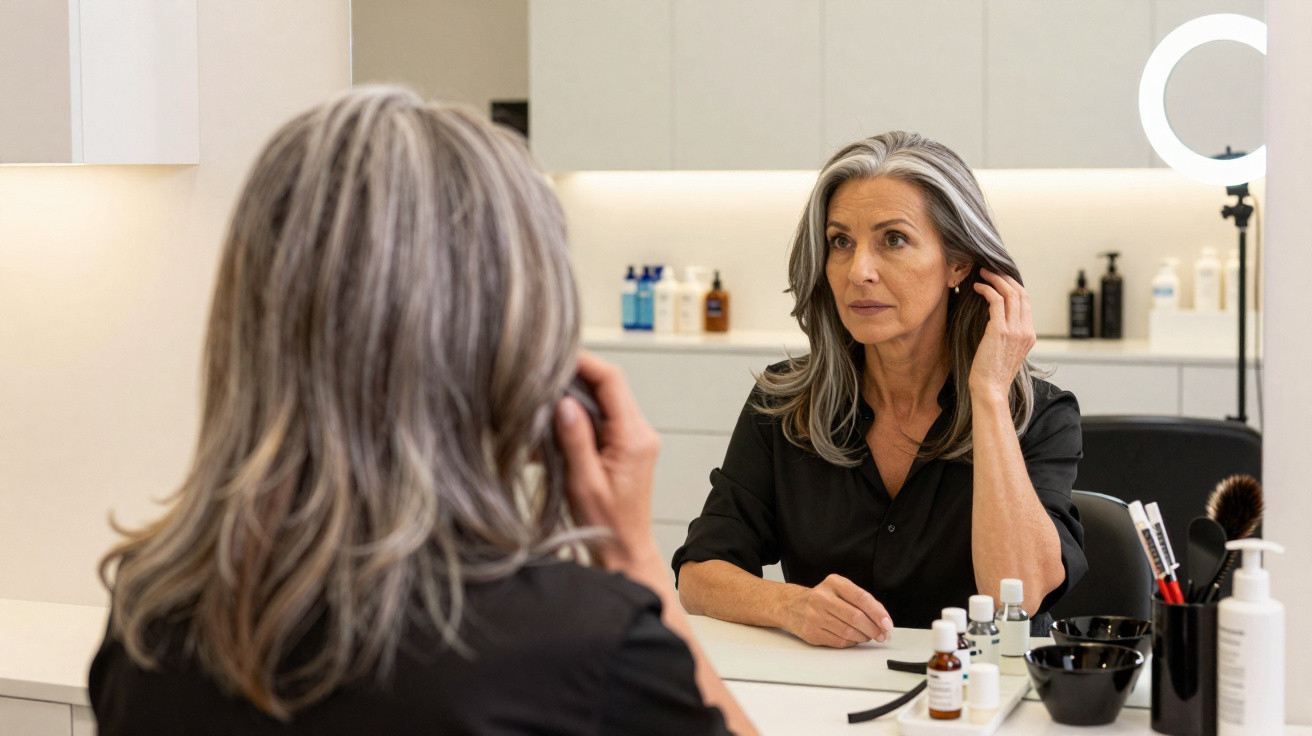
Saturday morning: gentle light fills the bathroom, and Claire, 48, stands before the mirror wearing an expression women immediately understand: “Something has to change.”
Her hair falls just past her shoulders, the ends look worn, and she is already scrolling through Instagram. A short bob. A sleek lob. A heavy fringe. Each image appears polished, youthful and “fresh”. Within ten minutes, she is in a salon: inspired, a little apprehensive and certain that a blunt cut will somehow reset it all - work fatigue, hormonal haze and the unspoken worry of becoming unseen.
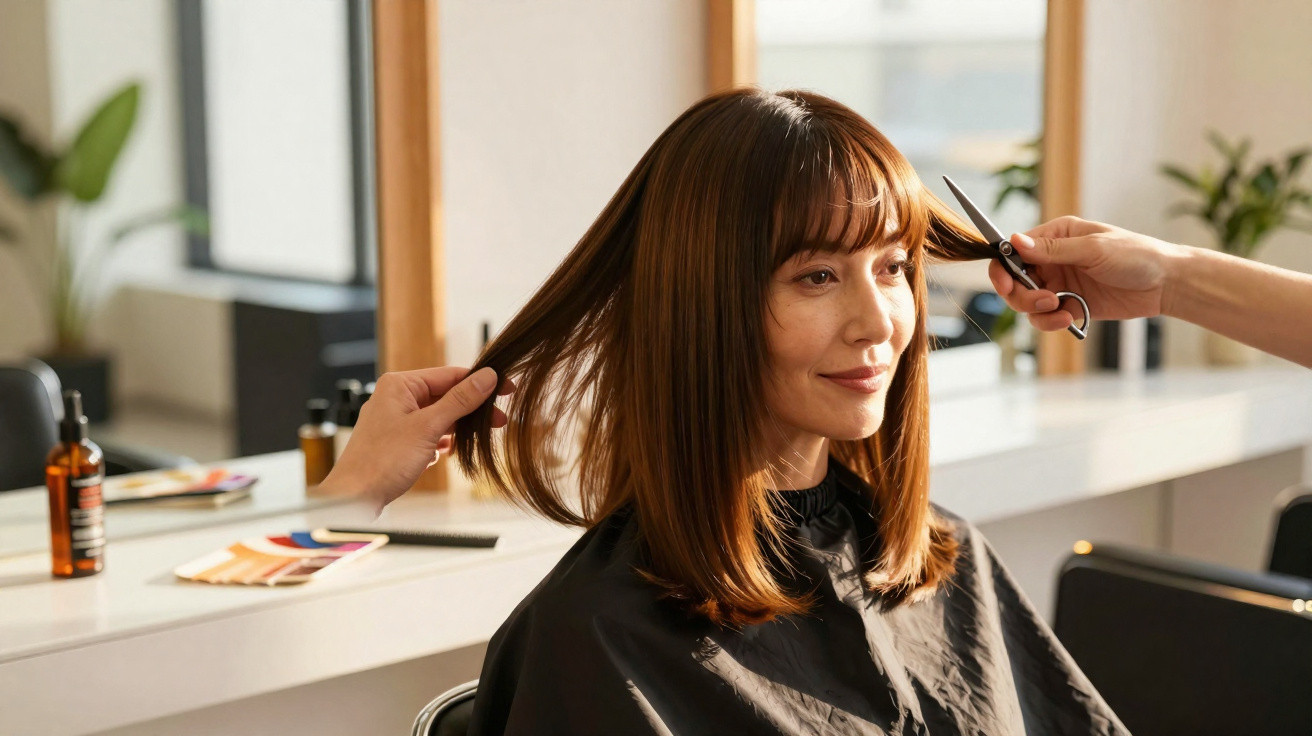
The scissors close, the stylist turns the chair, and there it is: a crisp, graphic line that feels somehow more severe than she imagined.
Her face appears different. Not unattractive. Just… tougher.
She gives the mirror a polite nod and smile, while privately asking herself: “Did I just age myself with the cut that was supposed to ‘rejuvenate’ me?”
When a “sharp” haircut becomes too sharp
Step into a fashionable salon and you will find mood boards filled with blunt cuts: precise bobs, weighty one-length lobs and pin-straight ends. On a 24-year-old with baby-angel skin, the effect can look naturally cool. On a woman in her late 40s, however, that identical outline starts meeting a different reality: a softer jawline, evolving cheekbones and the subtle loosening that comes with a life fully lived.
Hair never exists in a vacuum. It frames everything your face communicates quietly, particularly when your resting expression has altered over time.
An overly blunt perimeter can cut across that frame like a ruler dragged through a watercolour.
Any seasoned hairdresser will tell you that hair changes at 45, 48 and 52. Hormonal shifts affect its texture. Individual strands may become finer, the scalp can show more readily, and volume seems to travel from the crown to the ends in all the least helpful ways. Add a strict, straight base line to that picture and the result can be unforgiving.
It creates a visual “weight line” at the jaw or shoulders, directing attention towards features many women suddenly notice more: jowls, the neck and marionette lines.
Most of us know that moment when a side-on photograph appears and the thought arrives: “Why do I look so… rigid?”
The reasoning seems straightforward. Blunt cuts look neat, and neat lines are meant to read as youthful, aren’t they? Yet a face in its late 40s is no longer a blank canvas. It carries movement, experience and tiny asymmetries. Rather than softening these qualities, a perfectly straight cut can highlight them.
What complements teenage bone structure can feel almost confrontational on a perimenopausal face.
This is the point at which nuance matters more than trend. A trace of softness, an almost invisible graduation or a little gentle movement can often create a more “youthful” effect than the most exact blunt line.
At this stage of life, severe geometry can end up competing with your features rather than enhancing them.
Softer alternatives to blunt cuts when you want a big change
If your 47th or 49th birthday is approaching and you are desperate for a change, begin your salon appointment with one simple approach: explain how you feel, rather than only stating what you want. Say, “I feel heavy here,” as you gesture towards your jawline. Or: “I feel flat on top.” Or: “I feel like my hair is dragging my face down.”
Then request a haircut that “softens and lifts”, rather than a blunt chop.
In practice, this often means a base line with a slight irregularity, delicately textured ends or layers that cannot be seen but still do their work. Nothing jagged. Nothing resembling a “wolf cut”. Instead, it is a skilful redistribution of weight, allowing the hair to support the face rather than draw around it with a marker pen.
Many women in their late 40s gravitate towards a blunt bob because they are simply tired of their hair. After years of long layers, messy buns, children tugging at ponytails, a short razor-straight style can feel like a cleansing ritual. The problem is moving from “too much” straight to “too harsh” in a single salon visit.
Of course, hair grows back, but the awkward stage - when a blunt bob begins brushing the shoulders and flicking out unpredictably - can continue for months.
And honestly, hardly anyone styles their hair perfectly every day. A cut that only looks good after a campaign-shoot-quality blow-dry is a trap rather than a liberation.
“After 45, I almost never cut straight across anymore,” admits Sophie, a Paris-trained stylist now working in London. “I ‘fake’ blunt cuts with tiny inner layers and softened corners, especially around the jaw and nape. The client still feels like she has a strong shape, but the line moves with her face instead of fighting it.”
Request “soft blunt” or “diffused edges”
This signals that you want definition without a helmet-like result.Leave the front a little longer than the back
This subtle angle can visually lift the neck and narrow the jaw area.Prioritise the crown instead of the ends
A touch of height at the top pulls attention away from the lower face.Experiment with texture, not only length
Gentle waves or a slight bend through the ends immediately reduce the severity of a straight line.Assess the cut while seated and facing the salon window
Daylight combined with your usual posture will show whether the line looks too harsh.
Rethinking hair in your late 40s
At around 47, hair can stop being merely “hair” and begin carrying a quiet question: how visible do I still feel? A blunt cut may seem like a direct, powerful reply. On certain faces, it genuinely is. On many others, it raises its voice when a calm, self-assured tone would do more.
Reconsidering blunt cuts at this age does not mean abandoning style. It means working with the new realities of your features, texture and energy.
The most flattering hair in your late 40s is seldom the style with the most defined line. It is usually the one that seems to shift with your expression instead of trapping your face in one fixed mood.
Perhaps what you truly want is not a strict bob, but a mid-length “soft square” with airy ends. It may be a collarbone cut with soft face-framing pieces that skim your jaw rather than slice across it. Or it could simply be improved layering in your present length, alongside a fringe that works like a natural Instagram filter.
Trends are loud, but your mirror is honest.
Before committing to the next viral blunt cut, ask yourself: does this shape love the woman I am right now, or is it quietly attempting to turn me into someone I no longer need to be?
The best cuts after 45 rarely shout. Instead, they resonate softly each day, when you see your reflection and think, “Yes. That looks like me.”
| Key point | Detail | Value for the reader |
|---|---|---|
| Blunt lines can harden features | Straight edges draw attention to the jaw, neck and facial asymmetries | Helps you avoid styles that can unintentionally age the face or make it appear heavier |
| Soft structure beats strict geometry | Invisible layers, diffused ends and subtle angles around the face | Provides a modern look without losing softness or movement |
| Consultation matters more than the trend | Explaining feelings such as heavy, flat or dragged down leads to better choices | Helps you work with your stylist to create a cut suited to your real features and lifestyle |
















Comments
No comments yet. Be the first to comment!
Leave a Comment