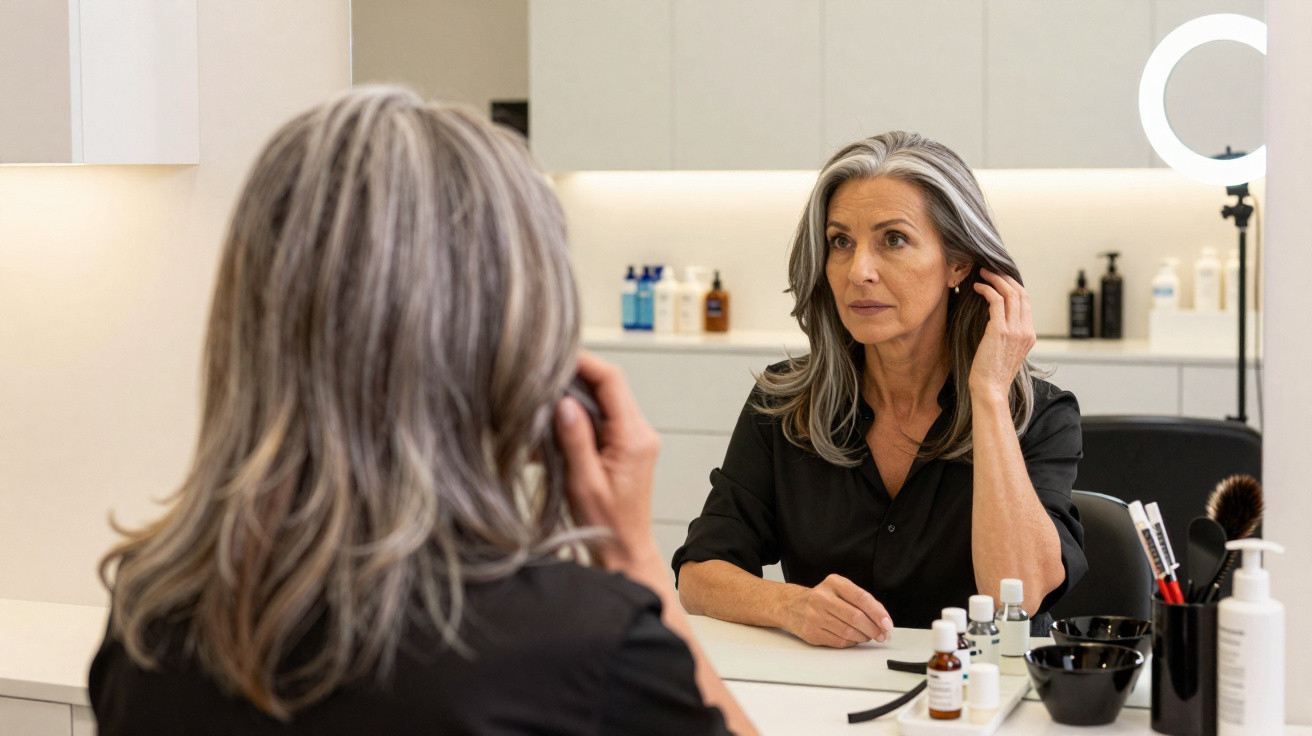
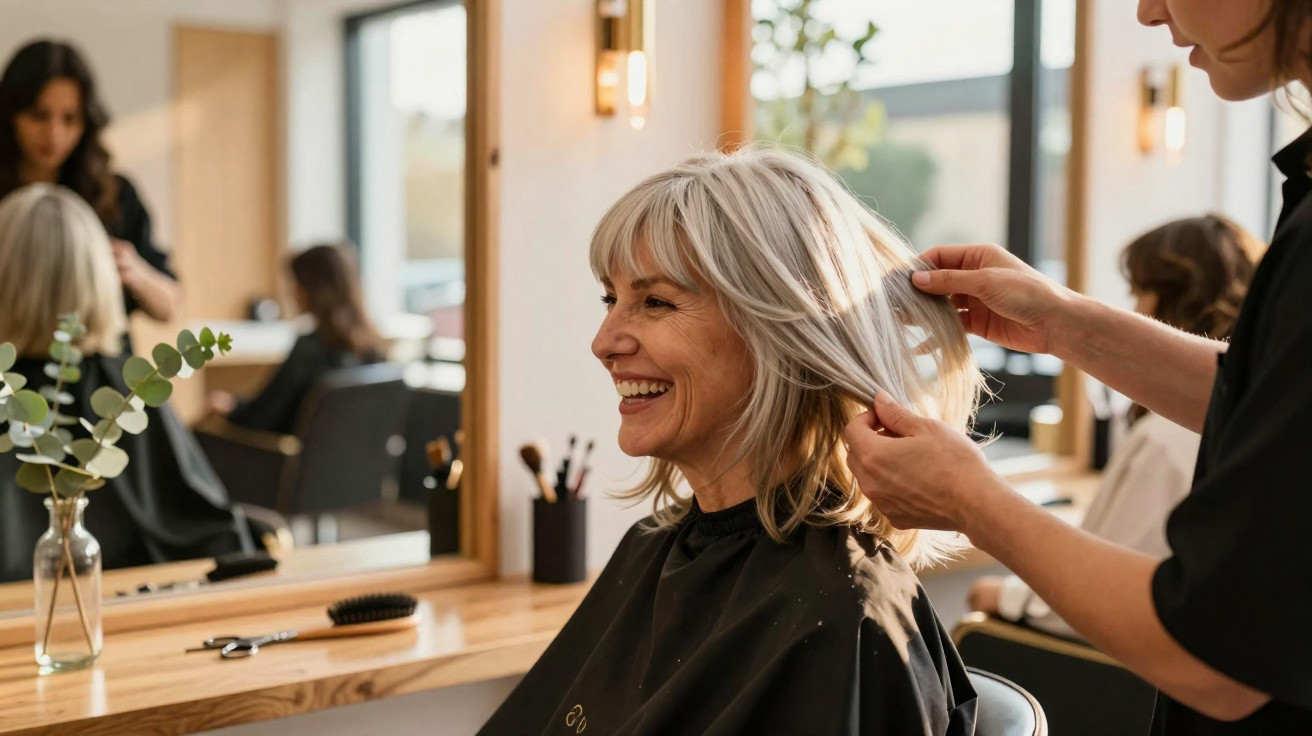
At the rear of a crowded Paris salon, a woman in her late fifties studies her image in the mirror. Her hair is largely silver, having grown out during lockdown, with a slightly unruly look at her temples. She looks…good. Healthier than the filtered image of herself on her phone.
Then the stylist begins to propose “solutions”: anti-grey pigments, scalp boosters and a “youth protocol” said to take ten years off. The consultation begins to resemble a medical assessment rather than a haircut. Gradually, the smile disappears from her reflection.
The same encounter is playing out in cities and small towns alike. Balayage menus are giving way to “anti-aging hair plans”, while price lists are replaced with diagnostic charts.
Something subtle is changing beneath the neon lighting of our salons.
From soft balayage to full-blown “anti-grey protocols”
Spend time scrolling Instagram and it becomes clear: beside the new “anti-grey revolution”, balayage now seems almost traditional. Instead of sun-kissed ends and naturally blended dimension, posts promote “hair rejuvenation journeys” and “grey suppression programs”.
The language is different, and so is the proposition. Stylists are no longer simply offering colour; they are offering the idea that time can be turned back.
In many contemporary salons, shelves are filled with laboratory-style bottles, scalp analysers and even ring lights for before-and-after images. You are not merely having your roots coloured. You are being “treated”.
London colourist Ana* says her salon now promotes a three-stage “Youth Hair Protocol”: a scalp scan using a tablet camera, followed by a pigment infusion “targeting grey at the root”, then a serum to take home that claims to “delay new white growth”. The package costs more than a flight to Barcelona.
Her regular clients, women who previously booked an easy balayage twice a year, now feel pushed towards six-month “anti-grey plans”. “They book it like orthodontics,” Ana laughs, though her expression does not really share the joke.
What was once a relaxing afternoon of self-care has, almost unnoticed, become a subscription to permanent upkeep.
This change has not emerged from nowhere. Brands have discovered that anxiety about ageing is more lucrative than any attractive shade chart, so they package grey coverage in clinical terminology: “melanin boosters”, “follicle youth”, “anti-oxidative scalp therapy”.
The more scientific the wording appears, the easier it is to feel that opting out is somehow irresponsible. Who wants to “neglect” their follicles? Who wants to sit in the waiting area as the only woman with visible white hair while everyone else has signed up to a rejuvenation plan?
With rising overheads and online discount platforms putting pressure on them, salons are embracing this medicalised approach because it generates more profit than a straightforward annual balayage.
When your salon starts feeling like a clinic
To avoid being drawn into the anti-grey conveyor belt, adopt one simple consultation habit: establish the terms before the salon does. Once seated, say calmly, “I’m not looking to erase my grey, I want to work with it” or “I want low-maintenance color that respects my natural tones”.
Those two minutes can transform the entire appointment. Instead of operating in “rescue mission” mode, the stylist can move into a more creative approach.
Request photographs of clients who have blended or welcomed their silver, rather than only examples of people who have concealed every strand. You will soon recognise which professionals value ageing… and which only want to battle it.
Many people arrive at the salon feeling slightly exhausted and vulnerable, already partly persuaded that their grey hair needs fixing. This is when guilt takes hold. You are offered an “anti-age scalp cure” and wonder, “If I refuse, am I letting myself go?”
At that point, you need allies rather than sales representatives. A skilled colourist will ask about your lifestyle, how frequently you can realistically return and what helps you feel most like yourself. A forceful one will immediately steer the discussion towards packages and add-ons.
Let us be realistic: hardly anyone completes a seven-step hair protocol every day. If the regime sounds like marathon preparation, it is not a beauty routine; it is a commercial strategy.
“Some clients whisper, ‘I actually like my grey, but I feel judged if I don’t cover it,’” says Elise, a French hairdresser who quietly specializes in silver transitions. “They’re scared of looking ‘tired’ next to colleagues doing filler and Botox. We’re turning natural hair into a diagnosis.”
- Ask for a “grey blend”, not “grey coverage”
Choose language that makes clear you see silver not as a flaw, but as a colour to incorporate. - Test one service at a time
Decline “protocols” at your first appointment. Start with a cut or gloss, and make a considered decision afterwards. - Set a budget ceiling before they start
State your spending limit aloud. It makes it easier to resist pressure when extras are proposed. - Watch how they speak about older clients
If they ridicule people for “letting hair go white”, take that as your signal: you are sitting in the wrong chair. - Bring reference photos that look like your age
Skip the 23-year-old influencer with extensions. Reality is the most useful filter.
Between liberation and new pressure: what do we really want?
There is an odd contradiction across our feeds today. On one side are glowing influencers proudly displaying silver streaks under #grombre and #agepositive. On the other are viral clips of women “removing ten years in three hours” with anti-grey makeovers that resemble medical transformations.
We are told that we have freedom of choice, yet the social approval still tends to favour the person who appears less “old”. That is the unspoken emotional cost of this new era.
Perhaps the real revolution is not anti-grey, but anti-shame. Someone should be free to colour their hair every three weeks without being called “vain”. Equally, someone else should be able to stop completely without being labelled as “neglecting themselves”.
| Key point | Detail | Value for the reader |
|---|---|---|
| Recognise the clinic atmosphere | Talk of “protocols”, diagnostics and “youth plans” in place of straightforward services | Helps you identify when fear of ageing, rather than hair care alone, is being sold to you |
| Take back the consultation | Explain your wishes around grey from the outset and ask about blending options | Gives you greater control during the appointment and limits pressure and upselling |
| Choose your own “aging story” | Colour, blend or go silver without attaching moral judgement to any choice | Encourages a calmer relationship with your reflection and your age |











Comments
No comments yet. Be the first to comment!
Leave a Comment