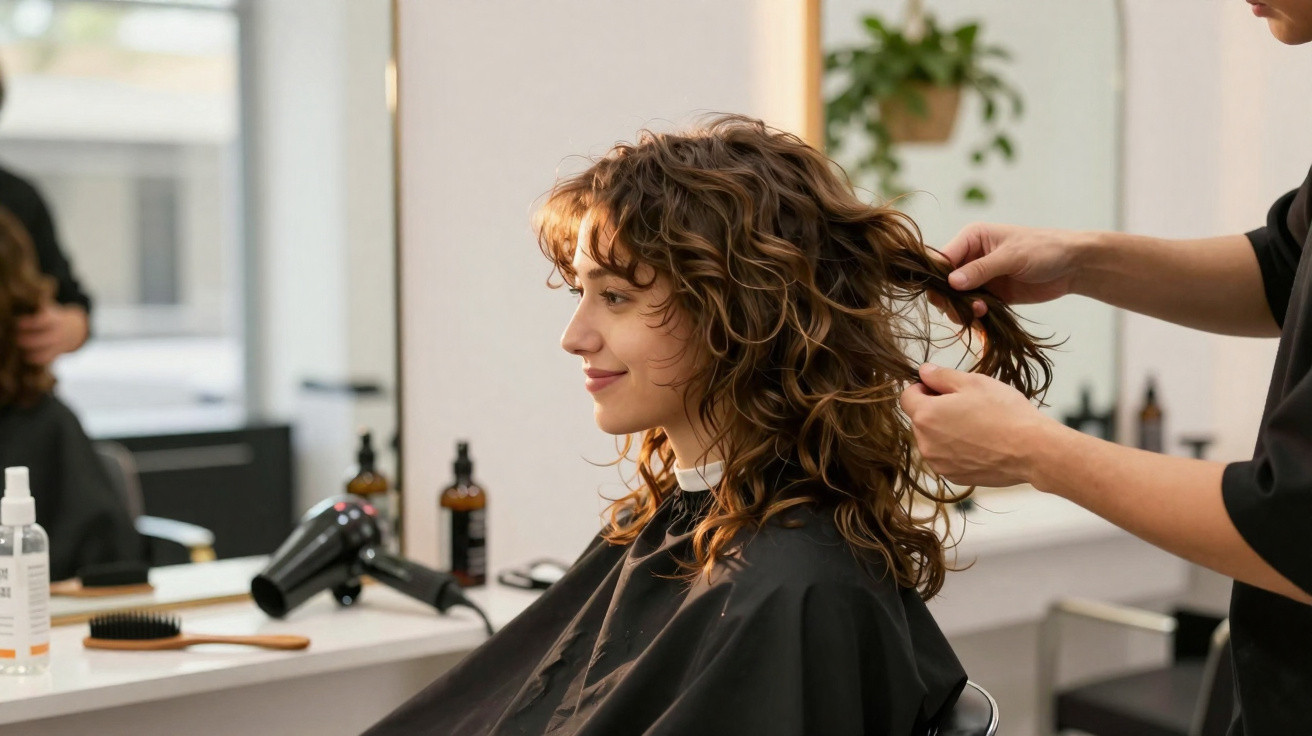
The woman in the salon chair seemed to have three separate hairstyles competing on one head. Her roots were pin-straight and flat; her mid-lengths were puffy and frizzy from previous colouring; and her ends had developed unpredictable corkscrew curls after a summer of sunshine and sea water. Looking at the mirror, she made a remark that was part joke, part desperate question: “Is this… fixable?”
The stylist did not hesitate. Smiling, she lifted the hair section by section and replied: “We’re going for a shag.”
The woman paused, then laughed.
Twenty-five minutes later, those “three hairstyles” had become one deliberately cool haircut.
The solution was not to conceal the mismatched texture.
It was to make it useful.
The shag haircut: when your “messy” texture takes centre stage
The modern shag is the haircut people often assume they cannot carry off-until they spot it on somebody who, moments before, clearly “wasn’t a hair person”. It relies on soft layers, natural movement and piece-y sections that appear to sit just right without much effort.
Its appeal for uneven hair is straightforward: a shag works with texture rather than battling it. Straight roots, waves through the sides and ringlets appearing at the back can become volume and personality instead of disorder.
There is a reason many hairdressers discreetly recommend it when clients admit, “My hair is just… weird.”
Imagine waking up to one side flipping outwards, the other turning inwards, plus a stubbornly flat area at the crown that will not lift. On Instagram, that might read as “bedhead chic”. In the bathroom mirror, it is… not that.
Emma, a client I spoke to, had precisely this issue. Years of straightening had left her lengths damaged and bent, while her regrowth was smooth but limp. Her stylist created a mid-length shag with long curtain bangs, taking away heavy, bulky sections and introducing shorter face-framing layers.
The following day, Emma sent a photograph. There was no blow-dry and no curling iron-only air-dried hair. Her previously “uneven” texture now resembled expensive, cool-girl waves. It was the same hair, with different architecture.
That is the understated brilliance of a shag: it redistributes the hair’s weight. Rather than allowing all the hair to pull downwards at the ends, the cut shapes discreet steps throughout. This lets each texture settle where it is most flattering. Tighter waves can sit around the cheekbones, softer sections can frame the jaw, and straighter pieces can maintain a sleek top layer.
From afar, people do not see “patchy” or “uneven”. They see softness, movement and volume. The inconsistency that annoyed you yesterday suddenly reads as intentional today.
It is not magic; it is simply a haircut that finally cooperates with what your hair naturally wants to do.
How to ask for a shag that suits your real-life hair
Take screenshots to the salon, but take honesty too. Explain what your hair does when it is left to dry fully on its own. For a shag, details such as “I swear it’s curlier when it’s humid” are genuinely important.
For uneven texture, the most successful version usually involves soft, graduated layers instead of dramatic chunks. Ask for long pieces around the face that frame it and can be styled as curtain bangs. At the back, aim for a light shape with lift-not a mullet imitation.
Ask your stylist to lightly cut into the ends, helping them look airy rather than blunt. This is what creates movement and allows different textures to merge visually.
The usual shag mistake is becoming too dramatic too quickly. Dense, short layers across the entire head can look brilliant on thick, consistently curly hair. On fine or uneven hair, however, the same technique may result in straggly ends and too little density where it is needed.
Begin more gently. A “shag-lite” that reaches the collarbones or falls just below the shoulders gives you a chance to see how your natural texture responds to added layers. At the next appointment, you can always shorten it or introduce more texture.
Be candid about how much styling you are willing to do as well. Honestly, nobody does this every day. If you do not own a round brush and never intend to, say so. Your stylist can tailor the shape to work with a quick rough dry and a little cream, rather than requiring a full blow-dry.
One stylist I interviewed expressed it in a sentence that stayed with me:
“Uneven texture isn’t a problem,” she said. “It’s just hair that hasn’t found the right shape yet.”
Finding that shape is simpler when a shag is treated as an easy routine rather than a major project. A handful of small habits can help:
- Pick one reliable product for “lazy days”, such as a lightweight curl cream or salt spray.
- Let it air-dry where possible, then adjust only the front sections with a brush or iron.
- Book small, regular trims rather than a drastic cut once a year.
- Use a satin pillowcase to minimise frizz and odd dents from sleeping.
- On days when you think “I hate my hair”, clip up the upper layers and allow the shag’s angles to stand out.
Living with a shag: when “good enough” hair becomes a style
There is a particular relief in no longer trying to “fix” your hair and instead giving it a structure. A shag does not promise perfection. It offers something more achievable: a shape that still feels like you on hurried Mondays, gym days and evenings when you partly dry your hair using the car heater vents.
The haircut also grows out in an interesting way. At six weeks, it becomes looser and softer. At three months, it may look like a long layered cut with a little rock-and-roll edge. Throughout every stage, uneven texture helps prevent the hair from appearing flat or overly styled.
We all know that moment of looking at our reflection and thinking, “If my hair would just behave, everything else would be easier.” Of course, a shag will not solve your life. It can, though, quietly remove one daily struggle from the list.
There is also something undeniably encouraging about leaving the house knowing that your hair does not need every strand to match in order to look as though it belongs on your head.
| Key point | Detail | Value for the reader |
|---|---|---|
| Shag suits uneven texture | A layered structure converts mixed textures into soft, intentional movement | Turns “problem” hair into a style asset |
| Start with a soft version | Request gentle layers and face-framing pieces rather than extreme choppy sections | Lowers the chance of regret and retains options as it grows out |
| Low-effort styling works | Air-drying, one key product and light adjustment at the front are often sufficient | Makes the cut practical for everyday life, not only salon days |
FAQ:
Question 1: Will a shag haircut work if my hair is straight at the top and wavy at the bottom?
Yes. That combination is actually ideal for a modern shag. Straighter roots keep the top smooth, while waves through the lengths add volume and texture when layers are introduced.Question 2: Is a shag a high-maintenance haircut?
On a daily basis, it can require very little effort. A small amount of product and a rough dry are often enough. The main upkeep is having soft trims every 8–12 weeks to preserve the shape.Question 3: Can fine hair handle a shag cut?
Yes, provided the layers are soft and not cut too short. Ask for minimal bulk removal and longer layers, so the hair retains density while gaining movement.Question 4: What face shapes look best with a shag?
Most face shapes can wear one because the cut is highly customisable. Round faces benefit from crown volume, while longer faces suit fuller layers at cheek level and curtain bangs.Question 5: Do I need bangs for a shag to look good?
No, although some form of face-framing is helpful. You might choose full bangs, soft wispy bangs or long curtain pieces that can be pushed back on days when you prefer a cleaner look.













Comments
No comments yet. Be the first to comment!
Leave a Comment