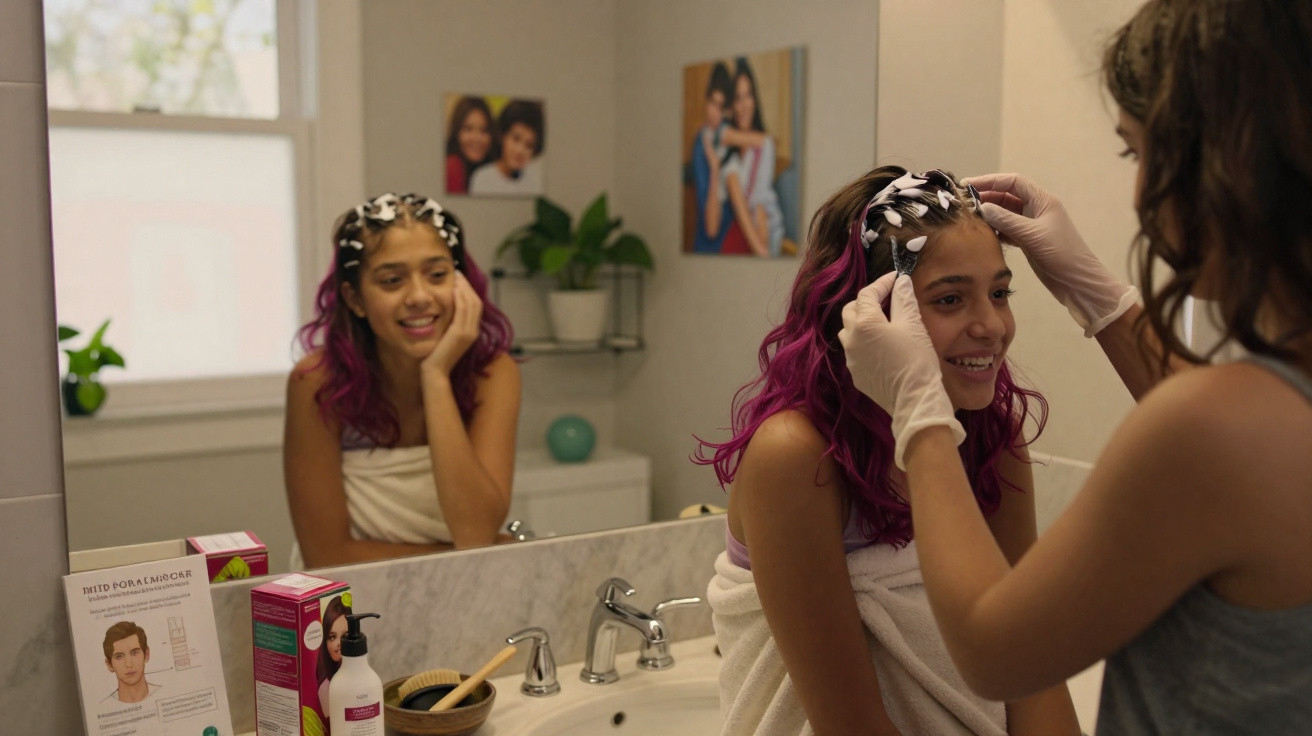
The girl in the mirror has hair the colour of a sports drink. A fortnight earlier, it was bubblegum pink. The month before, it was a dark forest green that marked every pillowcase in the house. From the doorway, her mother looks on, part amused and part alarmed, as another dye box lands on the bathroom sink with a thump.
On TikTok, “hair eras” move on faster than school terms. Teenagers scroll, stop at a creator with cobalt-blue fringe, and their own brown or blonde hair suddenly seems dull, weighty, too “them” and insufficiently “internet”.
Then a paediatric dermatologist appears on television, speaking about chemical burns and lasting harm to hair follicles.
The room falls silent.
Somewhere between neon self-expression and medical caution, a low-key beauty war is brewing.
Why teen hair has become a battlefield at home
On one side of the bathroom door is a teenager gripping a dye box as though it were a pass to a new identity. On the other is an anxious parent holding a screenshot from a health website about scalp irritation and hormonal changes.
This is not simply a dispute about colour. It involves control, anxiety and the uneasy point at which a child’s body no longer feels as though it belongs to the family, but to the young person themselves.
Hair becomes the least risky way to rebel. At least, that is what plenty of parents tell themselves.
Consider Marta, 43, whose 15-year-old daughter switches shades more frequently than she gets a new maths teacher. First there was a pale lavender colour “just for the holidays”. Then came teal for a concert. After that, copper because a K-pop star had worn it.
“Every three weeks we’re back in the bathroom,” Marta says. “The towels are ruined. The shower looks like a crime scene. And I’m on Google at 1 a.m. reading about hair breakage and allergies.”
Her paediatrician questioned the frequency. Her hairdresser bluntly described it as “chemical roulette”. Her daughter, meanwhile, calls it “finding myself”.
Doctors are not entirely exaggerating. Regular permanent colouring and aggressive bleaching can lift and roughen the cuticle, weaken the hair and, for sensitive teenagers, cause genuine allergic reactions on the scalp. Research is also examining long-term contact with certain dye chemicals, although the science remains developing and unclear.
Yet teenagers have always tested boundaries through their appearance: piercings, eyeliner, shaved sides and oversized hoodies. This particular trend just arrives in electric blue.
So who is correct: the specialists warning about accumulated exposure, or parents who would rather negotiate over hair than face more dangerous forms of risk? That is where the grey area truly begins.
Keeping teen hair healthy while reducing the drama
One straightforward change can transform the discussion: replace permanent, high-lift colour and full bleaching with semi-permanent or direct dyes, allowing more time between applications. These products generally remain closer to the hair’s surface rather than penetrating the shaft completely, so they are less likely to cause structural harm over time.
Another practical approach is to set “eras” rather than indulge impulses. If your teenager wants a new shade, agree that it will stay for, perhaps, six to eight weeks before it changes again. That alone nearly halves exposure compared with recolouring every fortnight.
Small, unexciting decisions can make experimentation safer.
Parents often go immediately to “no” because they are frightened, before becoming trapped in a power struggle they cannot reasonably win. The hair is, after all, on their child’s head. Teenagers know that too.
A gentler starting point is: “Yes, with conditions.” Keep the natural base colour, while allowing the ends to change. Skip home bleaching kits, but permit professional lightening once or twice a year. Carry out a simple strand test and patch test before a new product goes anywhere near the scalp.
Honestly, almost nobody studies every ingredient list or rings a brand’s helpline. Still, quickly checking for terms such as ammonia-free, PPD-free or “direct dye” can reduce the risk.
A paediatric dermatologist I spoke with put it very plainly:
“Zero chemical exposure is safest, of course. But that’s not real family life in 2026. My goal isn’t perfect purity. It’s avoiding burns, strong allergic reactions, and constant bleaching on young scalps still learning to regulate oil and sensitivity.”
When emotions start running high, practical measures are useful. Sit down with your teenager and create a “hair deal” that covers:
- The maximum number of colour changes each year
- Semi-permanent or direct dyes only for home use
- A patch test on the inner arm 48 hours before every new product
- One “hair rest” month with deep conditioning after two colour changes
- One clear rule: burning, severe itching or a rash stops all experiments, and a doctor is contacted
The teenager has freedom. The adult has a framework. Everyone feels a little less anxious.
Beyond the dye: what this teen beauty war is really about
Beneath the fluorescent bathroom light, the argument appears to concern colours and chemicals. At a deeper, quieter level, it concerns who has the right to decide how a teenager presents themselves to the world.
Some parents worry about being judged by teachers, grandparents or other adults: “What will they think of me if my kid turns up with neon orange hair?” Others privately grieve for the familiar brown curls they have known since nursery school. Scalp health becomes tangled up with nostalgia and social pressure.
Teenagers, meanwhile, are growing up with feeds in which hair is content rather than simply hair. Changing its colour can feel as ordinary as changing a filter. To them, hearing “no” may sound like being told to “stay invisible”.
There is no single correct response. Some families prohibit dye altogether and bring up confident, grounded children. Others have rainbow-haired teenagers alongside firm, thoughtful rules about maintenance and safety.
Perhaps the real win is not keeping virgin hair perfectly untouched. Perhaps it is helping a young person understand that their body is their own, that aesthetics can be fun, and that health is not something parents force upon them but something they safeguard together-even with a stained towel on the floor and a half-empty tube of blue dye in the bin.
| Key point | Detail | Value for the reader |
|---|---|---|
| Choose gentler formulas | Prefer semi-permanent, direct dyes and avoid repeated bleaching | Lowers the likelihood of breakage, irritation and long-term scalp stress |
| Set a “hair contract” | Agree limits on frequency, techniques and patch testing | Balances teenage autonomy with parents’ safety concerns |
| Watch the scalp, not just the colour | Burning, ongoing itching or a rash means stop and seek medical advice | Helps identify reactions early and avoids more serious complications |
FAQ:
- Question 1 How often is “too often” for a teenager to recolour their hair?
- Question 2 Are semi-permanent dyes genuinely safer than permanent ones?
- Question 3 Is bleaching hair at home a bad idea for teenagers?
- Question 4 Which scalp warning signs should parents take seriously?
- Question 5 How can I discuss hair health with my teenager without criticising their appearance?





Comments
No comments yet. Be the first to comment!
Leave a Comment