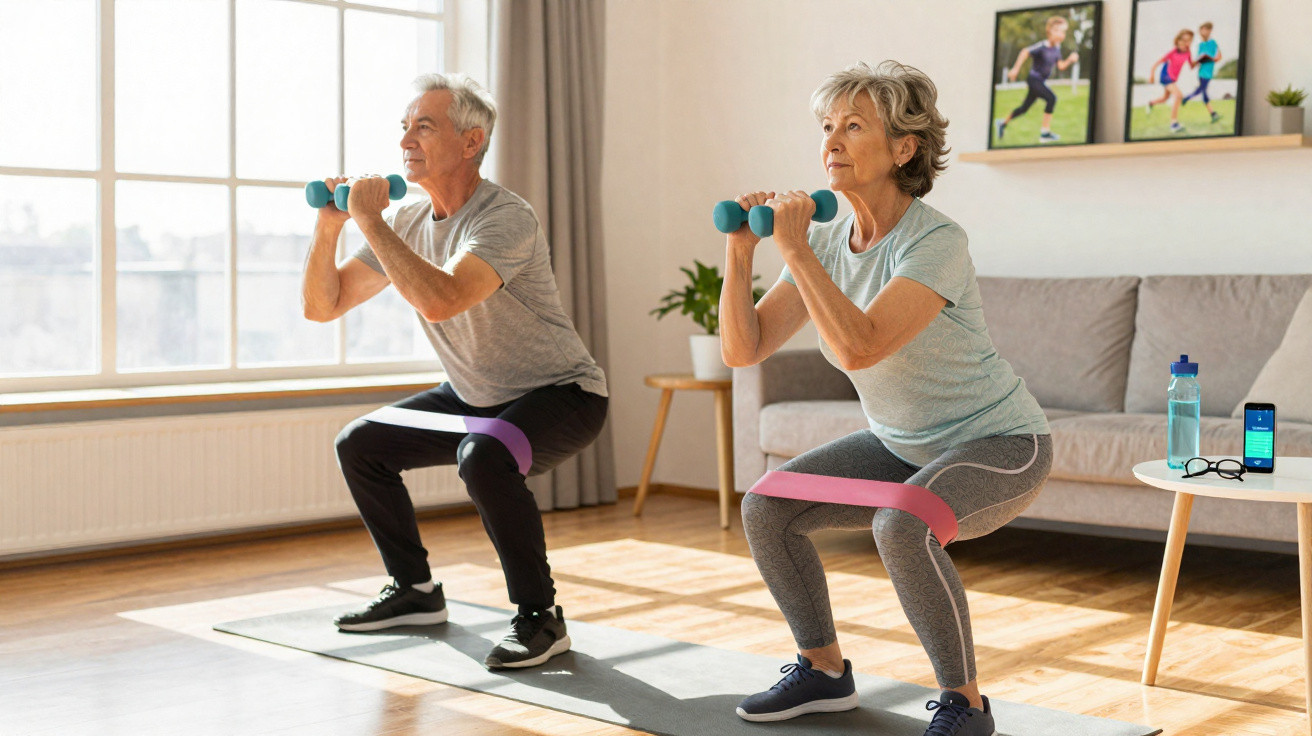
The aim is straightforward: to remain independent for as long as possible, climb stairs without becoming breathless, lift grandchildren and enjoy travelling. According to cardiologist and sports professor Martin Halle, this is not a privilege reserved for the young. What matters is how we exercise throughout the decades – and, above all, that we challenge our muscles deliberately.
Why ageing is primarily a muscle problem
Unless we take action, muscle mass declines with every passing year. Specialists call this sarcopenia: age-related muscle loss. From our mid-thirties onwards, the body gradually loses muscle mass, with the fast-twitch fibres responsible for strength and explosiveness disappearing first.
“Anyone who wants to stand up powerfully, carry shopping and walk safely in later life must treat their muscles like a bank account: make regular deposits.”
Professor Halle is clear: wrinkles are not the issue; the steady loss of strength is. Simply “going for a little walk” may slow the process, but it will not stop it. That requires purposeful strength training at every stage of life, adapted to the individual body.
Five stages of life, five training priorities
The sports physician divides life into five phases. Each one calls for different priorities to help the body remain strong over the long term – well into old age.
Childhood and adolescence: variety rather than early fitness training
Until around the age of 20, the body grows almost by itself. During this period, so-called satellite cells in the muscles are especially active. They act as repair and growth helpers for muscle fibres.
Halle’s message is that children do not need to become miniature bodybuilders. More important are:
- Plenty of everyday movement: playing, running about, running and climbing
- Sports involving coordination and speed, such as gymnastics, ball sports or athletics
- No demanding, heavy strength training while growth plates are still open
Those who learn to use their body during adolescence build a kind of “movement memory” that can benefit them decades later.
20 to 35: making the most of the golden phase
During the twenties and early thirties, the body is operating at full capacity. Heart, lungs and muscles all respond to exercise at their maximum. Halle calls this a genuine “investment phase”.
His recommendation:
- At least two to three strength-training sessions each week
- Regular endurance exercise, such as running, cycling or swimming
- Staying active in daily life: stairs instead of the lift, cycling instead of driving, and walking for journeys
This is the phase in which particularly large numbers of muscle fibres can be built. Every session is like a deposit into the “strength account” that can still be drawn on at 50, 60 or 70.
35 to 55: tackling muscle loss
From around the mid-thirties, the trend reverses. Without countermeasures, the body loses several per cent of muscle mass per decade, particularly in fast-twitch fibres. This becomes noticeable as reduced explosive power: stairs feel more difficult, and sprints require greater effort.
“Those who do nothing now will notice the cost at the latest when simple everyday tasks suddenly become arduous.”
Halle recommends brief, intensive sessions that specifically work the major muscle groups. Typical foundational exercises include:
- Squats, using bodyweight or moderate additional resistance
- Press-ups, including easier versions against a wall or table
- Planks and other core exercises for the abdomen and back
- Lunges for the legs and glutes
The important point is that muscles should have to work hard, without being overloaded. Even people recovering from a heart attack benefit, once medically cleared, from moderate strength and interval training that strengthens the heart and circulation while restoring confidence in their own body.
55 to 75: muscles as the key to independence
This stage of life often determines whether someone can continue living independently in old age or needs support early. Muscles do become less responsive to training, but that ability does not disappear.
The focus shifts: it is less about building muscle at any cost and more about maintaining what is already there. Halle advocates forms of exercise that are challenging for the individual while remaining safe. These may include:
- Targeted strength training on machines at a gym or rehabilitation centre
- Strengthening programmes at home using resistance bands and bodyweight
- A combination of strength and balance work, such as standing on one leg
Alongside reducing the risk of falls, strength training has further effects: metabolism functions better, blood sugar levels become more stable, and organs including the heart, liver and bones also benefit.
Over 75: movement as a life extender
People over 75 do not have to accept an armchair as their main place of residence. Studies show that even at this age, targeted muscle training can produce measurable improvements in strength – helping people remain independent for longer.
Sports education specialist Christine Joisten recommends dancing as an ideal blend of enjoyment and exercise. It challenges the legs, core and balance, trains the brain and creates social contact. For many older people, this very combination is crucial for staying motivated.
One important principle applies: every movement counts. Short walks, light strength work with water bottles or simple resistance bands, and one-legged exercises while brushing your teeth all help – the more often the body receives these stimuli, the better it maintains itself.
How often, how long and how intensely?
The exact training plan always depends on health and everyday circumstances. However, the basic framework is similar for almost every age group. A sensible weekly schedule is:
| Age | Strength training | Endurance |
|---|---|---|
| 20–35 | 2–3 sessions of 45–60 minutes | 2–3 moderate to brisk sessions |
| 35–55 | 2–3 sessions of 30–45 minutes, somewhat more intensive | 2 sessions, one of them slightly more intensive (e.g. intervals) |
| 55–75 | 2 sessions of 20–40 minutes, performed with good technique | Several easy sessions, such as brisk walking |
| 75+ | 2 short sessions of 15–30 minutes, heavily adapted | Daily movement, such as walking, dancing or everyday journeys |
As a rule of thumb, the final repetition of an exercise may feel strenuous, but it should not hurt.
Technology aids: what fitness trackers can do
Anyone who likes to monitor their progress can use fitness trackers and smartwatches. They record steps and heart rate, and some even measure ECG readings or blood oxygen saturation. For many people, such a device acts like a small motivational coach on the wrist: the step counter gives a reminder, while the resting-heart-rate chart displays training progress.
Models such as the Garmin Vivoactive, Huawei Watch Fit and Fitbit Charge cater for different user groups – from simple step tracking to detailed training planning. The brand is not what matters; the watch needs to be genuinely used and suited to the wearer’s habits.
Common mistakes – and how to avoid them
Many people who want to “finally start exercising again” fail for the same reasons. Three classic mistakes are:
- Too much at once: Starting daily workouts after months or years without exercise – overload and frustration are inevitable.
- Endurance only, no strength: Walking for hours but never doing squats or core training. The heart benefits, but the muscles remain weak.
- Inconsistency: Going flat out for two weeks, followed by a three-week break. Muscles respond to consistency, not isolated heroic efforts.
Halle advises following a simple principle: start small, but remain dependable. Two fixed appointments in the diary each week, even if they are only 20 minutes long, deliver more in the long term than restarting every week with a guilty conscience.
What “fit at 70 as at 30” realistically means
Naturally, a 70-year-old will not run a 100-metre sprint as they did at 25. The issue is everyday capability: standing up without pain, carrying a crate of water, completing a walking holiday and not needing to stop after every incline.
“Those who work consistently on strength, endurance and mobility over decades can maintain a level of performance in old age that many considerably younger people do not achieve.”
Training must be accompanied by recovery, sufficient sleep and a protein-rich diet. Muscles do not grow in the gym, but in the hours afterwards – provided the body receives the necessary building blocks.
Importantly, even those who begin at 60 or 65 can still achieve a great deal. Studies involving previously inactive older people have sometimes shown substantial strength gains after just a few months of targeted training. Feeling able to walk and stand more securely again changes everyday life as a whole.
Practical starter exercises at home
Anyone wishing to begin straight away does not need a gym. Here are three simple exercises that can be adapted for almost every age group:
- Chair stands: Stand up from a chair and sit down again several times in succession, without pushing off with your hands.
- Wall press-ups: Stand a short distance from a wall, place your hands on it, lower your upper body in a controlled way and push back up.
- Kneeling side plank: Support yourself on one side with your knees on the floor, lift and hold your hips – this strengthens the core and hip muscles.
Anyone who is unsure should discuss getting started with their GP, a physiotherapist or qualified trainers. Especially after heart problems or joint surgery, the programme can be carefully adapted without losing its benefits.
Ultimately, it comes down to a simple message: ageing cannot be stopped, but it can be influenced. Those who take their muscles seriously and challenge them regularly can, at 70, come remarkably close to the physical feeling they had in their thirties – not in the mirror, but in everyday life.















Comments
No comments yet. Be the first to comment!
Leave a Comment