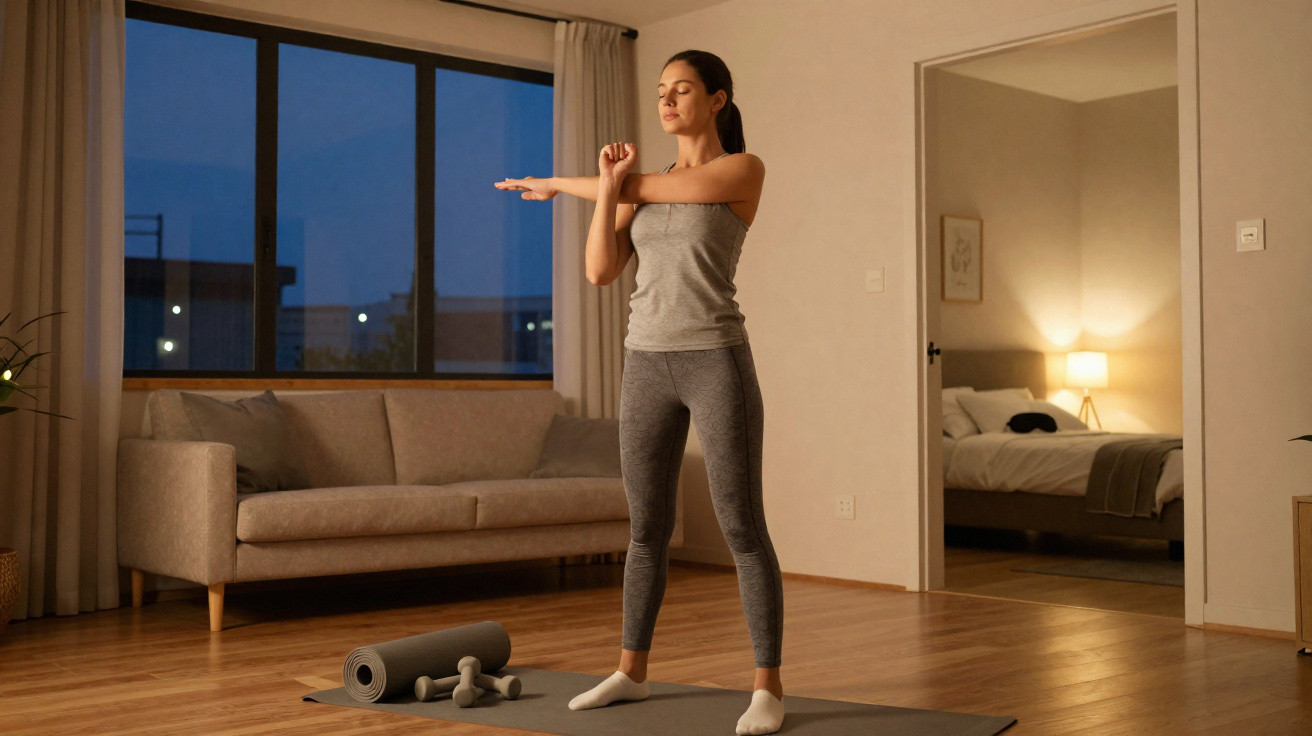
Working late, putting the children to bed, then squeezing in a quick gym session – only to lie awake staring at the ceiling.
Does it have to be this way?
Many people simply cannot fit exercise into the daytime. Their run, gym session or yoga mat therefore inevitably gets pushed into the period between 8 pm and 10 pm. Yet this is also when the body should really be preparing for the night. The obvious question is: does evening exercise make us fitter, or does it ultimately take away our sleep?
When the evening is the only time for exercise
A packed routine, with free time only after 8 pm
Anyone who works in an office, commutes, looks after children or does shift work knows the issue: there are not enough hours in the day. Pressure to perform, lengthy journeys and personal commitments mean genuine “me time” often begins only once everyone else is already on the sofa. For many, the hour after 8 pm is the only opportunity to move at all.
This is especially apparent in cities. The working day runs later, gyms are busy in the evening and parks are well used. The internal dilemma is straightforward: stay on the sofa and risk cardiovascular problems in the long term – or go for a run and risk a restless night?
Exercise as an outlet after a stressful day
After eight or nine hours of sitting, emails, meetings and mental pressure, the body calls out for balance. Many people need an evening workout to clear their head. Movement acts like a switch: work off, private life on. While pushing themselves physically, they are not thinking about deadlines, conflicts or unresolved tasks.
The tiredness at the end of the day is often more mental than physical. Moderate exertion can transform that inner restlessness into a tangible, pleasant physical fatigue. This is exactly what many people hope for: a calm, clear mind because the body has been able to “let off steam” through exercise.
Evening exercise can provide emotional relief – or disrupt sleep. The type, intensity and timing are what matter.
Why the body stays in alarm mode after exercise
A higher body temperature can prevent sleep onset
Quality sleep requires the body’s temperature to fall. During the evening, internal temperature gradually drops, signalling to the brain that it is time to enter rest mode. Intense exercise interrupts this process. Muscles are working, the heart rate rises, the body generates heat – and core temperature climbs.
If a workout takes place too close to bedtime, it sends conflicting signals. The body is still set to “activity” when you are trying to wind down. Cooling off takes time, often more than expected. It can easily take one to two hours for the body to return to its “sleep range”. During that period, people tend to feel alert and slightly stimulated.
The hormonal mix of adrenaline and cortisol
Physical exertion prompts the body to release various stress and activation hormones. Adrenaline sharpens reactions, while cortisol provides energy. Both are welcome during training, but are less useful in the bedroom. They counteract the sleep hormone melatonin, which would normally rise in the evening.
The result is that the heartbeat remains elevated and the mind feels clear – almost too clear. Many say that, after showering, they feel fit enough to take on another task, except it is usually already 10 pm. This inner alertness clashes with the time of night. It can lead to lying awake for a long time or to shallow, insufficiently restorative sleep.
Intensity makes the difference
Why very hard training can ruin the night
There is a world of difference between a gentle evening walk and a demanding HIIT session. Intense intervals, fast runs, cross-training or challenging ball sports raise both heart rate and stress levels sharply. The so-called “afterburn effect” keeps the metabolism running at a high level for hours.
Anyone finishing this type of session at 9 pm is unlikely to properly switch off before midnight. The nervous system remains in fight mode for a long time. The parasympathetic nervous system, which is responsible for rest and recovery, needs time to regain control.
- High intensity = high heart rate, substantial stress, slow winding-down process
- Late timing = little buffer between training and sleep
- Combining both factors = a greater risk of difficulties falling asleep and staying asleep
Such sessions are better suited to the morning or lunchtime. At those times, their energising effect can be used constructively instead of working against the body’s own sleep phase.
Moderate movement can actually improve sleep
The picture is different with moderate exertion. Moving at a level where conversation remains possible without becoming breathless is much gentler on the body. Brisk walking, an easy cycle ride, relaxed swimming or a gentle run are more likely to promote relaxation than inner agitation.
Body temperature rises less dramatically and falls again more quickly after the workout. At the same time, this mild stimulus helps reduce nervous tension. Many people even sleep better after this kind of evening activity, as physical tiredness interrupts the cycle of overthinking.
The harder and later the workout, the more likely sleep is to suffer. The more moderate and earlier it is, the more likely exercise is to help you switch off.
The body clock has a major role
Early risers, night owls and their response to evening exercise
Not every body follows the same rhythm. A person’s chronotype determines when they perform best and when tiredness sets in. Classic early risers get going quickly in the morning and become tired earlier in the evening. They are often considerably more sensitive to late training sessions.
Night owls, by contrast, stay energetic for longer in the evening. They can often cope better with a workout at 8 pm and still fall asleep around midnight. These differences explain why the same training plan can have completely different consequences for two people’s nights.
Test your own pattern rather than following advice blindly
Rather than relying on blanket recommendations, it is worth running a short personal experiment. Over two to three weeks, you can observe how your own body responds. A simple log is useful:
- Time of the session
- Duration and perceived intensity (light, moderate, hard)
- How long did it take to fall asleep?
- Periods of waking during the night?
- How did you feel in the morning: rested or exhausted?
If you find that hard sessions after 8 pm almost always lead to poor sleep, adjust one variable: move the session slightly earlier, reduce the intensity or choose a different form of exercise.
Practical tips for evening exercise
How to limit the impact
Anyone who cannot or does not want to give up evening exercise for organisational reasons can actively support the body’s wind-down process:
- Build in a buffer: Ideally, allow at least 90 minutes between finishing exercise and going to bed.
- Use a cool-down: Five to ten minutes of easy jogging or walking, followed by stretching, lowers heart rate and tension.
- Dim the lights: After training, reduce bright lighting and screen time so melatonin can rise.
- Eat lightly: Avoid a heavy, fatty meal immediately after the session, as this places extra demands on digestion and circulation.
- Establish routines: A shower, tea or a short read – repeated routines signal that “it is time to rest”.
If you feel overly wired, breathing exercises, progressive muscle relaxation or gentle stretching can also help. These methods gently bring the nervous system out of activity mode.
Further considerations for evening exercise and sleep
What “moderate intensity” means in practice
The term may sound abstract, but it is easy to recognise. In everyday terms, a workout is moderate when:
- breathing becomes faster but not frantic,
- you can still speak in full sentences,
- you could maintain the pace for 30–40 minutes without becoming completely exhausted.
Heart rate can provide guidance too: for many people, a moderate range is roughly 60 to 75 per cent of their individual maximum heart rate. It does not need to be measured precisely; how your body feels is often enough.
Suitable alternatives for very sensitive sleepers
Anyone who notices that even light evening sessions affect their sleep can opt for other ways to find balance. Gentle yoga, relaxed stretching, walks in the fresh air or short mobility routines place little strain on the circulation while easing muscular and mental tension.
For health benefits, weekly activity can also be distributed differently: more movement at weekends, short sessions before work, or an active commute by bike or on foot. This keeps the evening free for recovery – particularly valuable for people whose sleep patterns are already fragile.














Comments
No comments yet. Be the first to comment!
Leave a Comment