
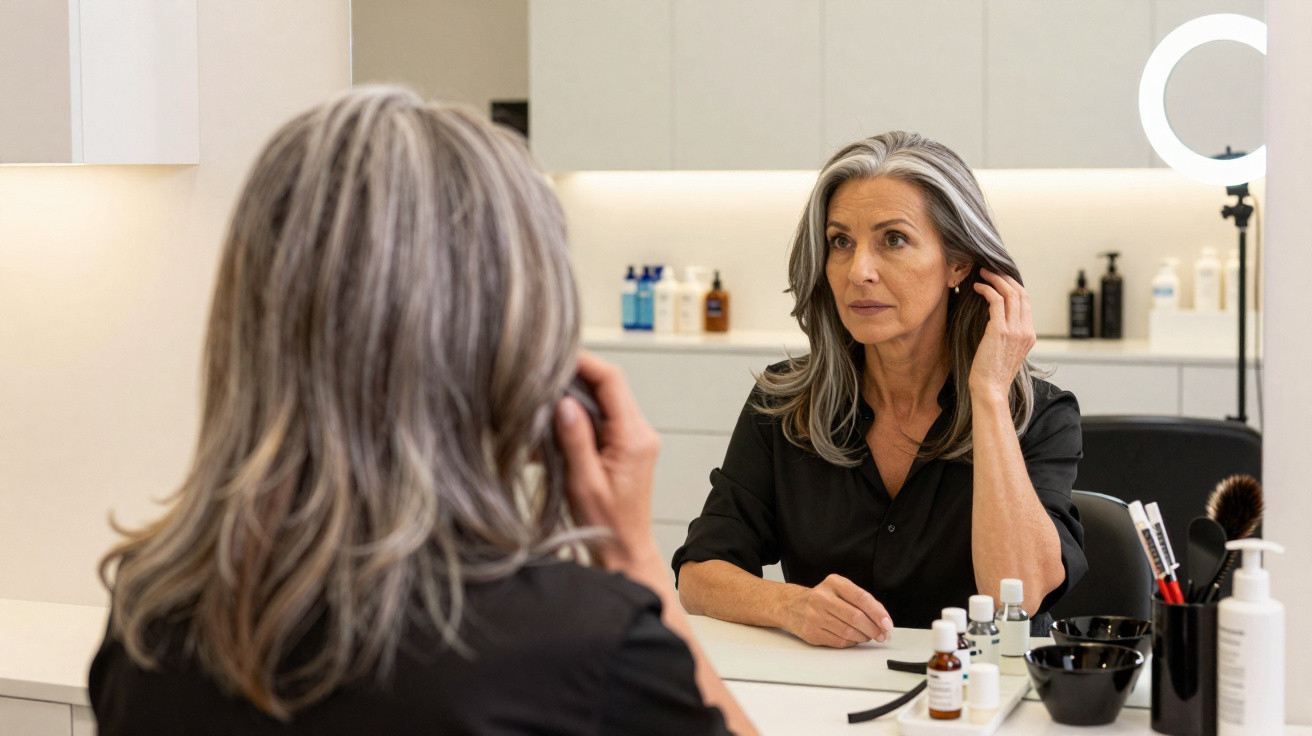
Looking in the mirror is a moment many people eventually face: the first silver hairs catch the light, the complexion seems more severe, and photographs suddenly make you feel older. Conventional hair dye is not an option for many people – it can be too harsh, costly or time-consuming. This is where an unassuming oil blend from the kitchen comes in, currently attracting attention on social media and in beauty groups.
Why grey hair causes so much frustration
Grey or white hair is entirely normal from a biological perspective. Over time, the pigment cells in the hair roots produce less melanin, so hair loses its original colour and grows back lighter. Some people notice their first strands in their mid-twenties, while others see them much later.
People deal with this very differently. Some wear a salt-and-pepper look proudly. Others feel they have suddenly been made to look “older” and would like to get at least close to their former colour. Those who reach for a conventional colourant on the chemist’s shelf soon encounter three common problems:
- Sensitive scalps: Many people complain of itching and burning.
- High costs: Ongoing salon colouring can become noticeably expensive.
- Maintenance: Roots grow out quickly, turning colouring into a constant task.
People with dry or sensitive scalps in particular therefore look for gentler options. This is where a natural homemade tint, using simple pigments from spices and coffee, comes into play.
The natural kitchen hair-tint blend
The principle is simple: rather than using chemical colourants, pigmented plant ingredients and ground coffee are stirred into a nourishing oil. The oil acts as a carrier, penetrates the hair structure to a degree and leaves a delicate layer of colour around each strand.
“The blend does not colour as intensely as a permanent dye; instead, it places a soft, natural veil over grey hairs.”
You will need the following for the recipe:
- 7 tablespoons of olive oil
- 1 teaspoon of turmeric
- 1 teaspoon of black seed (Nigella)
- 1 teaspoon of ground coffee
Each ingredient contributes its own pigments: turmeric provides warm golden tones, coffee brings brown depth, and black seed adds a slight darker cast. Combined, they create a subtle, warm-toned colour – especially suited to brown, dark blonde or reddish hair shades.
How to prepare the mixture step by step
Making it is more like preparing a kitchen sauce than applying conventional hair dye, and takes only a few minutes.
- Warm the olive oil: Put the oil in a small saucepan and heat it slowly over a low heat – do not let it boil.
- Stir in the spices and coffee: Add the turmeric, black seed and ground coffee, stirring with a spoon until evenly combined.
- Leave it to infuse briefly: Keep the mixture over a low heat for around two minutes, allowing the pigments to transfer into the oil.
- Take it off the heat: Remove the saucepan from the hob and leave the oil to cool until it is merely lukewarm.
If you have sensitive skin, test a small amount of the cooled mixture in the crook of your elbow first. This will show whether you react to any of the spices.
Targeted application: where and how to apply the oil to hair
The blend works best on dry hair, as this makes it easier to see where the grey sections are.
- Choose an applicator: An old toothbrush, tint brush or very fine comb is suitable for application.
- Apply the mixture: Brush the lukewarm oil onto all visible grey strands, including the parting and temples.
- Processing time: Leave it on for roughly 20 minutes. With dense, very light grey hair, you can increase the time slightly.
- Rinse out: Then rinse thoroughly with warm water and cleanse the hair with a mild shampoo.
Any remaining oil can be removed with a second wash. A towel that can get stained is ideal for this process, as turmeric can lightly colour fabrics too.
What does the result actually look like?
Anyone hoping for jet-black salon colour will be disappointed by this kitchen recipe. Its effect is gentler, but also more natural:
“Grey strands look less harsh afterwards, more like finely placed highlights that blend discreetly into your own hair colour.”
Many users report that their hair:
- appears slightly darker and warmer,
- gains a light shine,
- feels softer and better cared for.
As olive oil forms the base, the hair structure receives additional benefits: dry, brittle hair becomes more supple, is less prone to breakage, and the ends no longer look as dull.
How long does the effect last?
The pigments settle mainly on the outside of the hair. Each wash removes some of their intensity. Anyone wishing to maintain the result should use the mixture regularly.
As a broad rule of thumb:
| Frequency of use | Expected effect |
|---|---|
| Once a week | visible but subtle coverage of grey hair |
| Twice a week | a more intense colour film and considerably less noticeable grey |
| Every 14 days | a light tint, mainly shine and conditioning benefits |
Important: your natural starting colour plays a major role. On almost white hair, the result is more likely to be a slight beige tone; on darker natural shades, it appears much more harmonious.
What are the advantages of this gentle alternative?
Alongside the straightforward preparation, many people particularly value having control over the ingredients. Rather than checking lengthy lists of difficult-to-understand names, you use four familiar components:
- Olive oil: conditions, replenishes lipids and protects against dryness.
- Turmeric: provides warm, golden colour pigments.
- Black seed: gives a deeper tone and is traditionally described as strengthening.
- Coffee: enhances brown nuances and adds a slight shine.
There are also clear practical benefits:
- Lower cost than salon appointments.
- No ammonia and no oxidising colourants.
- Easy to fit into everyday life.
Risks and limitations of the method
As appealing as a kitchen tint may sound, a few points require a realistic view. Not every scalp tolerates every spice blend. Anyone with known allergies to turmeric, black seed or coffee should avoid it. A short skin test beforehand is sensible.
The resulting shade cannot be controlled without limits either. Anyone wanting to retain a cool ash blonde is unlikely to be pleased with this warm blend. Its effect clearly moves towards golden to brown tones. Those with strongly faded, very light strands may develop unwanted yellow tones.
In addition, this method works more like a natural tint than a true, deeply penetrating colour treatment. Dramatic colour changes – such as moving from light blonde to dark brown – are not realistic with it.
Who is this natural hair tint particularly suitable for?
Many readers report that the blend works particularly well in certain situations:
- When the first isolated grey strands appear.
- On dark or medium-brown hair that only looks slightly lightened.
- For people who experience irritation from conventional hair dye.
- For anyone wishing to make regrowth look a little softer between salon appointments.
However, those who already have a great deal of evenly white hair are likely to find the change too subtle. In this case, the mixture is better suited as a conditioning oil treatment with a faint hint of colour – not as a complete transformation.
Practical tips for everyday use
A few useful measures can improve the chances of a pleasing result:
- Put on an old T-shirt and cover your shoulders before application.
- Apply a little cream around the hairline to prevent the skin from becoming stained.
- Test the mixture first on a small strand at the nape of the neck.
- Take photographs before and after use – this makes changes easier to assess.
If you tolerate the mixture well, you can experiment with the processing time: less time produces a more delicate result, while more time gives a stronger veil of colour. Between professional appointments, the oil treatment can also make brittle lengths look more supple.
What the terms mean – from pigment to oil film
Many haircare marketing claims focus on “pigments” and “colour sealing”. Essentially, this means coloured substances settle onto the hair and remain there slightly longer because of oils and waxes. The kitchen blend works according to exactly this simple principle.
Olive oil forms a fine film around the hair. The plant pigments from turmeric, black seed and coffee sit within this film. With every wash, part of that film rinses away; when you apply the mixture again, a fresh film settles onto the hair. Over time, this produces a soft, repeatable colouring effect.
Those who want to work with this principle can also combine the method with other natural ingredients: camomile tea for golden reflections in blonde hair, or sage tea for a little more depth in brown hair. The main limits are your own patience – and a willingness to be satisfied with subtle rather than dramatic results.















Comments
No comments yet. Be the first to comment!
Leave a Comment