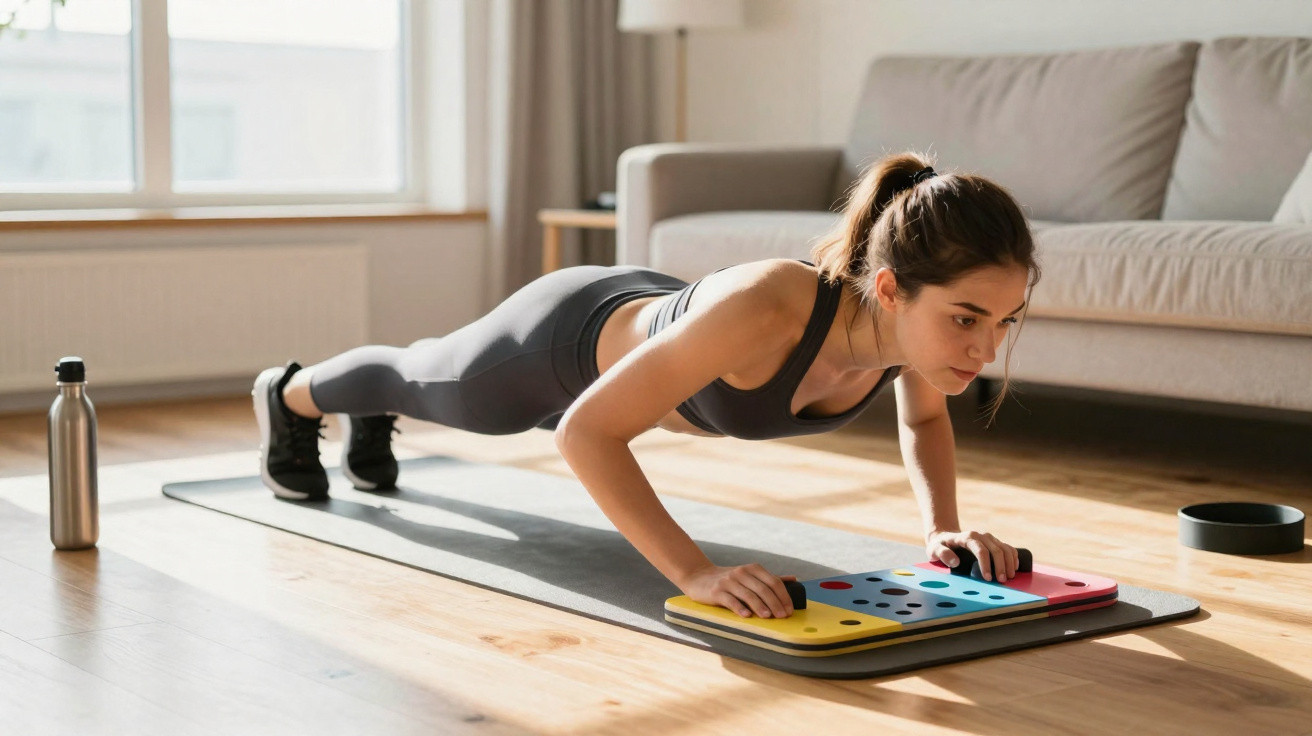
As summer approaches, the pressure mounts: trousers feel tighter and the mirror is unforgiving. Anyone looking to tone their midsection and strengthen their upper body can quickly end up considering costly gym memberships or complex training plans. However, a multifunctional push-up and core board from Decathlon promises an intensive full-body workout at home, with a built-in counter and clear colour coding for different muscle groups.
What the Decathlon Push-up Board is all about
At the heart of the offering is the HMS DBP03 multifunctional push-up board, currently sold by Decathlon. It is designed for people who want to work out at home without turning their living room into a full gym. The idea is simple: one compact 3-in-1 tool intended to replace several pieces of equipment.
“A sturdy board, adjustable push-up handles and an integrated counter combine upper-body and core training in the smallest possible space.”
The base board also works as a platform for planks and other core exercises. It comes with two removable handles that slot into designated openings. A colour-coded system allows the handles to be positioned to target specific muscle areas, including the chest, shoulders, triceps and back.
A particular highlight for technology enthusiasts is the small counter at the front of the board, which uses an optical sensor. It records every correctly performed push-up as the upper body lowers. Anyone who likes monitoring progress can see immediately on the display how many repetitions they have completed in a session.
Which muscles the Decathlon Push-up Board actually works
The DBP03 is more than a novelty for a few half-hearted push-ups. When used properly, it brings together several traditional upper-body workouts in one compact setup.
Targeted work for chest, shoulders and arms
The board’s colour system lets users place the handles at different angles. Each colour represents a particular muscle area:
- Chest: a central, slightly wider handle position
- Shoulders: handles turned slightly outwards and positioned further forward
- Triceps: a narrow position close to the body
- Back: staggered, diagonally arranged positions
These placements create different movement patterns. Those performing flatter, conventional push-ups place greater emphasis on the chest muscles. Narrower positions and longer leverage, by contrast, put noticeably more strain on the triceps. Rotating the handles adds further stimulus for the shoulders and upper back.
Core training: the abdominal muscles are always involved
As soon as the body moves into a push-up position, the abdominal muscles have to provide stability. The board makes consistent use of this, offering a wide padded surface on which to rest the hands or forearms.
Typical DBP03 exercises include:
- Static plank: Place the forearms on the board, keep the body straight and brace the abdominal muscles firmly.
- High-to-low plank: Alternate between support on the hands and forearms without allowing the lower back to arch.
- Side-plank variations: Support one side on the board to engage the oblique abdominal muscles.
Anyone who trains consistently will soon notice that the abdominal muscles can burn even without traditional crunches. The emphasis is less on isolated “six-pack exercises” and more on functional tension throughout the entire core.
How the board works in everyday use
Getting started is intended to be as straightforward as possible, so the equipment does not end up abandoned in a corner after two weeks. The DBP03 therefore follows an easy-to-understand formula: slot in, start, count.
Step by step: using it in the living room
A basic session takes only a few minutes:
- Place the board on a firm floor; it can also be used with a carpet or mat underneath.
- Insert the handles into the colour-coded openings for the muscle group you want to train.
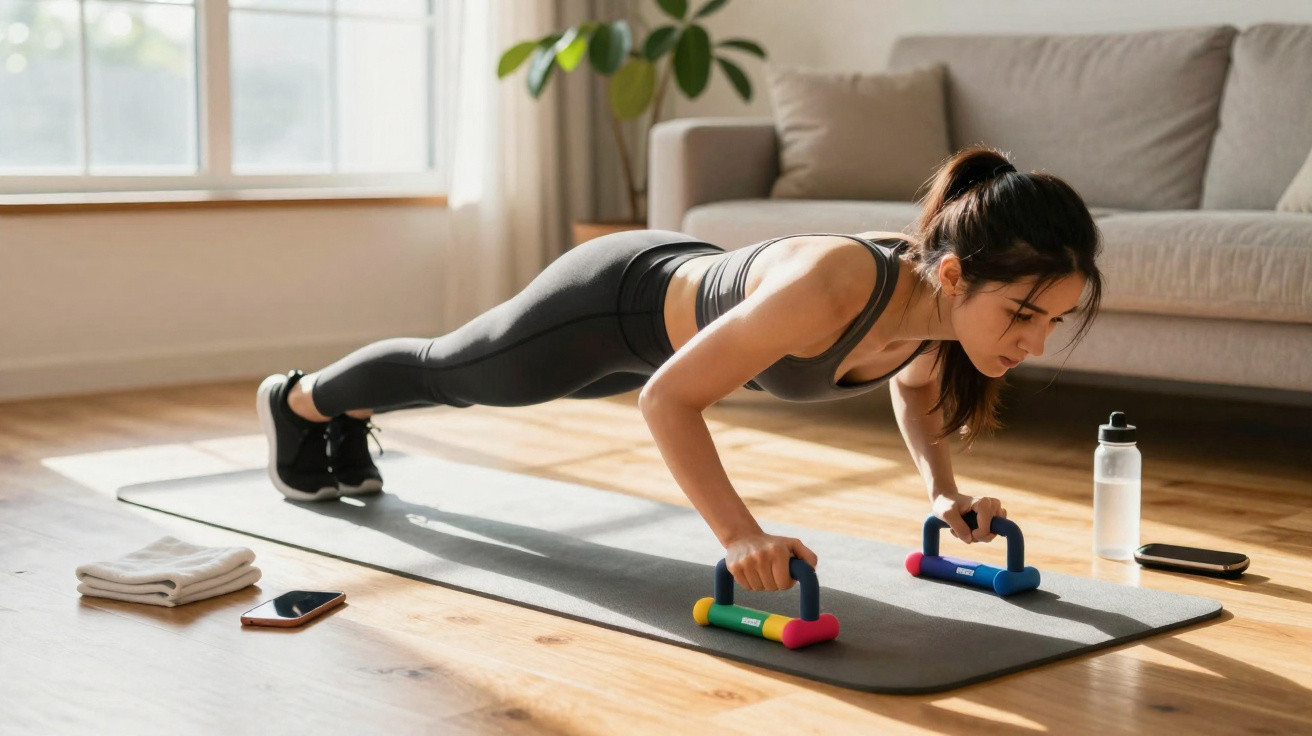
- Move into a push-up position: hands on the handles, arms extended and body held in a straight line.
- Lower yourself slowly until the sensor records the movement, then push back up.
- For core work, remove the handles and place your forearms or hands directly on the padded surface.
The counter removes one important task for beginners: keeping track of, or estimating, repetitions. Those setting clear targets, such as 3 × 12 clean push-ups, can check the numbers directly without having to keep counting mentally.
Who is the device really suitable for?
Decathlon markets the board to both beginners and experienced exercisers. That is possible because the training intensity can be adjusted easily.
| Training level | Typical use |
|---|---|
| Beginner | Knee push-ups, short plank intervals, a small number of sets with rest periods |
| Intermediate | Clean push-ups on the toes, dynamic planks, supersets |
| Advanced | Explosive push-ups, one-arm variations, long core sessions |
Many people underestimate how effective even simple variations can be. A beginner might start with knee push-ups and hold a plank for only 15 seconds. After a few weeks, this can become 30–45 seconds of plank work and regular push-ups, without needing to replace the equipment.
How the board differs from conventional floor training
Naturally, push-ups can also be performed directly on the floor. The DBP03 is designed to offer several advantages over this approach.
- Fixed handle height: The wrists remain in a neutral position, which many people find more comfortable.
- Non-slip surface: The underside is designed to prevent the board from sliding when it is used correctly.
- Guided handle positions: People without fitness experience often do not know which hand placement targets which muscles. The colour coding removes this uncertainty.
- Measurable progress: The counting mechanism records every individual repetition.
There is also a psychological benefit: having dedicated equipment in the living room provides a daily reminder to do at least a little exercise. The barrier to completing a quick set is considerably lower when the equipment is already there.
Can the device help reduce belly fat?
Anyone expecting the board to produce a flat stomach within a few days will be disappointed. It is not possible to train fat away from one specific area. Fat loss always happens across the whole body.
The DBP03 can still play an important part:
- It increases calorie expenditure through regular strength training.
- It builds muscle, which slightly raises the basal metabolic rate.
- It strengthens the core and improves posture, making the abdominal area appear firmer.
Combining the device with a reasonably balanced diet and occasional cardiovascular exercise, such as jogging, cycling or brisk walking, creates better conditions for measurable changes around the stomach.
Practical tips for getting started
A clear, realistic plan makes it easier to stay consistent over the long term. At the beginning, three to four short sessions per week are entirely sufficient. One 15-minute DBP03 routine could include:
- 3 × 10 push-ups (choose the variation for your level), with 1 minute of rest
- 3 × 20 seconds of plank, with 40 seconds of rest
- 2 × 10 high-to-low planks
The key point is quality over quantity. Proper form protects the shoulders and back. Anyone experiencing pain in the wrist or shoulder should initially reduce the number of repetitions or select an easier variation.
Traditional bodyweight exercises can also be added, including squats, lunges and hip thrusts. This quickly turns a single piece of equipment into a small full-body programme with an upper-body focus.
The Decathlon push-up board demonstrates how a modest training aid can be used to work the abdominal area and upper body even with the busiest schedule. No membership, no journey and no excuse - yet still enough intensity to tone the stomach over time and make the body feel noticeably more stable.








Comments
No comments yet. Be the first to comment!
Leave a Comment