Anyone who has had gel, acrylic or BIAB infills at the salon for years will know the dilemma: attractive nails, yet brittle, thin and irritated keratin plates underneath. This is precisely where the Japanese manicure comes in. Rather than adding fresh layers, it reinforces the natural nail with wax, minerals and vitamins, leaving a delicate pearlescent finish. This understated style is ideally suited to spring 2026, when the overall direction is noticeably more natural.
What the Japanese manicure is really about
The technique originated in professional nail salons in Japan, where tidy yet understated hands have long been regarded as a status symbol. The aim is not a statement design, but nails that look healthy in their own right.
“A Japanese manicure is less about cosmetics and more of a restorative treatment – it tackles the cause rather than merely concealing the surface.”
At the heart of the ritual are a particularly rich paste and a fine powder, both worked into the nail plate. These products commonly contain:
- Beeswax: seals the nail, protects it from drying out and adds shine
- Keratin: supports the nail’s natural structure
- Minerals such as silicon: strengthen the surface and make it more resilient
- Vitamins, often A, E and H/biotin: nourish the nail and cuticle
The result is a softly shimmering pink-nude nail. It does not look painted; instead, it resembles a “polished natural state”.
A Japanese manicure step by step
Although the process appears straightforward, it is considerably more intensive than a standard express manicure.
1. Preparing the natural nail
Every treatment begins with a thorough assessment. Ridges, discolouration and fragile tips all inform the care chosen. This is followed by:
- Gently shortening and filing the nails into shape, usually softly rounded or soft square.
- Carefully tending to the cuticles without aggressive e-files.
- Lightly mattifying the surface so it can absorb the treatment.
The nail plate should never be filed down in the way it can be during some gel removals. The guiding principle is to remove as little material as possible.
2. Massaging in the treatment paste
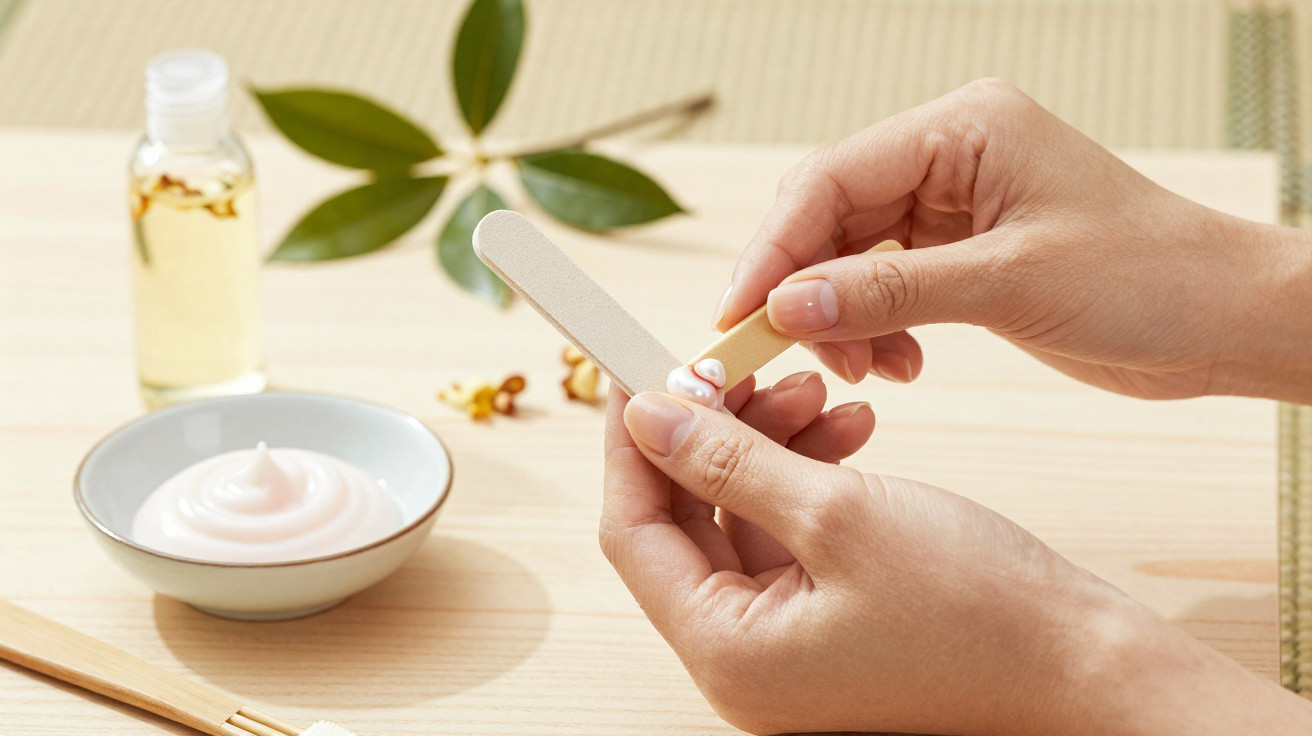
The actual treatment starts with a thicker, wax-like paste. Using a special spatula or fine buffing file, it is applied and thoroughly massaged in. Pressure and the warmth of the fingers soften the paste slightly, helping it penetrate the uppermost nail layer more effectively.
Afterwards, the nails do not feel sticky. Instead, they feel lightly oiled, without any visible coating.
3. Sealing with powder
The second stage uses a fine, usually subtly shimmering powder. It is rubbed into the nails with another polishing tool. The powder “seals in” the active ingredients applied beforehand and creates the characteristic shine.
“The shine does not come from a coat of polish, but from a compacted, smoothed nail surface that reflects light.”
Following this buffing stage, the nail looks firmer and smoother, with a pearlescent yet exceptionally subtle sheen. Many describe the effect as “your nails, only better”.
Why so many people are switching from gel to a Japanese manicure
Salons are seeing it clearly: clients with stressed, thin nails are actively looking for alternatives. The reasons are obvious.
| Gel / acrylic / BIAB | Japanese manicure |
|---|---|
| Artificial layer on the nail | Care delivered directly into the natural nail |
| Removal often requires an e-file or solvents | No filing off required; it simply grows out |
| UV or LED lamp needed for curing | No light device, only polishing |
| Incorrect application can cause leverage, cracks and thinning | Strengthening and rebuilding over several treatments |
| A more noticeable, “done” appearance | A very natural, well-groomed finish |
For anyone needing a break from artificial nails, it can serve as a form of rehabilitation programme. The improved circulation from the massage may encourage growth, fine cracks are less likely to continue splitting, and nails tend to peel less often.
Who is a Japanese manicure suitable for – and who is it not for?
This method is especially well suited to people who:
- have brittle, splitting nails after a long period of wearing gel,
- are not permitted to wear conspicuous colours at work,
- have sensitive skin or are prone to allergies from conventional products,
- want to avoid harsh chemicals during pregnancy or breastfeeding,
- prefer a groomed but understated look.
It is less suitable for anyone expecting extremely long, sculpted shapes or bold nail art. Nails remain at their natural length, or are only subtly enhanced through shaping and care; there is no “artificial nail effect”.
How long does the effect last, and how often should it be refreshed?
The sheen from a Japanese manicure generally remains visible for two to three weeks, occasionally longer. This depends on how quickly the nails grow and how much the hands are exposed to everyday wear, including washing-up, cleaning products and frequent sanitising.
Unlike polish, nothing chips away. The look simply moves forwards as the nail plate grows. Anyone seeking to build consistently stronger nails should ideally book another appointment every three to four weeks. After several sessions, many report that their nails feel noticeably denser and more stable.
Can you do a Japanese manicure at home?
Home-use kits are now widely available online. The process can broadly be replicated, but two factors are crucial:
- The quality of the paste and powder: cheaper products can still contain synthetic additives.
- The polishing technique: excessive pressure or unsuitable files can thin the nail.
Anyone with very sensitive or already severely damaged nails is best advised to begin at a professional salon and have the techniques demonstrated properly. Later, high-quality kits can be used at home as a kind of interim treatment.
How the Japanese manicure reflects the wider beauty trend
The trend forms part of a larger shift: away from appearance alone and towards rituals that strengthen skin, hair and nails over time. Skincare is focusing on protecting the barrier rather than using aggressive exfoliants, while bond-building treatments have replaced the classic over-bleaching approach for hair. Nails are now following suit.
“For spring 2026, hands are all about ‘clean, light, well-groomed’ – bold colours are taking a back seat, while subtle shine effects and natural shapes are gaining ground.”
Interestingly, the look also works well in the office. Nails appear clean and professional, without colleagues immediately asking which neon polish you are wearing. At the same time, many people avoid the continual salon appointments and expense associated with a full new set of extensions.
Tips to support the effect
Those who want to get more from a Japanese manicure can support it with a few everyday habits:
- Wear gloves when cleaning, so cleaning products do not dry out the nail plate.
- Apply nourishing nail oil or a hand cream containing urea in the evening.
- Do not tear at split corners; file them immediately instead.
- Avoid hard metal files for a few months and use glass or emery files.
Anyone who follows these basics will notice the treatment effect for much longer. Combined with a balanced diet – protein, minerals and sufficient fluids – nails can completely change in appearance within a few months.
Ultimately, the Japanese manicure signals a clear change of direction: away from drastic shaping and extending, and towards caring for your own nails. Especially at the beginning of the warmer season, this quiet, polished glow often feels more modern than even the most elaborate neon manicure.









Comments
No comments yet. Be the first to comment!
Leave a Comment