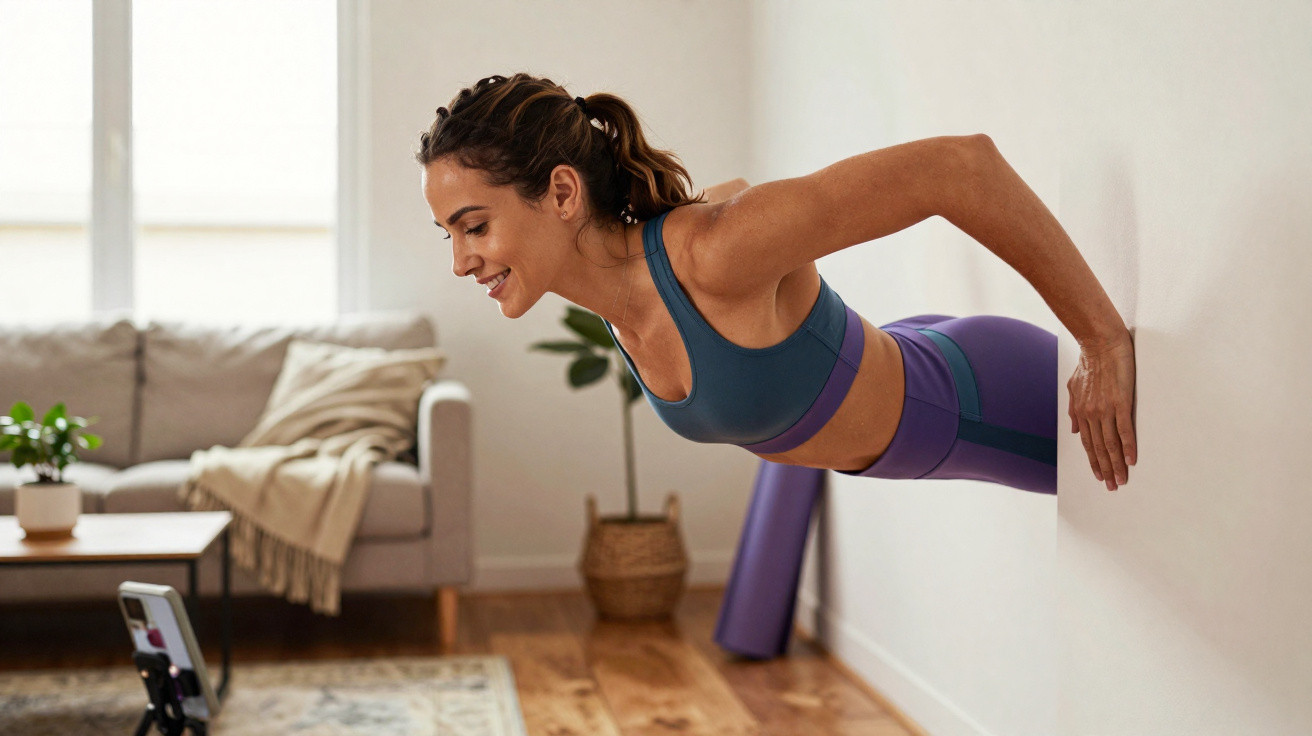
By the end of the day, many people recognise the almost automatic gesture: placing their hands on the hallway wall, stretching their shoulders after hours in front of a screen, then noticing their arms could do with a little more tone. Personal trainer Leticia Pelegrín puts this very straightforward movement back in the spotlight: pushing against a wall, as if doing a press-up, can activate the chest and arm muscles without a gym or bulky equipment. The living-room wall then becomes a discreet ally, ready to use between appointments, before a shower or while the coffee cools. It may not look dramatic, but the body often responds well to modest routines. What if that wall were a genuine starting point?
The wall press-up: a simple exercise that is far from trivial
The idea can seem almost too easy: step your feet slightly back, place your palms at chest height, slowly bring your torso towards the wall, then push away again. Even so, the triceps, shoulders and chest muscles start working from the first few repetitions, particularly when you keep your core engaged and your back properly aligned. This standing version removes much of the challenge of a conventional floor press-up without taking away the effort.
Whether you are in a narrow kitchen or an office, all you need is clear space in front of a closed door or a sturdy wall. A beginner can start with two sets of eight repetitions, taking time to breathe out with each push; this takes less than five minutes. The amount may appear modest, yet repeating it three times a week creates a tangible appointment with your body.
The principle is mechanical: the closer your feet are to the wall, the less body weight your arms support. Moving your feet further back changes the angle and gradually makes the exercise more demanding, without any sudden increase in difficulty. This scope for adjustment is especially valuable for anyone rebuilding strength after a long break, or simply wishing to avoid the intimidating prospect of getting down on an exercise mat.
Leticia Pelegrín’s recommended movement: finding the right distance
To perform the movement, Leticia Pelegrín suggests imagining your body as a fairly straight line from your heels to your head. Set your hands on the wall slightly wider than shoulder-width apart, take one or two steps back, then bend your elbows without allowing them to flare fully out to the sides. Bring your nose or chest towards the wall, before gently pressing through your palms to return to the starting position.
The most common mistake is moving only the face forwards while leaving the hips well behind. Everyone does this at times: there is a temptation to finish quickly, especially once the arms begin to burn. Let us be honest: nobody really does it every single day. Six slow, controlled repetitions are better than one long set in which the lower back arches and the shoulders take all the load.
Pace matters just as much as repetition count: breathe in as you lower yourself and breathe out as you push, without holding your breath. The trainer’s approach can be summed up in an accessible phrase:
“A useful exercise does not necessarily have to be complicated: above all, it needs to be one you can do again tomorrow.”
- Place your hands at chest height, keeping your wrists comfortable.
- Keep your shoulders away from your ears throughout the pushing phase.
- Gently brace your abdominal muscles to prevent your back from arching.
- Begin with 8 to 12 repetitions, then increase only if the movement remains smooth.
More toned arms without turning your living room into a gym
Wall press-ups do not promise sculpted arms in three days, and that is reassuring. They provide a realistic route into strength training, especially when tiredness, a packed timetable or worries about doing it incorrectly have already delayed many good intentions. As the sessions go by, the movement feels more natural, the shoulders become steadier and the relationship with exercise is often less anxious.
To make progress, you can gradually move your feet further away, take three seconds to lower yourself or add a third set. A sturdy chair may later be used as an incline support to develop the exercise, provided you first check that it will not slide. If you experience sharp pain in a wrist, shoulder or chest, stop the movement and seek advice from a healthcare professional.
The appeal of this approach lies in how almost unnoticed it can be in everyday life. A few pushes against the wall before leaving for work, during a phone break or after putting away the shopping do not only change the muscles being used: they also change how you see yourself. Your body is no longer a huge project to restart on Monday; it becomes something you can listen to, move and encourage today.
| Key point | Detail | Added value for the reader |
|---|---|---|
| Incline press-up | Your hands remain on a sturdy wall while your body leans slightly forwards. | An accessible alternative to the classic floor press-up. |
| Gradual progression | Moving your feet back naturally increases resistance. | Adapt the effort to your level without equipment. |
| Realistic consistency | Two or three short weekly sessions are enough to get started. | Build a lasting habit into a busy schedule. |
















Comments
No comments yet. Be the first to comment!
Leave a Comment