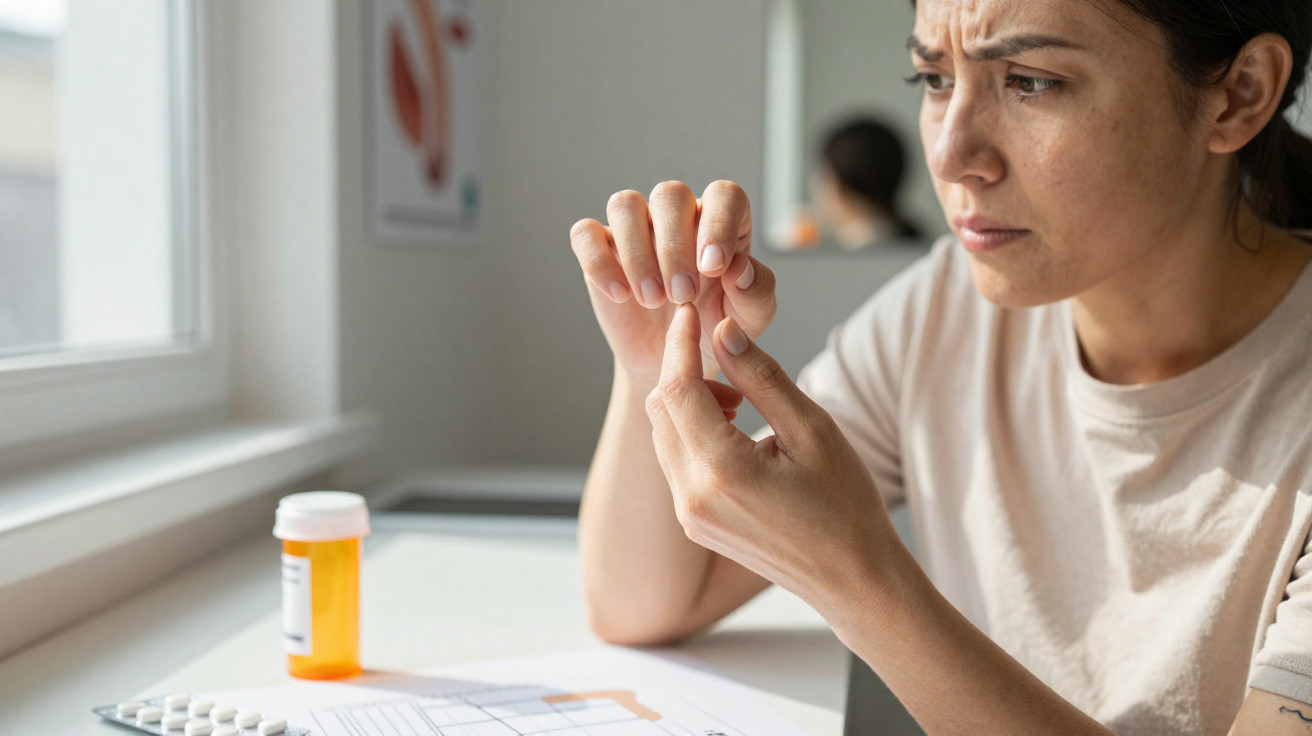
When you begin taking a medicine and spot a change in your body, it is natural to wonder whether the medication is to blame. Changes affecting your nails can raise the same concern.
A new study has explored whether nail conditions are more frequent in people using GLP-1 drugs for obesity and type 2 diabetes. The research, involving 1,904 people in four countries, identified a difference between those using the medicines and those who had never taken them.
Nail detachment was reported by 39 percent of GLP-1 users, compared with 9 percent of participants with type 2 diabetes or obesity who had not used these drugs. Yet roughly half of the users said they had experienced nail problems before beginning treatment.
The results were presented at the European Academy of Dermatology and Venereology (EADV) Congress 2026 in Vienna.
GLP-1 drugs and reported nail disorders
The researchers recruited 575 GLP-1 users and 1,329 people with type 2 diabetes or obesity who had never used the medicines. Participants came from France, the United States, Brazil and Mexico.
An EADV press release states that 66 percent of users reported at least one nail disorder, against 53 percent of the control group. Nail discolouration was reported by 46 percent of GLP-1 users, compared with 17 percent of controls.
"Our findings show a clear association, but they also underline an important point," says study author Charles Taïeb, the managing director of the European Market Maintenance Assessment.
"Not everything that happens during GLP-1 treatment is necessarily caused by the treatment itself."
Participants reported their own symptoms, rather than being assessed through standardised dermatological examinations over the course of treatment. As a cross-sectional study, it recorded experiences at a single point in time. It therefore cannot show that the medications caused the reported changes.
It is also uncertain how extensive the nail detachment was. The researchers have not said whether this meant a partial separation from the nail bed, complete loss of a nail, or both. Available information also does not indicate whether the reports concerned fingernails, toenails or both.
In general, separation of a nail plate from its nail bed is known as onycholysis. DermNet notes that it may affect fingernails or toenails and can arise from several causes, including injury, skin disease and infection. That context does not establish which conditions affected the participants in this study.
Consequently, the 39 percent figure should not be interpreted as showing that almost four in ten users lost their nails entirely. Nor does it indicate the likelihood that a new patient will develop the issue after starting medication.
What the study can and cannot show
In their analysis, the researchers adjusted for dermatological conditions and nutritional deficiencies. Although some associations became weaker, nail detachment and discolouration remained approximately two to three times more common among users, according to the press release.
The announcement does not provide the precise adjusted estimates or confidence intervals. It is therefore not possible to judge the precision of these comparisons from the release alone.
The team also assessed weight loss. The differences remained statistically significant when analysis was restricted to participants who had lost weight, indicating that weight loss alone may not account for the findings. Even so, this does not prove that GLP-1 drugs have a direct effect on nails.
The press release does not specify which GLP-1 medications were used, nor does it give findings for individual drugs. As a result, it cannot establish that any nail effect is linked to one particular medicine.
Both studies are cited in the release as conference presentations, rather than as findings reported in a published paper. The nail study received institutional support from DUCRAY Laboratories, part of the Pierre Fabre Group, which develops dermatological and hair-care products.
Hair and scalp symptoms in the same participants
A companion study of the same participants looked at hair and scalp symptoms, furthering interest in possible connections between GLP-1 pathways and hair loss.
Unusual hair loss was reported by 50 percent of users, versus 34 percent of controls. Reduced hair volume or density was reported by 42 percent, compared with 19 percent of controls.
For users, hair loss was commonly accompanied by scalp symptoms including itching, redness or scaling.
Study author and dermatologist Bruno Halioua, of the Société Française des Sciences Humaines sur la Peau (SFSHP), suggests this pattern may extend beyond the shedding commonly associated with rapid weight loss and could involve inflammation.
Because the hair findings came from the same group, they do not independently reproduce the nail findings. Rather, they provide a further perspective on symptoms reported by this particular sample.
Further research will need to establish whether similar patterns occur in other populations and how often problems emerge after treatment begins.
Researchers now intend to follow patients from the beginning of treatment. Standardised dermatological examinations and biological monitoring may help determine when changes arise, what factors contribute to them and whether they can be reversed.
Halioua says the changes are frequent and generally benign. His advice for people who notice nail changes, hair loss, or an itchy or red scalp is to speak with their doctor about these symptoms, rather than stopping treatment on their own.
This article was fact-checked by Rachel Garner and edited by Peter Dockrill. While we pride ourselves on our process, we are only human. If you spot a mistake, please let us know.















Comments
No comments yet. Be the first to comment!
Leave a Comment