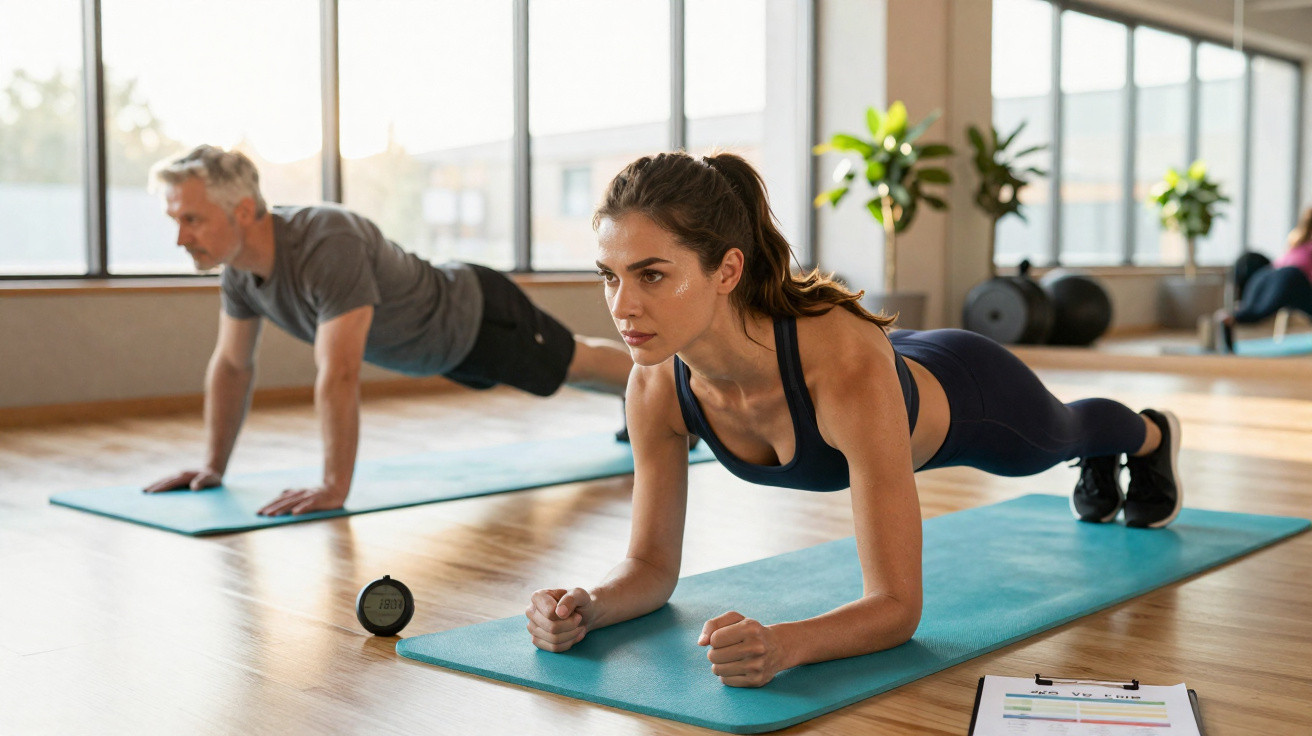
But what do reputable trainers say – and what is genuinely appropriate for your age?
The plank is a favourite among fitness influencers: supposedly straightforward, brutally effective and frequently exaggerated beyond reason. An NBA coach and other experts have suggested benchmarks for different age groups. They indicate what realistic holding times look like – without fitness obsession or back pain.
Why the plank is more than an abdominal exercise
At first glance, the plank may appear to work only the abs. In fact, it is a full core workout. The rectus abdominis is engaged, the obliques assist, and the deep transverse abdominal muscle stabilises from within. The spinal extensors, glutes, thighs and shoulder girdle are involved too.
The plank offers an excellent balance of effort, time and results – provided your form is right.
Trainers who work with professionals often describe the plank as a “fundamental exercise”: people with a stable core move more safely in daily life, lift loads with less strain on their back and are less likely to get themselves into trouble in sports such as tennis, football or skiing.
Its benefits are particularly apparent at an older age. Studies suggest that a strong, stable core improves balance and reduces falls. A few brief sessions each week can therefore achieve more than many a complicated gym-machine programme.
Plank target times by age: where you should roughly be
There is no single ideal time. Body weight, training experience, injuries and how you feel on a given day all play a role. Nevertheless, some coaches use reference ranges to give people a broad idea of their current level.
| Age | Solid benchmark | For well-trained people |
|---|---|---|
| 18–39 years | 45–90 seconds | up to around 2 minutes |
| 40–59 years | 30–75 seconds | up to around 90 seconds |
| 60 years and over | 20–60 seconds | individual, without pushing into pain |
These figures are not a test but a rough traffic-light guide: green if you are roughly in this range, amber if you fall well below it, and red if you force yourself through a record time while neglecting your back position.
What matters more than any stopwatch is a core working with good form – not desperate shaking just before you collapse.
Many trainers notice the same issue: people judge their fitness by viral challenges (“Who can hold a plank the longest?”), feel like failures at 40 or 60 seconds, then overdo it – at the expense of their health.
Technique over ego: what a proper plank looks like
The most common mistake is allowing the back to sag or arch excessively. This shifts the force into the lumbar spine rather than the muscles. It is therefore worth checking your technique carefully before trying to extend your time.
Checklist for the classic forearm plank
- Keep your forearms parallel, with elbows beneath your shoulders and hands relaxed or clasped.
- Keep the shoulders active: do not “hang into the floor”; instead, gently push yourself away from it.
- Lower the breastbone slightly towards the floor, lengthen the neck in line with the spine and look down.
- Draw the abdomen in as though you were pulling your navel towards your spine.
- Squeeze the glutes, without tilting the pelvis or pushing it upwards.
- Keep the front of the thighs firm and the knees straight, or support yourself on the knees for the easier version.
- Breathe smoothly; do not strain or hold your breath.
As soon as your back sags or you lose the feeling in your abs, the set is over – even if the stopwatch has not yet reached your desired target.
For beginners, the kneeling version is suitable: the abdominal muscles still carry a substantial load, while the lower back is relieved. If you can hold this position steadily for 30 seconds, you are building a sound foundation.
How to progress without frustration or pain
Long-term improvement rarely comes from extreme challenges, but from small, manageable steps. A simple approach is to use short efforts consistently.
A possible four-week plan
- Week 1: 3–4 times a week, 3 sets of 20 seconds each, with 30–40 seconds of rest between sets.
- Week 2: increase the hold in each set to 25 seconds for every session.
- Week 3: progress to 30–35 seconds; anyone who wishes can add a fourth set.
- Week 4: aim for 40–45 seconds, but only if technique remains stable.
People who build these blocks on top of one another can comfortably reach the stated benchmark ranges after a few months – entirely without a social-media challenge. The key point is this: on days when your back feels tight or you are tired, do shorter sets or switch to an easier variation.
How useful are extreme plank challenges really?
Plank competitions lasting three, four or five minutes look impressive. Sports scientists are more critical of them. Beyond a certain duration, the body is mainly fighting muscle burning and pain in the lower back. Their practical benefit for everyday life decreases sharply.
There is also a psychological aspect: anyone who defines themselves solely by records ignores other important signs of health – such as sleep quality, stress levels, climbing stairs or being able to play energetically with the children without becoming breathless straight away.
What really reveals your fitness
Trainers who work with recreational exercisers often ask a different question: “How do you feel in everyday life?” A strong core helps you carry shopping, sit upright at work or head out spontaneously for a bike ride.
Someone who can walk up two flights of stairs without puffing is often in better shape than someone focused only on a two-minute plank.
That is why many coaches advise viewing the plank as one component of a short full-body programme. One possible mini circuit is:
- 15 squats
- 10 lunges per leg
- 20–40 seconds of plank
- 30 seconds of easy walking or marching on the spot
Repeat this sequence twice – it takes barely ten minutes and trains the legs, core and cardiovascular system far more comprehensively than an endless static hold.
Plank variations that challenge your body in new ways
Once you have mastered the basic position confidently, variations can provide new stimuli and improve strength, stability and coordination without simply holding the position for longer.
- Side plank: particularly strengthens the muscles along the sides of the core and helps counter uneven loading.
- Plank with shoulder taps: from a high plank, touch the left shoulder with your right hand and vice versa – ideal for core stability.
- Plank with leg lifts: raise one leg a few centimetres at a time, keeping the glutes and lower back stable.
- Plank on an elevated surface: place your hands or forearms on a bench or sturdy chair; this reduces the load for beginners and teaches the line of tension.
These variations ensure that balance and body awareness benefit alongside the back and abdominal muscles. They also make it easier to keep holds shorter while maintaining close control of your technique.
When the plank is not a good idea
Anyone with severe acute back pain, a recent slipped disc, shoulder injuries or significant high-blood-pressure problems should discuss planks with a doctor or physiotherapist. The same applies after pregnancy or abdominal surgery: first regain stability in daily life, then begin gradually with gentle variations.
A simple principle can help as a guide: the effort may feel intense, but it should not be sharp, burning or radiate into the legs. If these signs occur, stop training and seek professional advice.
Why regular short sessions achieve more than heroic efforts
Ultimately, the plank is a tool. Someone who includes it in a short programme two or three times a week benefits far more than someone who forces a painful record time once a month. The combination of core strength, mobility and endurance determines how strong and resilient you feel in everyday life.
Whether you hold for 30 seconds, 90 seconds or two minutes, you are on the right track as long as your back remains stable, you breathe calmly and, once you finish, feel that “something is working”. The stopwatch provides only the numbers – your body tells the real story.









Comments
No comments yet. Be the first to comment!
Leave a Comment