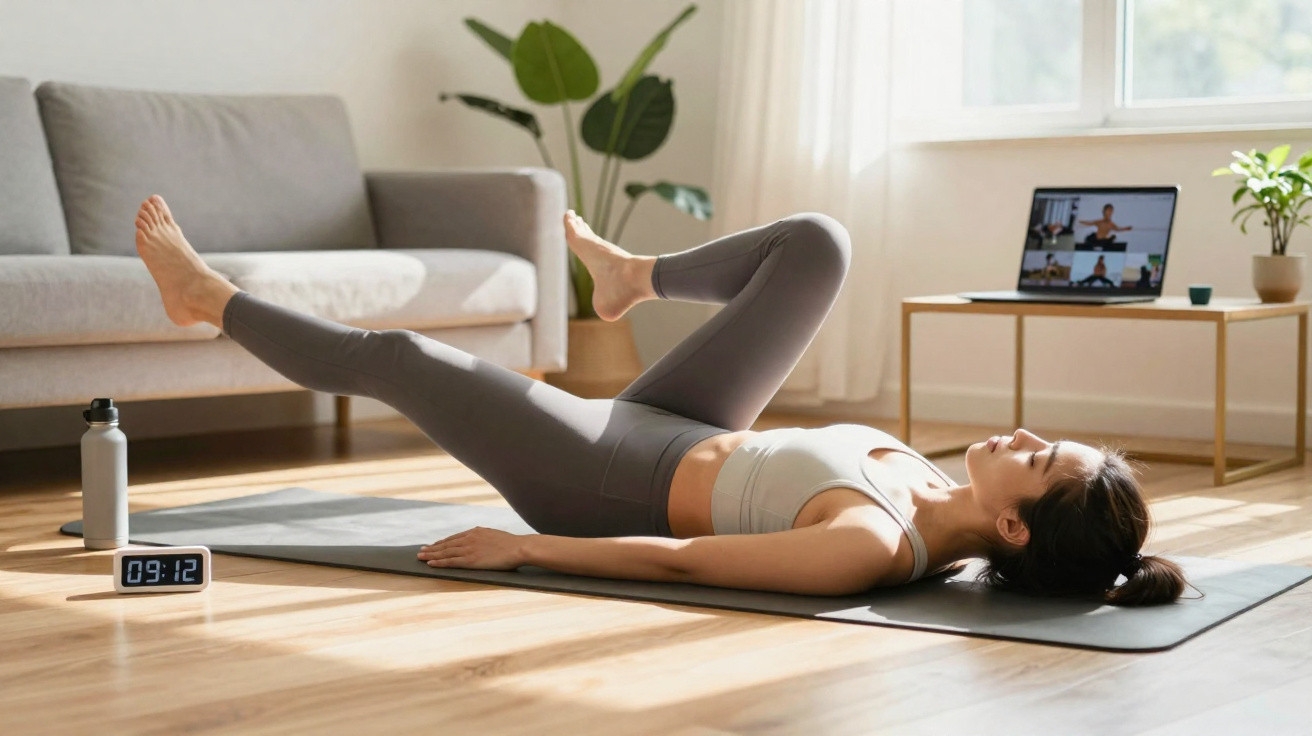
Many people diligently do sit-ups and then wonder why almost nothing changes around the lower abs. This is usually not due to a lack of discipline, but to choosing the wrong type of exercise. This short Pilates-inspired routine targets precisely the areas where conventional crunches fall short: the deep lower abdominal muscles and the stabilising core.
Why lower abs are so difficult to target
The area below the navel is anatomically and functionally demanding. It is where the deep abdominal muscles, hip flexors and pelvic floor meet. If you only train the upper part of the rectus abdominis, the lower abs can remain soft, regardless of how many sit-ups you complete.
“Focused, calm movements that stabilise the lumbar spine and engage the deep muscles usually achieve more than a hundred rushed crunches.”
This workout plan relies on controlled, small movements. Muscle tension and technique matter more than speed. That also makes it well suited to the living room: no jumping, no noise and very little space required.
How the 10-minute workout is structured
The programme includes ten exercises for the lower abs and deep core muscles. Each exercise lasts 45 seconds, followed by 15 seconds of rest. If you are just starting out, shorten the work intervals and allow yourself longer breaks.
- 45 seconds of work – calm, precise movements
- 15 seconds of rest – take a brief breath and change position
- 10 exercises in total – around 10 minutes of actual exercise time
The sequence follows typical Pilates principles: a stable core, smooth breathing and controlled movement patterns.
The 10 key lower abs exercises
1. Lowering bent legs while lying on your back
Lie on your back with your feet together and knees opened out to the sides. Keep your lumbar spine firmly pressed into the mat. Slowly lower your bent legs, then bring them back up. Maintain continuous tension through the lower abs throughout.
2. Straighten the legs and lift the hips
Still lying on your back, alternate between extending your legs long just above the floor and gently lifting your hips towards the ceiling. Avoid momentum and jerky movements: the effort should come from your abs and glutes.
3. Lower and extend one leg with a firm core
From a lying position, extend one leg upwards and lower it steadily towards the floor. Keep your abdominals engaged and your lower back glued to the mat. Then switch to the other leg.
4. Seated upper-body rocking movement
Sit with your legs drawn in, lean your upper body slightly backwards and hold a semi-reclined position. From there, make very small pulses forwards and backwards. Keep your shoulders low, gently draw the shoulder blades together and brace your abs firmly.
5. Lean back and open the legs
From sitting, recline further and extend both legs into a slight straddle. Try to put as little pressure as possible through your heels into the floor. Your abs provide the stability while your upper body and legs hold their position.
6. Large vertical scissor kicks on your forearms
Support your upper body on your forearms and keep your legs fully extended. Perform large up-and-down scissor movements. Keep your back straight, neck long and heels hovering just above the floor.
7. Open the legs at a 45-degree angle
In the same forearm-supported position, extend both legs forwards at roughly a 45-degree angle, then open and close your thighs. Keep the lumbar spine stable and the upper body as still as possible.
8. Alternate leg extensions just above the floor
Return to lying on your back, with your head and shoulder girdle slightly raised and your gaze directed upwards. Alternately extend one leg forwards, keeping it just above the floor. Choose either the easier variation with a slightly bent leg or the more challenging version with a fully straightened knee.
9. Alternate hip lifts with lowering the legs
With your legs bent and raised, lift your hips slightly off the mat before lowering your legs a little again. Control every centimetre: do not swing or “fling” the legs.
10. Horizontal scissor kicks with leg lowering
To finish, combine horizontal scissor movements with slowly lowering the legs. Keep your lumbar spine firmly connected to the mat at all times – that is your safety anchor.
How to get the most from 10 minutes
The results come from tension, not speed. Working too quickly means losing control of your back and hips – the very areas these exercises are designed to engage.
“Slow does not mean boring in this workout; it means effective. Every second under tension counts twice.”
A few straightforward rules make all the difference:
- Keep movements smooth and free from jerking.
- Exhale during exertion and inhale as you release.
- Never hold your breath – it only raises blood pressure.
- Keep the lumbar spine stable and do not allow your lower back to arch.
- Prefer a smaller range of movement performed with clean technique.
Three sessions each week are ideal, with a rest day between them. Beginners can start with 30 seconds of work and 30 seconds of rest, then gradually progress to the full 45/15 format.
Why this training alone will not “melt away” belly fat
As stubborn as abdominal fat can be, so too is the myth that you can burn fat from one specific body part through targeted exercises. It does not work that way. Your body determines where it draws on fat stores first.
The benefits of this programme lie elsewhere:
- the lower abdominal muscles become stronger
- the waist looks more defined when body-fat percentage falls
- the core provides better stability in everyday life and sport
- strain on the back and hips is reduced
Anyone who wants visibly defined abs also needs a moderate calorie deficit and regular endurance exercise, such as brisk walking, cycling, running or swimming. Only the combination of nutrition, cardio and targeted strength training reveals the shape of the muscles.
Common mistakes and how to avoid them
Many people make a lower abs workout unnecessarily difficult – or even risk pain. Three pitfalls appear time and again:
- Too much speed: Rushing turns the exercise into momentum-driven movement. The hips shoot upwards, the lower back arches and the abs lose tension.
- An arched lower back when lying down: As soon as the lower back lifts off the mat, the lumbar spine takes over. Instead, keep your legs a little higher and reduce the range of movement.
- A tense neck: Anyone who pulls their head up using the neck muscles will soon feel tension in the neck. The solution: look diagonally upwards, move your shoulders away from your ears and keep the neck long.
What this focus on the core can also do
The deep core – meaning the lower abs, obliques, pelvic floor and small muscles around the spine – has far more roles than simply “looking good”. It stabilises every everyday movement, from tying your shoes to lifting a shopping bag.
People who train this area regularly often notice side benefits: more upright posture, less pulling in the lower back and greater control in sports such as running, tennis or dancing. This is especially useful for desk-based work, as the spine no longer has to carry every load on its own.
How to combine the workout effectively
For a more complete home programme, the 10-minute lower abs plan is easy to build upon. Two or three additions work particularly well:
- begin with a brief mobility session for the hips and spine, such as cat-cow, pelvic tilts and hip circles
- follow with a few minutes of gentle cardio, such as climbing stairs, jumping jacks at a moderate pace or a brisk walk
- on other days, do a workout for the back, glutes and legs to strengthen the body evenly
If certain terms keep appearing, “core” essentially refers to this centre of the body: the combined work of the abs, back, hips and pelvic floor. A stable core acts like an internal belt that supports every movement.
Ten focused minutes can already make this belt noticeably stronger. Consistency, sound technique and the confidence to work slowly rather than chasing explosive speed are what matter. That is what makes the difference – not the number of repetitions.











Comments
No comments yet. Be the first to comment!
Leave a Comment