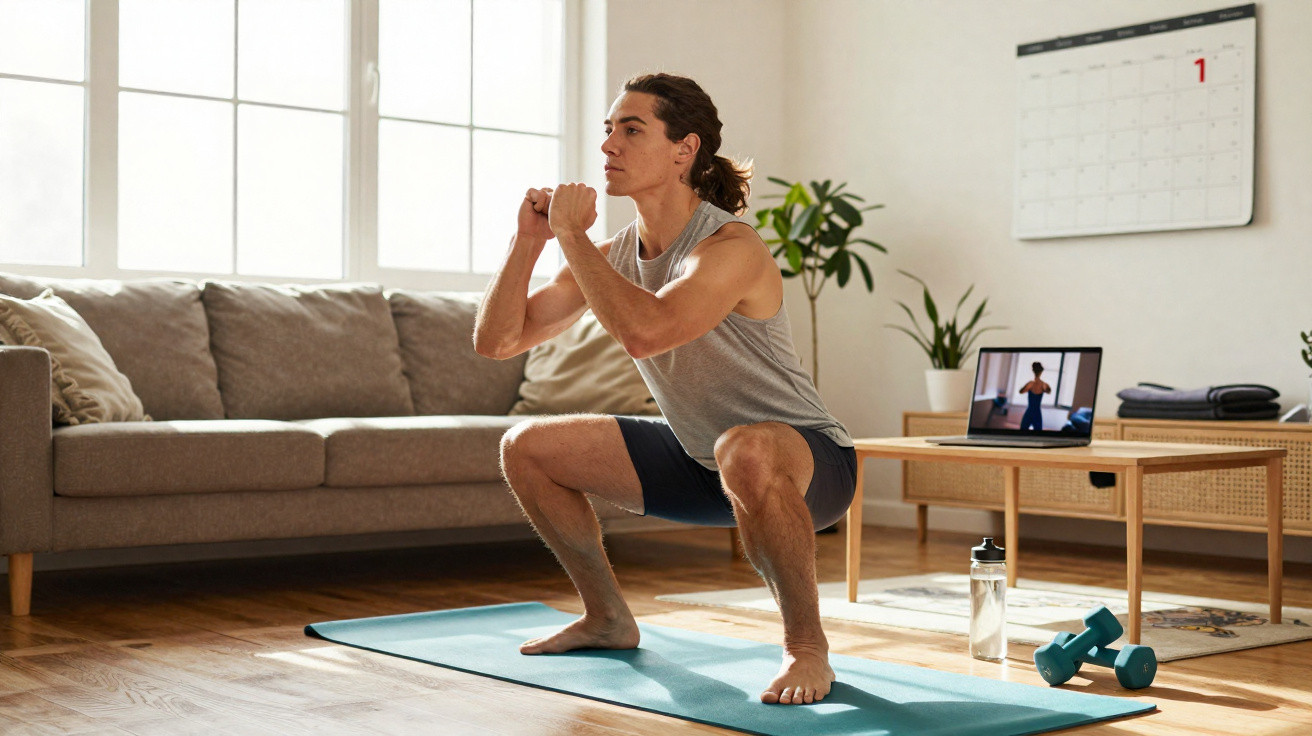
Many people hold an annual gym membership yet have little time-or patience left-for crowded changing rooms, loud music and rush-hour traffic after work. The good news is that you do not need to go anywhere to get back into shape. With a structured 30-day plan and ten straightforward full-body exercises, you can begin in your living room-without equipment, wall-to-wall mirrors or fitness posturing.
Why your living room can be more effective than any gym
Training at home may sound unremarkable, but it can be extremely effective. There is no journey, no gym bag to pack and no waiting around for equipment. You decide when you train, where you train and how quickly you progress.
“Regular sessions of 15 to 25 minutes achieve more than an excessively hard workout that you only force yourself through once a month.”
If you work from home, you can fit in a brief session before the first email, during your lunch break or in the evening after putting the children to bed. The barrier to getting started is much lower when all you need to do is roll out a mat, set a timer and begin.
Your body responds quickly to this new consistency. Your breathing becomes calmer, your circulation steadier and your joints feel more mobile. People who spend much of the day sitting in particular often notice within a few days that their neck, back and hips feel less stiff.
30-day commitment: turning exercise into a habit
A month may seem manageable, but it is enough time to set real changes in motion. The first few sessions can feel tough: muscles burn and your heart rate rises. That is entirely normal, especially after a lengthy break.
The key is not perfection but consistency. At first, schedule three sessions each week using the same ten exercises. After ten days, the sequence will feel more familiar; after roughly three weeks, it becomes less of an effort and more like a regular appointment with yourself.
“What matters is not how fit you are when you begin-it is that you keep going, even on tired days.”
After 30 days, many people notice clear benefits: improved sleep, less tension, a more stable core and more breath when climbing stairs. Visible changes are a bonus, but they are not the only measure of progress.
The 10 most important exercises for your living room workout
You only need a little clear floor space, a mat or carpet, and comfortable clothes. The following movements work your legs, glutes, core, back and cardiovascular system.
Legs and heart rate: build lower-body strength and endurance
- Squats: Stand with your feet roughly shoulder-width apart and your toes pointing slightly outwards. Bend your knees as though lowering yourself onto an invisible stool. Keep your heels on the floor, your back upright and your gaze forwards.
- Reverse lunges: From standing, take a large step backwards with one leg and lower the rear knee towards the floor. Push yourself forwards again in a controlled way. This version is generally kinder to the joints than stepping forwards.
- High knees on the spot: March or run on the spot, bringing your knees as high towards your hips as you can. Keep your upper body steady and land softly on the balls of your feet.
- Jumping jacks: From a closed stance, jump your legs out to the sides while raising your arms, then return to the starting position. They support cardiovascular fitness and warm up the entire body.
- Side-to-side skater jumps: Leap sideways from one leg to the other as if gliding across ice. Slightly bend the supporting leg while keeping your upper body engaged. This develops balance and hip stability.
These five movements efficiently target the leg muscles, glutes and cardiovascular system. Anyone who sits at a desk for long periods particularly benefits from activating the large muscle groups in the thighs and buttocks.
Core and back: stability rather than an arched lower back
A strong core protects your spine and improves everyday movements, from carrying shopping bags to lifting a child into a car seat.
- Forearm plank: Lie face down, then support yourself on your forearms and toes. Lift your hips until your body forms a straight line. Draw your navel in, squeeze your glutes firmly and do not let your lower back sag.
- Press-ups: Start on your knees if needed. Place your hands beneath your shoulders, with your elbows angled slightly backwards. Lower your upper body under control and press yourself back up. Your chest, shoulders, arms and core work together.
- Mountain climbers: From a press-up position, alternately draw one knee towards your chest. Choose a pace that matches your fitness level. This exercise challenges your abs, shoulders and cardiovascular system at the same time.
- Superman: Lie on your front with your arms stretched forwards. Raise your arms and legs a few centimetres off the floor, hold briefly, then lower them again. This strengthens the muscles along the lumbar spine.
- Glute bridge: Lie on your back with your feet hip-width apart and knees bent. Raise your hips until your knees, hips and shoulders create one line. Squeeze your glutes strongly, pause briefly and lower yourself slowly.
“Anyone who strengthens their core regularly eases pressure on the spinal discs and helps prevent painful everyday tension.”
What your 30-day plan could look like in practice
A fixed routine helps you organise the exercises effectively. Here is one example for beginners:
| Day | Content |
|---|---|
| 1–10 | 3 sessions per week, 20 seconds of exercise / 30 seconds of rest per exercise, 1 round |
| 11–20 | 3–4 sessions per week, 30 seconds of exercise / 30 seconds of rest, 2 rounds |
| 21–30 | 4 sessions per week, 35–40 seconds of exercise / 20 seconds of rest, 2–3 rounds |
Make sure you deliberately include rest days between sessions. On those days, a walk or some gentle stretching is enough. Your body needs recovery to build muscle and avoid overloading the tendons.
Adapting your training: make it easier or deliberately progress
No two people begin at the same fitness level. Pay attention to warning signs from your joints. Sharp pain or a feeling of blockage clearly means that you should make the exercise easier.
- Only squat halfway down if your knees object
- Do press-ups against a wall or sofa rather than on the floor
- Do jumping jacks without jumping, using side steps instead
If the movements feel noticeably easier after two weeks, you can raise the challenge: lower yourself more slowly, shorten the rests or add another round. This lets you progress without overwhelming your body.
Mindset: how to stay consistent on lazy days
The biggest obstacle is rarely your muscles; it is usually your inner resistance. After a long working day or a short night, the sofa can seem endlessly tempting. At times like these, one rule helps: five minutes is always possible.
“Once you start, you have won-even if it only becomes a mini session.”
Begin with a short warm-up and two or three exercises at an easy intensity, then stop before you are completely exhausted. Many people find that once they are moving, they naturally carry on for a few extra minutes.
Write down small everyday wins: becoming less out of breath on the stairs, lifting crates of drinks more easily or feeling freer in your back while sitting at your desk. Specific improvements like these are far more motivating than a number on the scales alone.
What else to consider: safety, breathing and your surroundings
Safety is particularly worth considering when you exercise at home. Clear your workout area so that you do not catch yourself on anything. If the floor is slippery, train in shoes with good grip. Drink enough water before and after your session.
Breathing matters more than many people realise. Do not hold your breath; breathe out during the effort and breathe in during the easier phase. This stabilises your core and helps keep your circulation balanced.
A small ritual can help: use the same mat, the same corner of the living room and perhaps a regular music playlist. Your brain will then automatically associate that space with movement and activity. Over time, your body will begin to look forward to this break from the desk chair.
If you remain consistent in the long term, you can expand the programme-for example, with stretching sessions, easy jogging or cycling. These ten exercises remain a valuable foundation because they build and maintain your basic strength and stability for everyday life.














Comments
No comments yet. Be the first to comment!
Leave a Comment