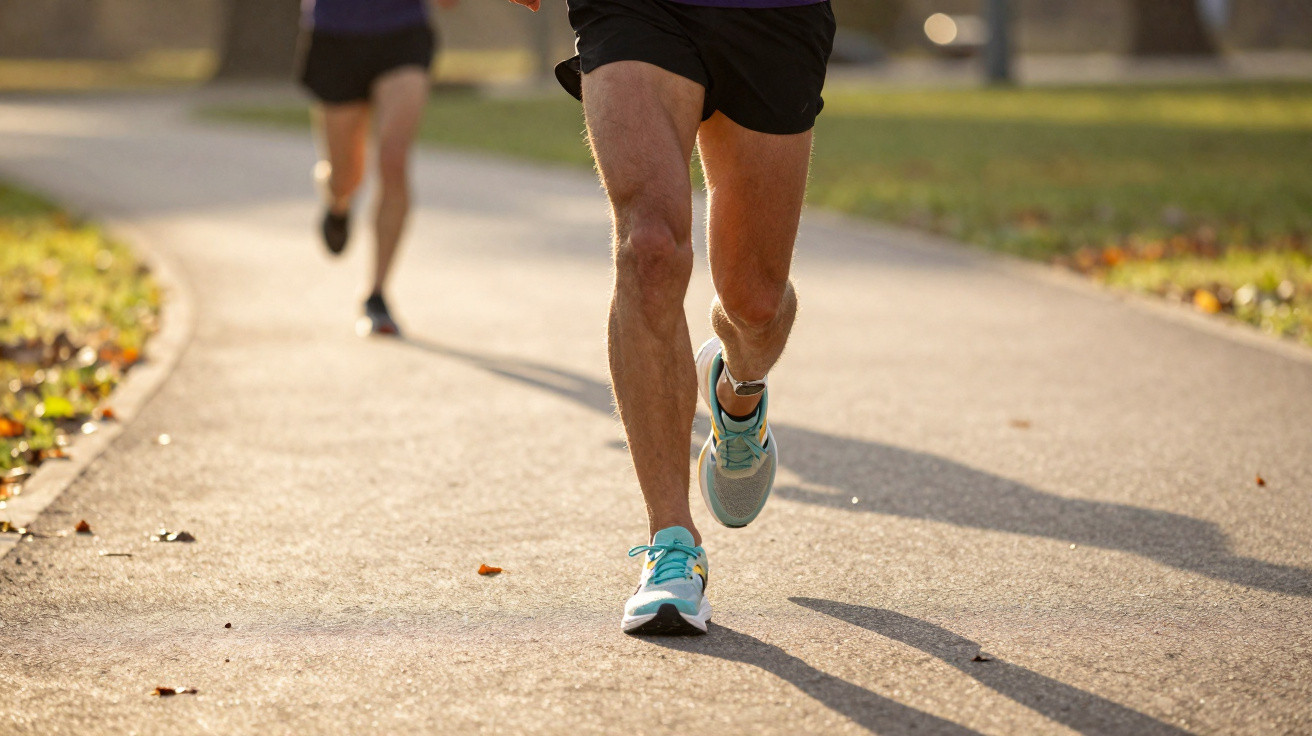
At the traffic lights, a man taps at his smartwatch, takes two deep breaths and breaks into a jog. He starts gently, then picks up speed; his strides lengthen and become almost heroic. On paper, it looks athletic. In reality, it sounds like small thunderclaps on the tarmac. Every landing sends a brief jolt through his whole body. I walk along the pavement beside him, hearing his laboured breathing and watching him slow almost imperceptibly after the second junction. Nearly everyone who has ever felt motivated to “take jogging seriously” will recognise this kind of run. It feels powerful – while draining energy we never realised could disappear so quickly. Yet there is one inconspicuous adjustment that can change everything.
Why we instinctively overdo it when jogging
We all know the feeling: as soon as we lace up our running shoes, a little film starts playing in our minds. Sports adverts, running influencers, marathon runners at sunrise. Something unhelpful happens beneath the surface: we want to look just like them. Tall, light and fast. The result is exaggerated, overly long strides, with the foot landing far ahead of the body. From the outside, it appears dynamic; from within, it can feel like carefully managed loss of control. The hips sway and the upper body works harder than we would like. Suddenly, there is that quiet sense of forcing something that simply does not want to flow.
A running coach I accompanied in a park in Cologne calls this the “Superman stride”. She points out one of her trainees: in his early thirties, fit and ambitious. His feet land almost a full shoe length ahead of his knee. His heel strikes first, and the rest of his body wobbles behind it. Before he has even completed two kilometres, it is obvious how hard he is working. Interestingly, his watch displays a respectable pace, yet his heart rate is already deep in the red zone. During a short break, he says: “I’ve run like this for years; I always thought it had to be this way, otherwise you don’t get faster.” It is clearly a sentence the coach hears all the time.
The plain truth is that our bodies tolerate long strides while jogging only to a limited extent. Biomechanically, “overstriding” – when the foot lands too far ahead of the body’s centre of mass – creates a small collision at every foot strike. Braking forces increase, the knee absorbs more impact and the hips have to stabilise something that was never meant to be stable. Energy disappears into the ground instead of moving us forwards. Shorter steps at a higher frequency, by contrast, make use of the elastic system of muscles and tendons. It is like having an invisible trampoline beneath each foot. Less braking, more spring. Suddenly, the body works with physics rather than against it.
How shorter steps can make running feel easier
The key is an understated figure: stride frequency. Many recreational runners sit somewhere around 150–160 steps per minute and compensate with longer strides. Try experimenting with a number such as 165–175 steps per minute. Do not force it; treat it like a gentle rhythm in the background. Imagine taking slightly quicker, lighter steps without greatly changing your overall pace. Your foot will immediately begin to land closer beneath your body. The impact sounds quieter and each landing feels more stable. For the first few minutes, it can feel odd, almost as if you are denying yourself proper strides. Then comes that unusual moment when you are no longer running against the ground, but moving along with it.
Many people push too hard at the beginning. They hear about a “high frequency” and jump straight from 155 to 190. After two runs, their calves are rock hard and their motivation has vanished. Let us be honest: nobody willingly sticks to such a radical change for long. A more realistic approach is to increase your frequency by just five steps per minute at first, for one or two weeks. Then add another five, perhaps. At the same time, deliberately ease your pace slightly, especially in the first attempts. It is fine if your watch feels a little “slow” for a while. Your body needs room to store new movement patterns rather than merely trying to survive them.
“Most recreational runners aren’t running too slowly; they’re running too hard for their technique,” says the coach in the park as her trainee passes us with noticeably shorter steps. “If they have the courage to shorten their strides, they suddenly become faster – but only once they stop trying to force it.”
- Practise shorter steps at an easy pace first – technique and the nervous system need calm conditions to adapt.
- Change only one variable at a time – either raise your frequency slightly or vary your pace; do not mix both chaotically.
- Listen to the sound – a quieter landing points in the right direction, while a loud slap usually means strides are too long or heel striking is too hard.
- Add short technique blocks once or twice a week rather than rebuilding every run – consistency beats perfection.
- Check your running style regularly – use your shadow, shop windows or a phone video to compare what you feel with what is actually happening.
What happens when we truly listen to our running style
Things become interesting when theory gradually turns into personal experience. The runner from Cologne spends several weeks consciously taking shorter steps. He says that at first they felt almost “ridiculously short”. Then one morning, he leaves the house and notices that his body is doing it on its own: no thinking, no counting. At the same pace, his heart rate is lower; his knees complain less; and long runs no longer feel like a battle for every kilometre. He is still not running marathon times. But he looks as though he has finally arrived in his own body instead of stumbling alongside it.
That is the emotional centre of what seems like a purely technical question. Overly long strides are often an attempt to look “fast” to other people. Shorter steps are more like a quiet acknowledgement of what you can genuinely do – and of what your body can give you if you let it. There is something disarming about that. You consciously give up the dramatic display, that “look how athletic I am” stride. In return, you get something that is rare in everyday life: movement that does not constantly scrape against your limits, but feels sustainable. It is almost as though, when jogging, you finally arrive rather than always trying to run somewhere else.
Perhaps you will soon be standing at traffic lights again, discreetly observing how other people run and recognising something familiar. The noisy landings. The overextended strides. The tense faces. And perhaps, in that same moment, you will notice how you set off yourself – with steps shorter than your ego once allowed. But smoother. Calmer. You are still running ordinary routes through the same streets. Only the ground feels different. Quieter. There is no heroic film playing in your head now; instead, it is a calm scene from real life. One you may even want to share.
| Key point | Detail | Benefit for the reader |
|---|---|---|
| Shorter steps reduce braking forces | The foot lands closer beneath the body’s centre of mass, with less impact and more rolling through the stride | Kinder on the joints, lower injury risk and more stable running training over time |
| A slightly higher stride frequency saves energy | Greater use of the elastic rebound in muscles and tendons | Longer distances with less exhaustion and a better basis for pace improvements |
| Changing your stride takes time | Small adjustments of 5–10 steps per minute and regular technique blocks | A realistic way to improve your technique without overload or frustration |














Comments
No comments yet. Be the first to comment!
Leave a Comment