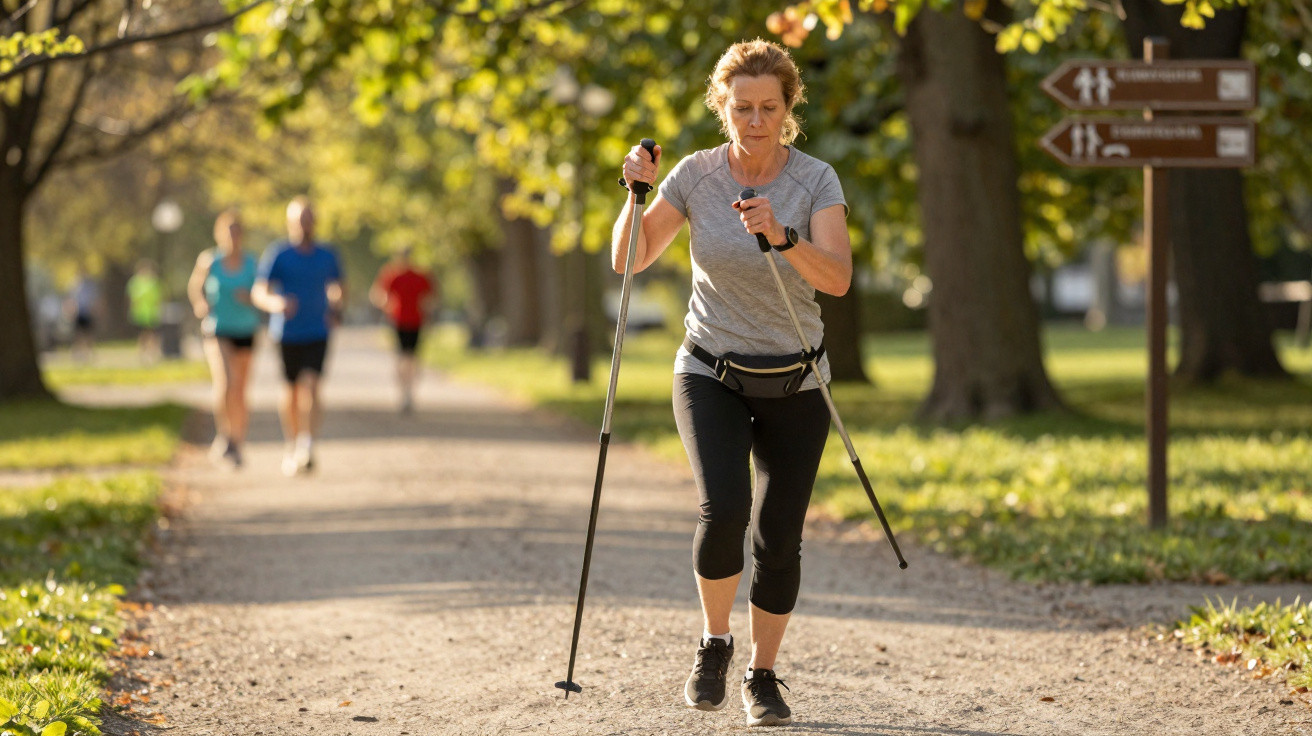
More and more people are picking up poles and heading out on Nordic Walking routes. It is particularly popular with older exercisers. Yet many barely tap into the full potential of this activity, while some even put unnecessary strain on their bodies. By following a few essential rules, a “walk with poles” can become a genuine full-body workout.
Why Nordic Walking is far more than walking with poles
At first glance, Nordic Walking appears straightforward: walk, swing the poles, done. In reality, it relies on a carefully coordinated movement pattern. When performed correctly, it works not only the legs and glutes but also the arms, shoulders, back and abdominal muscles intensively.
Up to around 80 per cent of the muscles can be active during Nordic Walking – substantially more than during ordinary brisk walking.
Using the poles creates a type of “four-point movement”. Part of the body weight is transferred through the poles, easing pressure on the knees, hips and spine while also stabilising the upper body. The cardiovascular system gets going, with heart rate and breathing increasing without the activity feeling overwhelming.
This is a major benefit for many older people: they can stay active, protect their joints and still build muscle strength. People who are slightly overweight, have early-stage high blood pressure or spend much of their day sitting can also benefit from regular exercise.
The most common technique mistakes – and why they matter
The effectiveness of Nordic Walking depends entirely on technique. Anyone who merely strolls along carrying poles loses much of the training benefit and may develop tension. Three mistakes occur time and again.
Mistake 1: Carrying the poles rather than properly using them
The classic error is allowing the poles to tap lightly on the ground ahead of the feet, with virtually no pressure applied. It may look like Nordic Walking at first, but it is effectively just a walk.
- The poles are placed too far ahead.
- The arm remains bent, with no active push backwards.
- The hands do not open, and the grip stays rigid.
Walking this way offers very little joint relief and barely engages the upper body. The central principle of the sport – generating propulsion with the arms – is lost. Instead, the pole should touch down roughly level with the rear foot, the hand should push distinctly backwards, and it should open slightly from the strap at the end of the movement.
Mistake 2: A rounded back and looking at the ground
Many Nordic walkers constantly watch their feet and lean their upper body forwards. Although this may feel cautious, it limits breathing and mobility. The shoulders creep upwards and tension builds in the neck.
Walking upright, with the shoulders relaxed downwards and the gaze directed ahead, allows unrestricted breathing and reduces strain on the spine.
If a quick “body check” reveals raised shoulders, a relaxed abdomen or a rounded back, it is time to make a conscious correction: gently draw the shoulder blades back and down, lightly engage the abdominal muscles and lift the chin a little. This lets the arms swing more freely and produces a longer, more dynamic stride.
Mistake 3: Incorrect arm and leg coordination
When the movement rhythm becomes muddled, Nordic Walking can quickly look awkward. Some people bring the pole and leg on the same side forwards at once rather than moving diagonally. This affects balance, shortens the stride and restricts the upper body.
The basic rule is simple: right leg with left arm, left leg with right arm. It is the same pattern as normal walking, only more pronounced and combined with pole use. At the beginning, it is worthwhile practising the sequence slowly and deliberately, for example on level ground with few distractions.
Getting started properly: how to begin this popular sport
Many mistakes can be avoided by not spending the first few weeks in trial-and-error mode alone. A beginner’s course, or at least a technique session with an experienced instructor, can save weeks of experimentation.
- Introductory course: basic technique, the right stride length, pole use, braking and walking uphill.
- Video analysis: recording your gait on a mobile phone can provide surprisingly quick clarity.
- Training in small groups: mutual corrections and greater motivation.
If no course is available, clear, high-quality instructional videos can help. However, it remains important to keep checking how your body feels: Does the movement feel fluid? Can I breathe freely? Can I clearly feel my arms working?
The right Nordic Walking equipment makes a real difference
Nordic Walking poles are not hiking accessories. They are designed for a specific technique. Choosing the correct length is crucial: a rough guide is around 68 per cent of your height, often calculated using height in centimetres x 0.68. Someone measuring 1.70 metres, for instance, would need poles of approximately 115 centimetres.
| Height | Recommended pole length |
|---|---|
| 1.55–1.65 m | 105–110 cm |
| 1.66–1.75 m | 110–115 cm |
| 1.76–1.85 m | 115–120 cm |
Poles that are too short reduce the stride’s dynamism, while poles that are too long force the shoulders into an unnatural lift. Wrist straps that allow the hand to open and close are essential. Many inexpensive sets cut corners precisely here, and that becomes apparent during training.
Footwear also makes a difference. Flat, flexible shoes with reliable grip on tarmac and woodland paths are usually more suitable than heavily cushioned, bulky running shoes. The sole should allow the foot to roll through easily, and the toes need sufficient room.
Building your training: increase gradually rather than overdoing it “heroically”
Anyone who has been inactive for a long time should begin gently. Two sessions a week, each lasting 20 to 30 minutes, are entirely enough for the first few weeks. This gives the muscles time to become accustomed to the new demands and allows tendons and joints to adapt.
- Weeks 1–2: 2 short routes, with the emphasis on technique.
- Weeks 3–4: increase to 3 sessions, with slightly longer distances.
- From week 5: carefully raise the pace or distance and include gentle inclines.
Many instructors advise choosing a pace at which you can still talk but could no longer sing comfortably. If you are permanently gasping, you are moving too fast. If you can chat easily without becoming breathless, you are usually working within a good range for health.
How much can Nordic Walking really do for your health?
Regular sessions can affect numerous aspects of health. Endurance improves, blood pressure may fall and blood sugar levels are more likely to stabilise. People with mild to moderate excess weight can gradually lose weight, provided their diet supports it.
Compared with an ordinary walk, Nordic Walking burns more calories because the arms are actively involved. It also develops coordination and balance, which are important for helping prevent falls in later life. Walking confidence improves as the body learns to control each step and pole placement accurately.
Nordic Walking, hiking or jogging: which suits whom?
Nordic Walking sits somewhere between brisk walking and jogging. For people who quickly develop knee or back problems when running, it can often provide a good compromise. Compared with hiking, its movement rhythm is more consistent and the training effect is easier to plan.
The activity is especially well suited to people with restricted joints, beginners returning after a lengthy break from exercise, and older adults. Younger, fitter people can use interval sessions, alternating brief, faster sections with easier stretches. This can make Nordic Walking a demanding workout.
Practical tips from experience
Anyone feeling uncertain can begin in a car park or along a quiet promenade: the surface is level, there are no roots and there are few distractions. This provides a calm setting in which to learn the diagonal movement pattern. It is worth pausing briefly from time to time for a body check:
- Are the feet hip-width apart and pointing straight ahead?
- Is the back upright without slipping into an exaggerated hollow back?
- Do the shoulders and neck feel relaxed and mobile?
- Do the poles travel back roughly parallel to the body?
Combining a Nordic Walking route with gentle strengthening exercises using a park bench or tree trunk – such as squats, torso rotations and calf stretches – adds even more to the session. The poles then serve as support, rather than only as exercise equipment.
Over the long term, establishing a routine is worthwhile: set days each week, a familiar route and perhaps a small group of neighbours or colleagues. That way, Nordic Walking becomes more than a one-off springtime burst of motivation and instead forms part of a stronger, more stable approach to health – provided the technique is right.












Comments
No comments yet. Be the first to comment!
Leave a Comment