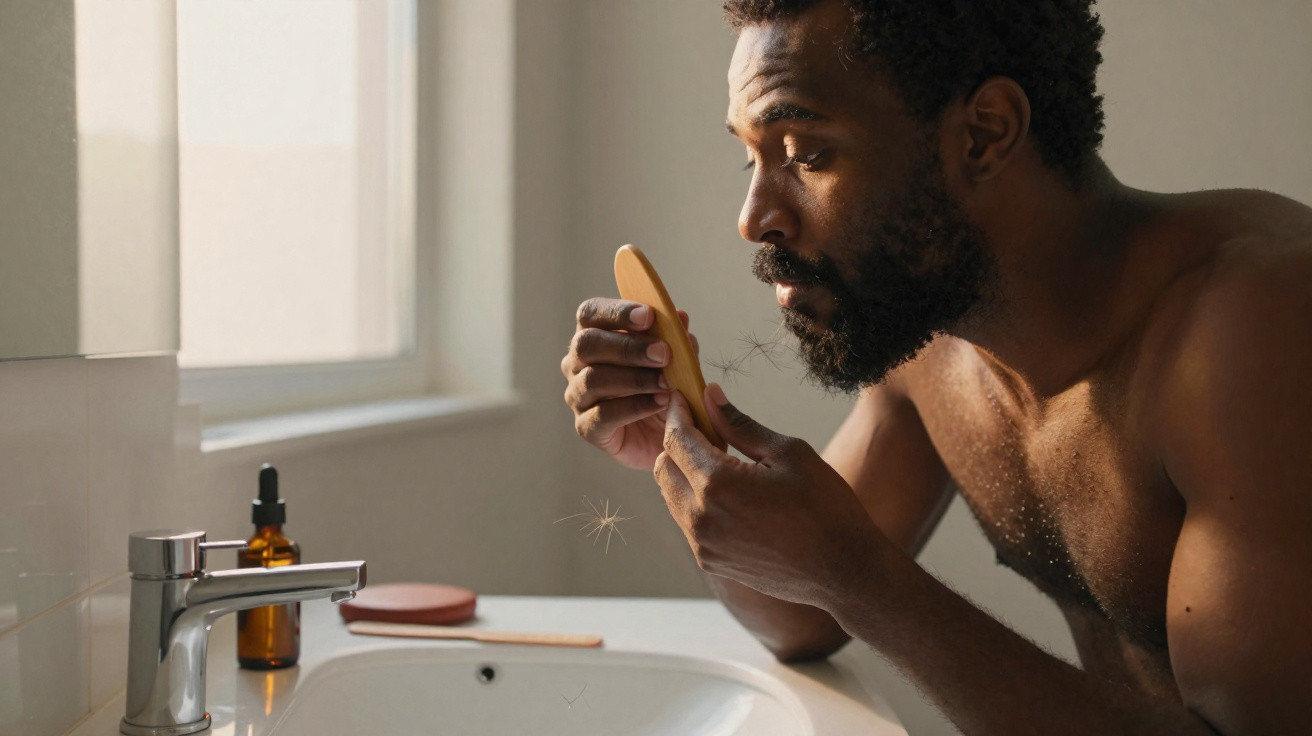
His beard appeared sharp from afar: thick, jet-black and well defined. Up close, however, it told another story-tiny broken hairs around the jaw, areas that would not fill out, and a cloud of damaged curls. The barber gripped a cheap plastic fine-tooth comb and pulled it through the beard to the familiar scratch-scratch sound. Half the beard remained where it was; the rest collected in the comb.
He stared at himself in the mirror and sighed. “I moisturise. I use oil. Why does it still look…tired?”
In the chair beside him, another man took a solid wooden pick from his pocket. Its teeth were broad and smooth, like polished twigs. He made one unhurried pass through his beard. No catching. No wincing. Only the gentle, quiet separation of curls that afro-textured hair gives you when it is handled properly.
The setting was the same barbershop and the beard type was the same, but the results could not have been more different.
Why fine-tooth combs turn an afro beard into broken stubble
Afro-textured beards do not grow directly downwards. They form spirals, S-shapes and tight zigzags that curl back into themselves. Every strand bends, loops and catches on those around it, creating a dense forest beneath the chin. A fine-tooth comb was not made for this landscape. With such little space between its teeth, it tears through the beard like a rake dragged across brambles.
Each tooth attempts to pull tight coils into a straight path they were never intended to take. The hair pushes back, and the comb wins by breaking the weakest strands-often at the point where the curl begins. A few days later, that shows up as short, sharp stubble sticking out from an otherwise full beard. It is not that your beard “won’t grow”. Your grooming tool is silently shortening it every morning.
Speak to almost any experienced Black barber and you will hear a similar account. A client arrives frustrated by a “patchy” beard that will not join up. He puts it down to genetics, age, stress or perhaps diet. Then the barber runs a wide-tooth comb or pick through the beard and spots the real issue: breakage along the middle of the hair shaft, particularly on the chin and jawline, where the hand naturally presses harder.
One London barber kept track for three months. Of 40 regular clients with afro-textured beards, almost 30 said they used either a fine-tooth plastic comb or a small hairbrush picked up on impulse at a supermarket. He told them to swap to a wooden pick and return after six weeks. Something unexpected followed: the men who had described their beards as “patchy” began to see density in places where they had previously noticed gaps. Their hormones were unchanged. So was their barber. The only difference was the tool.
The reasoning is straightforward. Afro-textured hair is naturally drier, as its curls make it more difficult for sebum to move from the roots to the ends. That lack of moisture leaves each strand less pliable and more prone to damage from rough treatment. Fine teeth focus tension on very small points of the shaft. Rather than gliding through, the hair catches and is pulled. Under a microscope, broken afro hairs can resemble splintered wood, with uneven, jagged fractures. A wooden pick reverses that process. Its wider teeth lower the tension, while its smoother surface spreads force more evenly. Instead of being pulled straight, the beard is softly separated one curl at a time.
How a wooden pick changes the daily beard ritual
The benefit of a wooden pick starts before it touches your face. Wood offers a gentle grip that plastic lacks. Apply a small amount of beard oil or butter to your hands, warm it between your palms, and work it through the beard from the neck to the cheeks, roots to ends. When you then bring the wooden pick up from beneath the beard, the coated strands react differently: they flex, slide and part rather than snagging and breaking.
Begin with the ends of your beard, where the hair is oldest, driest and most vulnerable. Work outwards and slightly upwards in small sections, allowing the wide teeth to move slowly. Once the ends are free from tangles, move roughly 2.5 cm closer to the face and repeat. In effect, you are helping your beard open up rather than forcing it apart. It is a slow, almost meditative process. The first time you try it, you may be surprised at how little hair remains in the pick compared with your old comb.
One damp Tuesday morning, a friend tried this approach before heading to work. He had always kept his beard closely trimmed because “it just goes wild when it gets longer.” That morning, he chose to give a wooden pick a proper chance. He applied oil, worked it in, and picked from the ends towards the roots while half-watching the news. There was no pulling, no snapping noise and no small black hairs left around the sink. By the end, his beard looked fuller, but it also seemed more settled. The curls were no longer battling one another.
Three weeks afterwards, he noticed another change. The area beneath his chin, which normally felt like fine sandpaper by the third day, had become softer. The familiar “shadow gap” between his moustache and beard began to look less distinct. He had not bought different products or altered his diet. He had simply changed the tool he used every day. It was the beard equivalent of replacing sandpaper with silk.
There is a physical explanation for why the experience feels so different. The shape and material of a wooden pick spread stress more evenly across the hair shaft. Rather than making the entire curl straighten like a stubborn spring, it follows the natural bend. Picture a stadium wave: a fine-tooth comb tries to pull everyone down the steps at the same moment, whereas a wooden pick lets each person rise in sequence, row by row. There is less disruption, less resistance and less damage. Over time, the effect appears in one clear, visible outcome: length retention.
Using a wooden pick without wrecking your beard goals
The ideal way to use a wooden pick on an afro-textured beard begins before styling, long before you step out of the bathroom. Start after a warm shower, when your pores are open and the beard is slightly damp rather than dripping wet. Gently pat it dry with a towel; do not rub it. That friction is another subtle way to lose length.
Use your fingers to distribute a light leave-in conditioner or beard cream through the hair. Follow with a few drops of oil, paying particular attention to the ends and the skin underneath. Once the beard feels soft without becoming greasy, bring the pick up from under your chin. If useful, hold the beard slightly away from your face with your free hand. Pick upwards and outwards using short strokes, and stop as soon as you meet resistance. Move to a different area instead of driving the teeth through a knot. Leave persistent tangles until the end and gently loosen them with your fingers.
Most men with afro beards have been taught, directly or indirectly, that facial hair must be “tamed”. Press it flat. Brush it into submission. Shrink it so that it appears neat. That attitude often creates the very over-combing that leads to breakage. There is no need to run a pick through your beard 20 times a day. For most people, once or twice on a well-moisturised beard is more than enough.
Let’s be honest: nobody really manages that every day. Life gets in the way, routines are missed, and sometimes you fall asleep on the sofa with your face pressed into a rough cushion. That is normal. The overall habit matters, not an unbroken perfect run. On the days you do care for your beard, slow your hands down. Loud scraping or a sharp tug is your cue to pause and start again. You are not forcing your beard into shape; you are directing it.
The impact of a wooden pick is not purely practical. It can be emotional as well.
“The day I ditched my tiny plastic comb for a wooden pick,” a reader told me, “was the day I stopped fighting my beard and started listening to it.”
That may seem dramatic for such a small grooming tool. But afro-textured beards hold many stories about identity, culture, work, pride and insecurity. When your beard repeatedly breaks, it can chip away at the quiet confidence you feel when you see yourself in a shop window and genuinely like the reflection.
- Wooden teeth glide through coils rather than scraping against them.
- Wider spacing follows the natural pattern of afro-textured curls.
- Less static, less snagging means more moisture remains where it should.
- Together, these benefits lead to thicker-looking, longer-lasting beards over time.
With the right tool, grooming can become a modest daily victory rather than a daily struggle. Those small victories build on one another.
A beard that breaks less says more
A wooden pick will not transform a thin beard into a Viking mane overnight. Genetics still count. Hormones still count. Diet, stress and sleep all have a role to play. Yet when one easy change immediately reduces the amount of hair left in the sink, it can alter how you see your beard. You stop judging your body so harshly and begin to notice where the damage had really been coming from: the tiny plastic teeth you had never thought to question.
There is something quietly radical about selecting a tool that works with your hair’s natural shape rather than fighting it. Passing a wooden pick through an afro-textured beard is not an attempt to press it into an imaginary straight-hair standard. It recognises that your beard has its own volume, direction and character. That small choice changes grooming from control into cooperation. And cooperation usually grows better beards.
On a packed train or across a busy office, most people will not know that you replaced a fine-tooth comb with a wooden pick. They will simply notice a beard that looks fuller, softer and more deliberate. You may experience fewer snags, reduced irritation and perhaps less urge to shave it all off in frustration on a difficult morning. That is the understated strength of a better tool: it does not make a fuss; it simply removes a point of friction you may have carried for years.
The next time you find yourself dragging a tiny comb through tight curls, ask yourself what you are really trying to straighten: your beard, or the idea of what your beard is “supposed” to be? It is a question that stays with you. It may even send more men to barbershops or online searches, finally prepared to exchange plastic teeth for polished wood. Perhaps somewhere between those smooth passes and the extra 1.3 cm of length you suddenly manage to retain, a different story about afro beards starts to grow.
| Key point | Detail | Why it matters to the reader |
|---|---|---|
| Fine-tooth combs cause breakage | Narrow teeth catch tight curls and snap dry afro strands mid-shaft | Explains why your beard looks patchy even when it “should” be fuller |
| Wooden picks respect curl pattern | Wide, smooth teeth separate coils rather than forcing them straight | Shows how a simple tool swap can boost thickness and length retention |
| Technique matters as much as the tool | Picking from ends to roots on a moisturised beard reduces daily damage | Gives a clear, realistic routine you can actually follow |

















Comments
No comments yet. Be the first to comment!
Leave a Comment