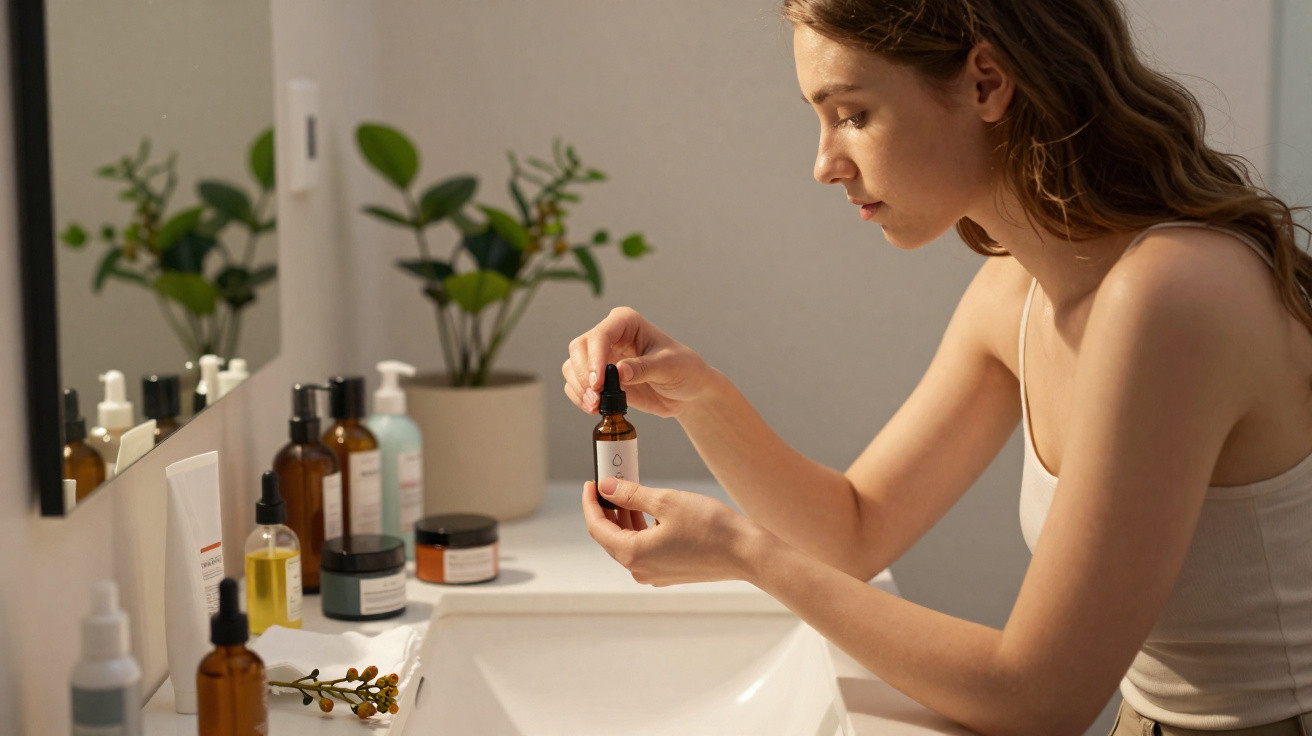
Anna was standing in front of the bathroom mirror one evening, doing the sums in her head, when she realised the products on her shelf were worth more than her laptop. Yet her skin was still unpredictable: radiant on some days, tight and red around her nose on others, and regularly both at the same time. So she made a decision that felt almost defiant. No more refills and no more “last chance” serums waiting in her basket. Instead, she left just two small amber bottles by the sink: jojoba oil and squalane. At first, the routine seemed almost suspiciously simple. But after a few nights, her skin began responding in its own understated way. What changes when you swap a €90 cream for two ingredients whose names you can actually say?
When you take skincare back to basics
For many people, the first noticeable change is simply… less upset. Redness may ease, while that stripped, over-exfoliated tightness starts to fade. Skin rarely transforms overnight, but it can begin to feel more settled, as though the intensity of irritation has been turned down. Jojoba and squalane are both skin-mimicking oils, meaning they closely resemble substances your skin already recognises. Your barrier is therefore less likely to feel under attack. Rather than applying layers of active ingredients that may compete or clash, you allow your face time to regain balance. It is not especially glamorous, but waking without stinging cheeks has a quiet kind of luxury.
Dermatologists who regularly treat over-treated skin often describe the same scenario. Someone arrives with a lengthy collection of premium products but a fragile skin barrier: flaking, flushing and breakouts in unexpected areas. They then simplify things to a mild cleanser, perhaps a straightforward hydrating serum, and a basic oil in place of a rich luxury cream. Within two or three weeks, their skin is often less reactive. Pores appear less inflamed, dehydration lines look softer, and they spend less time inspecting their face beneath unforgiving bathroom lighting. One London dermatologist told me that the most striking improvements recently have come from taking excess away, rather than adding more actives.
There is a biological explanation for why this apparently dull change can be so effective. To keep its barrier supple and sealed, skin produces its own mixture of lipids, including ceramides, cholesterol, fatty acids and wax esters. Jojoba is not technically an oil at all, but a liquid wax ester that is remarkably close to substances naturally made by your pores. Squalane is the stable relative of squalene, which is an important element of human sebum. Applied sparingly, they do not demand that skin function differently; they work alongside systems it already has. Expensive moisturisers frequently include similar lipids, but package them with fragrance, silicones, texture-enhancers and marketing. Choosing a simpler option removes possible irritants while retaining the essential elements that help a moisturiser do its job.
How to switch to jojoba oil or squalane without upsetting your skin
Moving from a 10-step regimen to cleanser and oil in a single night can feel like plunging into cold water. A more forgiving route is to make the change gradually. Begin by replacing only your evening cream. Once you have cleansed and used any serum you genuinely want to keep, warm 2–3 drops of jojoba or squalane between your palms and press it lightly over damp skin. Do not rub vigorously or massage for five uninterrupted minutes. It only needs to create a gentle seal. Wait two weeks before deciding whether it is working. If your skin appears more content, introduce the oil in the morning too, perhaps blending it with a simple moisturiser initially. Think of it as helping your skin settle into a calmer new rhythm.
Quantity is where people often go wrong. They hear the word “oil” and picture a nightly facial massage that leaves them dripping with product. Let’s be honest: nobody really does that every day. Two to four drops will generally cover the whole face. If a greasy layer remains on your skin, you are probably using too much. Another common error is removing every product at once, then holding the oil responsible for each minor reaction. A breakout in the first week can sometimes be your skin adjusting after months of fragrance and acids. When it is mild and brief, it may settle. When it is painful, cystic or spreading quickly, it is time to stop and speak with a professional.
There is an emotional aspect to this shift that no ingredients list can explain.
“When I stopped chasing the next miracle cream and committed to one jojoba oil for six months, my skin changed less than my head did,” a reader in her 30s told me. “I finally stopped feeling like a project I needed to fix.”
That change in perspective is genuine. In practical terms, a pared-back oil routine also relies on a few small supporting habits:
- Apply oil to slightly damp skin so it helps retain water, rather than merely sitting on the surface.
- Store oils somewhere cool and dark, and use them within 6–12 months.
- Patch-test a new oil on a small area for several days before applying it liberally.
- Introduce only one new product at a time, particularly if your skin is sensitive.
- Choose according to your skin’s mood: jojoba for balanced or oily skin, and squalane for drier or more reactive skin.
Most of us have had the moment of believing that a €120 jar will finally help us “glow like her” on Instagram. Giving up that promise can be nearly as difficult as working out how much oil your nose can tolerate. Simple doesn’t mean careless; it means moving your attention away from constant novelty and towards observing your skin’s response over weeks rather than hours.
Where a simpler routine leaves you: a bathroom shelf and a bigger question
When the packaging becomes less noisy, something else shifts. You begin noticing how your face feels at 3 p.m., rather than focusing only on how it looked that morning. A comfortable, well-hydrated skin barrier can help make-up apply more smoothly, reduce the urge to scrub, and, oddly, release some mental space previously occupied by comparison. For some people, the savings from premium creams pay for one facial a year, better sunscreen or simply remain in the bank. For others, a nightly ritual of two or three uncomplicated steps becomes a small point of steadiness in a busy day.
Oils will not suit everybody: some acne-prone skin types do better with gels and lightweight lotions. That is exactly the value of simplifying skincare. It lets you see your own real pattern instead of following a marketing story. Your cheeks may respond beautifully to jojoba while your T-zone prefers only squalane. Winter may call for two additional drops, while summer may require almost none. The process itself shows you how reactive, adaptable and opinionated your skin can be. It becomes less about finding a product that is right or wrong, and more of an ongoing conversation with the barrier that has quietly protected you all along.
| Key point | Detail | Benefit for the reader |
|---|---|---|
| Skin calmness | Natural oils such as jojoba and squalane help support the skin barrier with fewer potential irritants. | Can help lessen redness, stinging and the tight feeling associated with over-treated skin. |
| Cost versus effect | Simple oils often provide the same essential lipids as luxury creams, without a substantial marketing premium. | Allows you to reduce skincare spending while maintaining - or improving - results. |
| Routine clarity | Returning to basics makes it easier to identify what genuinely works for your skin over time. | Offers more control, less uncertainty and a routine that genuinely suits your life. |
















Comments
No comments yet. Be the first to comment!
Leave a Comment