
In the mirror-lined interior of a busy city salon, you notice it sideways before you have even taken a seat: that flat, faintly see-through area above your ear that no amount of hairspray can disguise. As the stylist lifts your hair to fasten the gown, your profile suddenly comes into view, and you wonder when your formerly thick hair began to look so… small. It is not awful, exactly. It simply appears finer than it feels between your fingers.
From the front, you can rely on a clever parting and dry shampoo. A ponytail conceals plenty from behind. The side view, though? The side view is honest.
Then comes that subdued moment when the stylist asks, “So, what are we doing today?” and you find yourself replying, “Something that makes it look fuller, especially from the side.” After all, this is the angle that appears in shop windows and video-call previews. It is also the angle that can shift how you feel in an instant.
And stylists have a particularly precise solution for it.
The one cut stylists swear by for denser-looking hair in profile
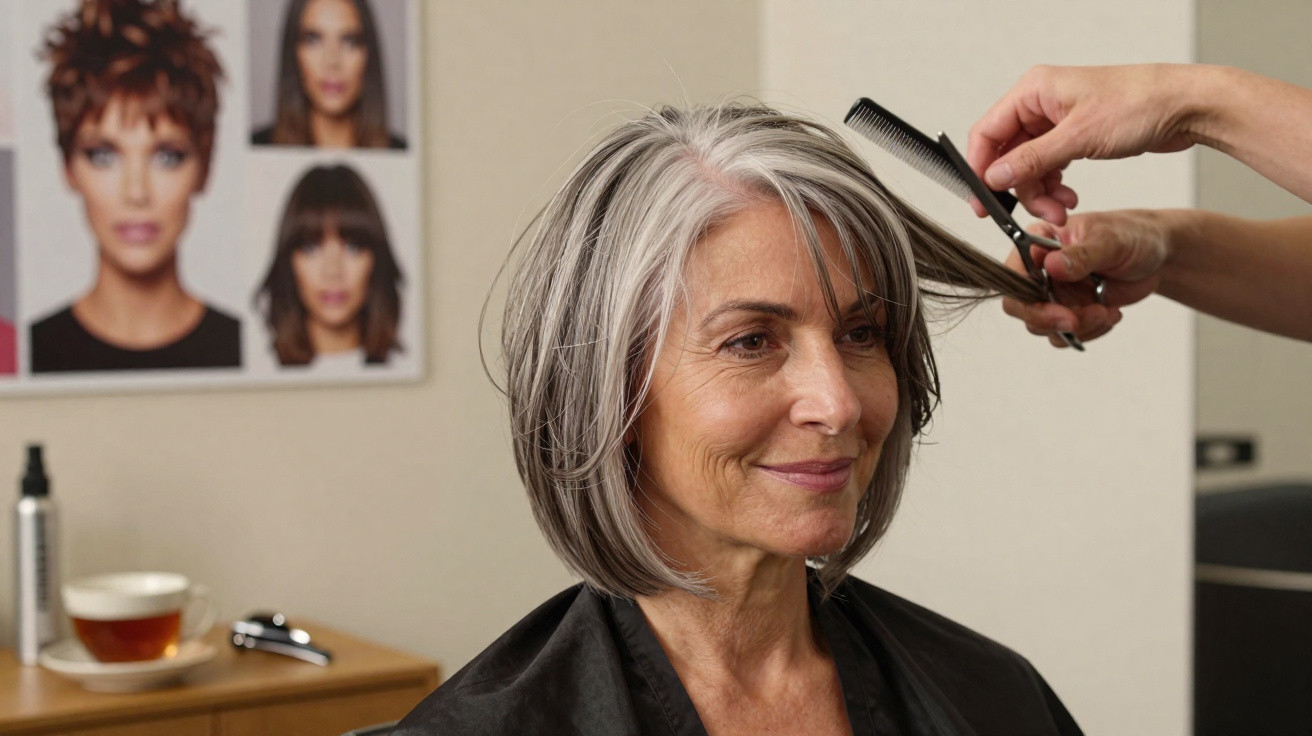
Ask five experienced stylists how to create the appearance of density in thin hair from the side, and four are likely to give almost identical advice: choose a softly layered, collarbone-length blunt cut, with discreet layers beginning around the cheekbones. It is not a severe bob, nor is it a cut full of wispy stepped layers. Instead, it has a neat, solid outline at the ends, falling somewhere between the jawline and shoulders, plus subtle internal texture.
Why does this particular shape work? Profile is all about the silhouette. A straight, weighty baseline creates visual “weight” at the ends, while gentle layering through the upper lengths prevents the hair from dropping flat like a curtain. Rather than clinging to the head, the hair appears to push softly away from it. Seen from the side, this produces a fuller, almost thicker-looking edge.
It is rather like tracing a stronger pencil line around fine hair.
When Paris-based stylist Anaïs Lambert discusses thin hair, she often mentions one client. “She had long, mid-back hair, very silky, very flat,” Anaïs tells me. “From the front, she could tease the roots and get some life. From the side, it was just a sheet.” The client arrived one day with screenshots from a video call, distressed by just how flat her profile appeared.
They opted for a cut, but not a dramatic pixie or a sharply cut bob sitting beneath the ear. Instead, they settled on the collarbone-grazing blunt cut, with its ends nearly resting on the collar of her jacket. The layers were so subtle that they were not visibly apparent, yet they worked beneath the surface. When Anaïs rotated the chair to the side, her client was astonished. Rather than a vertical line, her hair now created a softly rounded triangular shape. Without a single extension, it looked twice as dense.
After that, side-on photographs were no longer an issue.
There is straightforward visual reasoning behind the result. Long, thin hair tends to lie close against the neck, making the head seem narrower in profile. Very short cuts with heavy layers can create the reverse problem: they remove so much from the perimeter that the side view shows more empty space than hair. The collarbone blunt cut occupies the ideal middle ground.
The firm baseline forms a “ledge”, much like a shelf, beneath the rest of the hair. Internal layers raise selected pieces away from the scalp enough to create a soft swell above that ledge. It is this curved shape that the eye interprets as fullness from the side. Since the ends are neither shredded nor excessively textured, light does not pass through them so easily. Instead of a frayed outline, the eye sees a concentrated, dense-looking mass.
It’s less about having more hair, and more about tricking the eye from every angle.
How to ask for this cut (and not walk out with the wrong one)
Stylists repeatedly make the same point: the way you describe the cut is important. Saying, “I want volume,” offers little direction. Saying, “My hair looks very flat from the side. I want a collarbone-length blunt cut, with soft, hidden layers that give lift at the temples and crown,” changes the entire discussion. You are describing your profile rather than only specifying the length.
Take profile photographs with you, rather than relying solely on front-facing selfies. Include one side-view image with a silhouette you like and another showing where your hair falls flat. Identify the precise area where the hair “collapses” - usually above the ear or directly at the crown. Ask your stylist to retain a solid perimeter instead of a feathered one, and request layers that blend so seamlessly that no distinct steps can be seen.
This is the sort of wording that makes professionals’ eyes light up.
This is also where many people go wrong. They request layers to “add volume”, only to leave with choppy sections that appear sparse from the side. Others hold on to long hair “for density”, when those long, fine ends are actually undermining their profile. Most of us know that feeling: spotting the back of our head in a photograph and realising that the hair resembles a transparent veil.
The emotional element matters. Losing length can feel like losing part of your identity, particularly if you have always been known as “the one with long hair”. That is why a collarbone cut can feel like a compromise rather than a shock. You retain movement and can still tie it back, while the outline immediately looks thicker. If the term “layers” worries you, ask for “internal texture, not visible layers”; stylists will understand what you mean.
Let’s be honest: nobody really does this every single day.
“From the side, thin hair doesn’t need height as much as it needs substance,” explains London stylist Marco De Luca. “I build what I call a ‘density frame’: a blunt edge for weight, micro-layers for lift, and a side part that doesn’t expose the scalp. Once clients see their profile transform, they stop chasing complicated blowouts and start asking for better structure.”
To make the essentials easier to remember, many stylists reduce the advice to this straightforward checklist:
- Length around the collarbone – sufficiently long to feel feminine, yet short enough to look denser.
- Blunt perimeter line – a crisp edge that makes hair seem more “solid” from the side.
- Soft internal layers – concealed lifting sections that form a gentle curve rather than a flat sheet.
- Side or slightly off-centre part – prevents that see-through stripe of scalp showing in profile.
- Minimal thinning or razor work – stops the ends becoming wispy and transparent.
Living with the cut: daily tricks that change the side view
Once the cut is in place, everyday styling is unexpectedly straightforward. Most stylists recommend drying your hair with your head angled slightly forwards, raising the roots with your fingers instead of spending ages with a round brush. The aim is to establish the hair’s “curve” as it dries, rather than trying to force it into place afterwards.
Apply a light volumising mist only to the roots across the top and sides, then gently scrunch the mid-lengths to help the hair sit away from the head. The collarbone-length blunt shape handles the rest. As the perimeter is denser, your profile will still appear full even after the style has relaxed later in the day. There is no need for oversized rollers or a 30-minute blow-dry. A little direction is enough.
That slight lift above the ear can transform the way your hair looks on a video call.
People with thin hair often use too much of the very products and techniques that work against them. Excess mousse at the roots can weigh fine strands down, causing them to collapse towards the scalp. Hairspray applied everywhere creates a rigid helmet effect that may actually sit closer to the head from the side. Heavy oils on the ends can make the perimeter look stringy, drawing attention to every gap.
A gentler method is lighter but more purposeful. Apply a pea-sized amount of volumising cream solely to the root area visible from the side - generally along the parting and above the temples. Restrict conditioner and oils to the final third of the hair to maintain that compact-looking perimeter. And, politely, decline if someone holding scissors offers to “just texturize the ends a bit more.”
Your density illusion depends entirely on that area.
With this cut, several simple, almost unexciting habits have the greatest effect:
- Regular micro-trims every 8–10 weeks – preserve a properly blunt line rather than a shredded one.
- Sleeping with hair loosely secured in a low, soft scrunchie – helps prevent one side becoming flat.
- Using a lightweight dry shampoo at the crown on the second day – brings back that soft profile lift.
- Moving your parting slightly every few days – prevents one side from being permanently flattened.
- Choosing subtle, face-framing highlights – adds dimension that reads as thickness from every angle.
None of these steps is glamorous, and none is likely to go viral on TikTok. Still, this understated maintenance is exactly what preserves the illusion between salon visits. When you catch your reflection in the street from that brutally revealing three-quarter angle, your hair will not look “fine”. It will simply look like you, with a little more presence around your face.
The sort of presence that makes you pause, look twice, and continue on your way standing a little taller.
| Key point | Detail | Value for the reader |
|---|---|---|
| Cut shape | Collarbone-length blunt cut with soft internal layers | Instantly denser-looking silhouette from the side |
| Side-view strategy | Focus on perimeter weight and gentle curve above the ear | Makes thin hair appear fuller without extensions |
| Styling routine | Light root lift, minimal product, regular micro-trims | Low-effort daily habits that keep the fullness illusion |
FAQ:
- Question 1 Will this collarbone blunt cut work if my hair is very fine and straight?
- Question 2 How do I explain “internal layers” if my stylist doesn’t use that term?
- Question 3 Can I still tie my hair up with this length and keep it looking thick?
- Question 4 What should I avoid asking for if I want my hair to look denser in profile?
- Question 5 How often should I trim this cut so the side view stays full?












Comments
No comments yet. Be the first to comment!
Leave a Comment