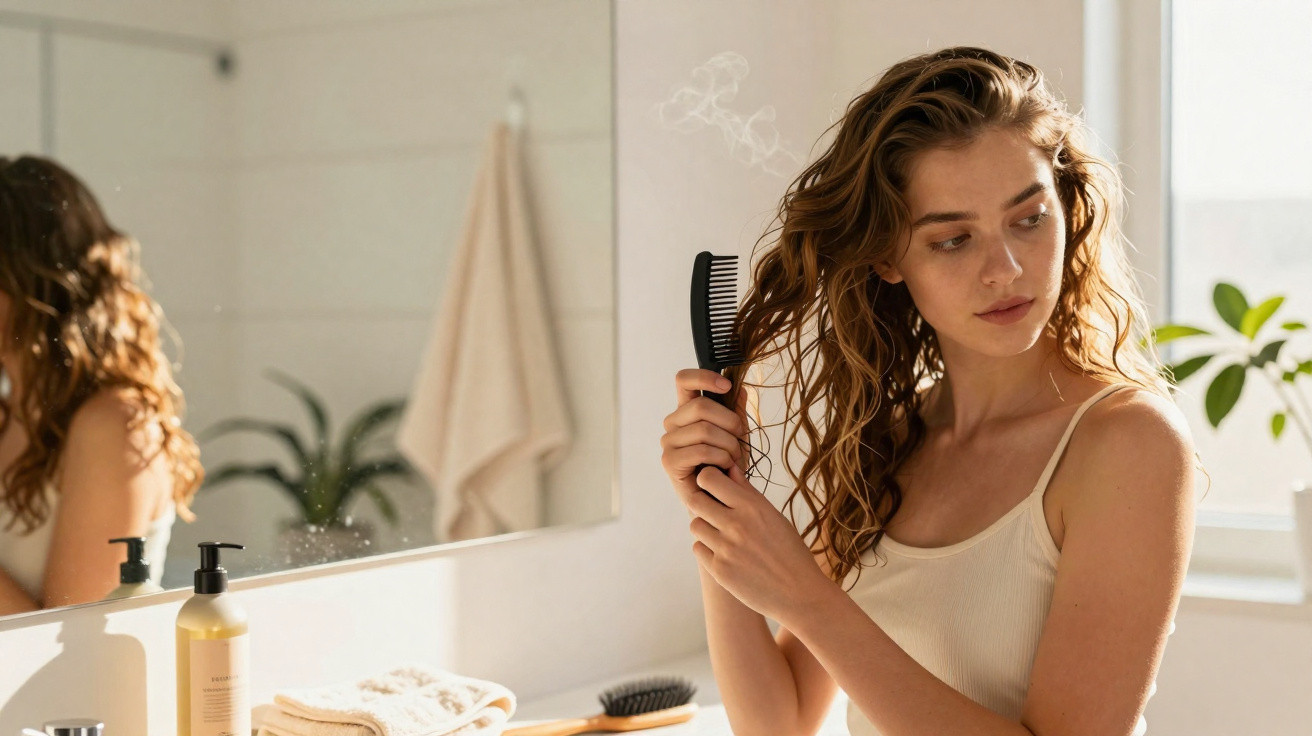
Combing your hair before or after a shower does not have to follow one fixed rule. The best time to detangle depends on your hair texture, how easily it knots and how much pulling is needed to comb it through. Paying attention to these factors helps you choose a routine that creates less friction and maintains the look of your hair.
Why does hair type affect the best time to comb it?
Straight, wavy and curly hair have different shapes, which affects how strands twist together and develop knots. Straight hair can generally be detangled more easily before washing, whereas wavy and curly hair may benefit from extra slip in the shower, particularly when conditioner is used.
Wet hair can also be more vulnerable to pulling and stretching. For this reason, the right time is not determined solely by whether hair is dry or wet, but also by the amount of force required to undo tangles. The more difficult detangling is, the more important it becomes to minimise friction and avoid tugging.
What helps reduce breakage and frizz?
The key precaution is to avoid trying to undo every knot at once. Dividing the hair into smaller sections and starting at the ends lets you loosen tangles gradually, reducing the force used closer to the roots.
The tool used matters as well. Wide-tooth combs or tools suited to the hair’s texture can make detangling easier. Rubbing hair with a towel or combing it with very quick movements after a shower increases friction and may leave the strand surface less smooth.
How should detangling be adapted for each hair type?
For straight or slightly wavy hair, combing gently before a shower can help remove knots and make washing easier. Afterwards, the hair may be combed again carefully, especially if any tangles develop during cleansing.
With wavy, curly or coily hair, detangling in the shower with conditioner or another suitable product can make the process easier. After washing, it is best to handle the strands gently and avoid brushing repeatedly if this disrupts their natural definition.
Who should adjust this routine, and when?
Long, very thick hair, hair that readily forms knots, or hair that has undergone chemical treatments may need a different routine. In these cases, conditioning products and suitable tools can reduce the force needed for detangling, although the technique should remain gentle.
It is also worth watching how your own hair responds. If detangling before a shower causes a great deal of tugging, it may be better to do it when the hair is conditioned. Equally, if combing during a shower leads to more knots for a particular hair type, gentle preparation before washing may be more suitable.

















Comments
No comments yet. Be the first to comment!
Leave a Comment