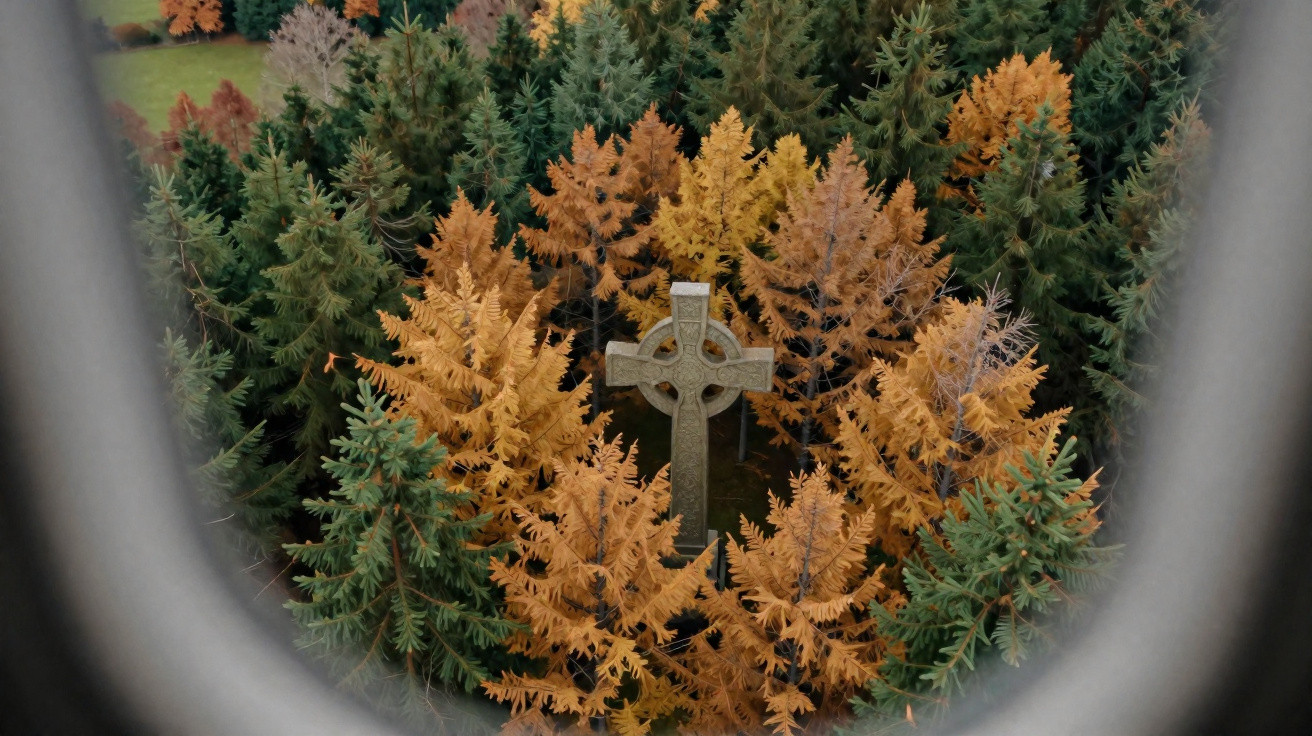
Damp pavements, darker afternoons and gold leaves are familiar signs of autumn. In a woodland near Derry, though, the changing season reveals something that cannot be spotted from the ground: a large Celtic cross picked out in contrasting trees.
It is not a natural formation or a temporary display. The pattern was planted deliberately, using deciduous larch trees within a darker evergreen forest. For a short period each autumn, the larches turn gold and make the design visible from above.
The hidden artwork at Bogay Glebe
The woodland is at Bogay Glebe, near Killea in County Londonderry. From the air, the trees form a Celtic cross reported to measure about 100 feet long and 70 feet wide - roughly 30 by 21 metres.
At ground level, there is no obvious outline. A visitor sees trunks, branches and undergrowth rather than a complete image. The cross needs height and distance for the contrast between the tree species to resolve into a recognisable shape.
The design attracted widespread attention in 2016, when aerial images of the woodland began circulating. What looked like an extraordinary seasonal accident was in fact the result of planting carried out years earlier.
The autumn colour is not an added decoration: it is the part of the design that makes the planted pattern readable.
How trees create the cross
The cross is generally credited to Liam Emmery, a forestry worker who planned and planted the design in 2005. It uses Japanese larch within a surrounding area of evergreen spruce.
The idea depends on the different habits of the two conifers.
1. Use evergreen trees for the background
Spruce retains its needles throughout the year, creating a relatively dark green canopy. That gives the pattern around it a consistent backdrop.
2. Plant larch in the intended outline
Reports have said that about 3,000 Japanese larches were planted in the shape of the cross. Unlike most conifers, larch is deciduous: it sheds its needles in autumn.
3. Let autumn provide the contrast
Before the needles fall, larch foliage turns yellow and gold, sometimes with warmer coppery tones. Against the surrounding spruce, the planted shape becomes much easier to see from the air.
This sort of woodland design requires patience. A planting plan may be precise on paper, but the pattern only develops as the trees grow and the canopy fills out.
Why the view is brief
There is no guaranteed date for the cross at its brightest. The timing of autumn colour depends on the season, including temperatures, rainfall, wind and the pace at which the larch needles fall.
A mild autumn can prolong green foliage, while windy or wet weather may shorten the golden stage. Northern Ireland’s weather can change quickly at this time of year, so photographs taken only days apart may look noticeably different.
The woodland also changes across the year:
- Spring: young larch needles are a lighter green than the spruce.
- Summer: the contrast is less pronounced, making the shape harder to pick out.
- Autumn: gold larch foliage provides the strongest contrast.
- Winter: after needle fall, the design loses much of its colour definition.
That is why a dramatic aerial photograph should be seen as a seasonal moment, rather than a view that can be expected on any visit.
A design completed after its creator’s death
Emmery died in 2010, before the trees had matured enough for the pattern to become widely visible. The woodland cross is often known as Emmery’s Celtic Cross in recognition of the person who planned it.
Its story illustrates the long timescale of forestry. Trees may be planted for timber, habitat, shelter or landscape management, but their effects can take decades to become fully apparent. Here, the changing foliage was part of the visual plan from the start.
It is also a useful reminder that woodland is not always untouched landscape. A forest can support wildlife and perform practical forestry functions while also reflecting deliberate decisions about layout, species and appearance.
A view that looks spontaneous from an aircraft window may have taken years of planning and growth to create.
What the Celtic-cross shape signifies
A Celtic cross is usually recognised by the ring that joins or sits behind the arms of a cross. Such forms are strongly associated with historic high crosses in Ireland and Britain, particularly in Christian art and heritage.
Its symbolism is not fixed in one simple explanation. The ring has been interpreted in different ways over time, and popular accounts may link it with eternity, the sun or continuity. Those interpretations vary by context and belief.
For this woodland, the most reliable point is the visible one: the shape was deliberately planted as a Celtic cross. It is best not to assign further religious, political or personal meanings without clear evidence from the people involved.
Can you visit or photograph it?
An aerial image can make a location seem easy to explore, but a working woodland is not automatically open for unrestricted access. Routes may be affected by forestry operations, fallen trees, wildlife management or poor ground conditions.
If you are visiting the wider area for autumn colour, take a low-impact approach:
- Use official visitor information and public rights of way where they are available.
- Check access arrangements before travelling, especially after storms or prolonged rain.
- Do not climb fences, obstruct forestry tracks or approach machinery.
- Keep dogs under effective control and follow any site signs.
- Avoid treating a location shared online as permission to enter private or managed land.
The cross is designed to be seen from above, but that does not mean drone flying is appropriate. Drone users should check the latest Civil Aviation Authority guidance, airspace restrictions and the rules for the exact take-off and landing location. The woodland is in the wider area of City of Derry Airport, so extra care is particularly important. Do not fly unless you can do so lawfully and safely.
Common mistakes when sharing the image online
The aerial view is striking, which can encourage captions that lose the important details. These are the most common errors:
- Calling it a naturally occurring shape: it is a planned tree planting.
- Giving the dimensions in metres: widely reported measurements are in feet, not metres.
- Assuming it is clear from a footpath: the full pattern needs an elevated viewpoint.
- Expecting a fixed annual peak date: autumn colour varies with the weather.
- Treating an aerial photograph as an invitation to trespass or use a drone: access and aviation rules still apply.
- Claiming a single universal meaning for every Celtic cross: symbolism depends on historical and cultural context.
A different way to look at autumn woodland
Emmery’s Celtic Cross is compelling because it changes the way a familiar autumn scene is read. At first glance, it looks like a remarkable pattern in the canopy. Look closer and it becomes a long-term piece of landscape design, made visible by the seasonal behaviour of two different tree species.
If you see the image online this autumn, enjoy the ingenuity behind it as much as the spectacle. The most respectful response is to share accurate information, follow access guidance and leave the woodland undisturbed.
















Comments
No comments yet. Be the first to comment!
Leave a Comment