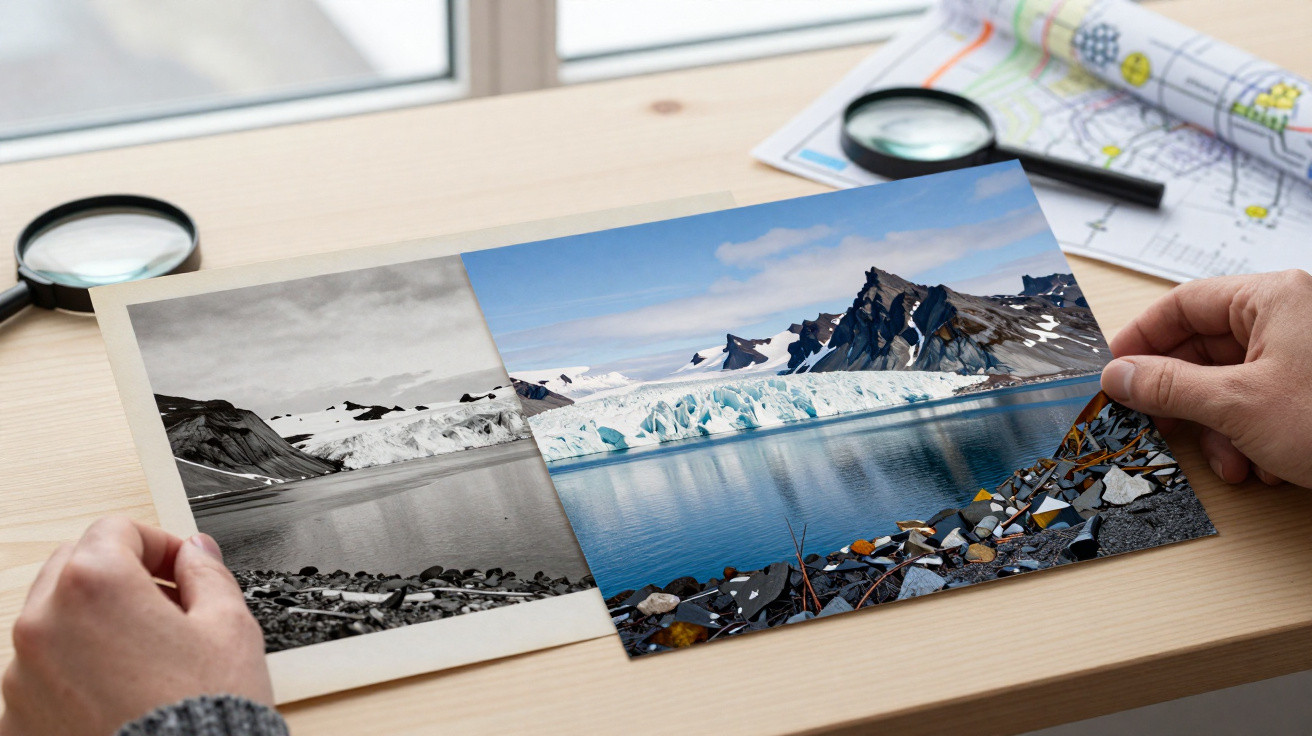
A photograph from the Arctic in 1895 placed beside one taken today can make environmental change feel immediate. In the older view there may be a broad sweep of shore-fast ice or a glacier reaching the sea; in the newer one, darker water, exposed rock or a more distant ice front may stand out.
The key is not to stop at the dramatic before-and-after effect. A pair of photographs can be powerful evidence, but only when you ask whether they show the same place, season, tide and viewpoint. Read carefully, and the contrast becomes more than a striking image: it becomes a useful way to understand both changing landscapes and the limits of photography.
Why side-by-side Arctic photographs have such impact
The Arctic can look timeless in a single picture. Snow, glaciers, sea ice and low light can make a landscape seem outside ordinary time. Put two views of the same coast, fjord or glacier valley together, however, and the eye quickly searches for what has shifted, melted or disappeared.
Historic photographs from the late 19th century were often made during surveys, expeditions and voyages. They may show ships in ice, camps on shore, glaciers, settlements or mountain coasts. A recent image from a comparable location can reveal a different balance between ice, land and water.
A photograph records one moment, not a whole Arctic season. A well-matched pair can nevertheless make long-term change easier to see.
The most convincing comparison is not always the most spectacular one. It is the one in which the same headland, ridge, island or valley can be recognised in both frames.
What a photograph from 1895 can - and cannot - show
An image made in 1895 can be valuable evidence of how a location appeared at that time. It may preserve details not captured in written records, such as the position of a shoreline, the height of an ice front against a cliff, or the extent of snow on a slope.
It also has limitations. Early cameras needed careful set-up, and photographers chose scenes for practical, scientific or artistic reasons. The picture may have been taken after summer melt, or during spring when snow and ice were more extensive. Captions can be incomplete, inaccurate or added long after the photograph was made.
When viewing an archive image, look for:
- a named place, if one is given;
- the date, or at least the month and year;
- whether the image shows sea ice, glacier ice, seasonal snow or a mixture of them;
- fixed features such as peaks, rock faces and islands;
- ships, buildings, tents or tracks that may help establish scale.
Black-and-white photography adds another complication. Snow, cloud, water and ice can appear similar in tone, making it harder to tell where one surface ends and another begins.
Matching the location is the difficult part
A modern photograph taken somewhere in the Arctic is not automatically a true companion to a historic view. A useful comparison needs the closest possible match in place and composition.
1. Begin with fixed landmarks
Look for features unlikely to have changed greatly over more than a century:
- a distinctive mountain outline;
- a rocky promontory;
- the curve of a fjord;
- an offshore island;
- a steep valley side.
Ice can move, melt and reform. Rock formations are generally the best guide to the original location.
2. Work out the original viewpoint
The first photographer may have been standing on a beach, aboard a ship, on a ridge or even on sea ice. Camera height matters. A modern photograph made from a drone, boat deck or elevated road may still be useful, but it can alter the apparent size and distance of features.
3. Compare season as well as year
An August image should not be casually compared with one taken in April. Daylight, snow cover, sea-ice conditions and glacier surfaces vary strongly through the year.
A close seasonal match is usually fairest. Even then, short-term weather and year-to-year variation can affect what is visible.
4. Keep the framing honest
Repeated images work best when the horizon, key landmarks and viewing angle broadly align. A tight crop of an old image set against a modern wide-angle photograph can create a misleading impression of change.
Sea ice, glacier ice and snow are different things
The word “ice” can hide important differences.
Sea ice forms when ocean water freezes. It moves with winds and currents, may break up quickly, and changes greatly between seasons. Open water where sea ice once appeared may be significant, but a single image pair cannot explain the wider pattern on its own.
Glacier ice is land ice formed from snow accumulating and compacting over many years. A glacier terminus can advance or retreat, while its height and width may also change. Repeated photographs can sometimes show these local shifts clearly.
Seasonal snow can cover rock and glacier ice alike. In a distant monochrome photograph, it is often the easiest feature to confuse with permanent ice.
Dark water beside a glacier is visually dramatic. The more useful question is: what is being compared, and at what time of year?
What the difference may mean
A modern picture with less visible ice may be consistent with broader, well-documented changes in Arctic climate. Long-running observations, satellite records and field measurements have recorded major changes in sea ice and many glaciers across the region.
But one matched pair cannot establish every cause, calculate an exact rate of loss or predict what happens next. It shows a local view at two points in time, not the whole Arctic system.
To put an image in context, look for supporting material from reputable public bodies, museums, universities and polar research programmes. Useful records may include dated field photographs, glacier-monitoring data, maps, satellite imagery and explanations of local geography.
For UK readers, museum collections, university research pages and established polar science organisations can help distinguish between an evocative image and a documented long-term record.
How cameras can exaggerate contrast
Photography is not neutral. Lens choice, exposure, cropping and editing all influence how large, bright or distant a feature appears.
A wide-angle lens can make cracks, meltwater and foreground ice seem larger. A telephoto lens can visually compress mountains, water and an ice front. Strong contrast can turn a grey day into a severe-looking division between white ice and dark sea.
Historic photographs have their own problems. They may survive as faded prints, damaged negatives, altered scans or hand-coloured reproductions. That does not make them unreliable by default; it means they should be treated as historical objects as well as landscape records.
Common mistakes when reading before-and-after images
The most persuasive comparisons are often the easiest to oversimplify. Watch for these errors:
- Assuming the locations are identical without checking landmarks. Similar fjords and glacier valleys can look remarkably alike.
- Ignoring the month or season. Snow and sea ice may change dramatically within weeks.
- Confusing floating sea ice with glacier ice. They form differently and tell different stories.
- Treating an archive caption as complete evidence. It may lack precise dates, coordinates or context.
- Using different camera heights or focal lengths without saying so. This can make change look larger or smaller than it is.
- Assuming one image proves a global trend. It is a visual clue, best considered alongside wider records.
- Forgetting perspective. A ship, tent or person can help with scale, but may still be positioned deceptively within the frame.
Viewing and sharing Arctic imagery responsibly
The Arctic is not an empty backdrop for dramatic pictures. It is home to communities, wildlife and working environments, with deep cultural and environmental importance. Captions should name places accurately where possible and avoid describing inhabited landscapes as untouched wilderness.
If travelling in polar areas, use experienced local operators and follow local guidance. Keep well away from wildlife and unstable glacier fronts. Never walk on sea ice, glaciers or crevassed ground without appropriate equipment and experienced professional guidance: conditions can change quickly, even on a calm-looking day.
When sharing a comparison online, include what you know and what remains uncertain: the approximate date, location, archive source, whether the viewpoint is closely matched, and whether the season is known.
A more useful way to look at the change
The strongest response to an Arctic comparison from 1895 and today is neither to dismiss it as a photographic trick nor to treat it as a complete explanation. Identify the fixed landforms, work out the type of ice in view, check the timing, and then seek wider context.
That approach does not reduce the emotional force of the images. A familiar mountain above a changed coastline, or a glacier valley with much more exposed ground than an earlier photographer recorded, can still be startling. The real value lies in seeing both the power of the photograph and the evidence needed to understand it properly.

















Comments
No comments yet. Be the first to comment!
Leave a Comment