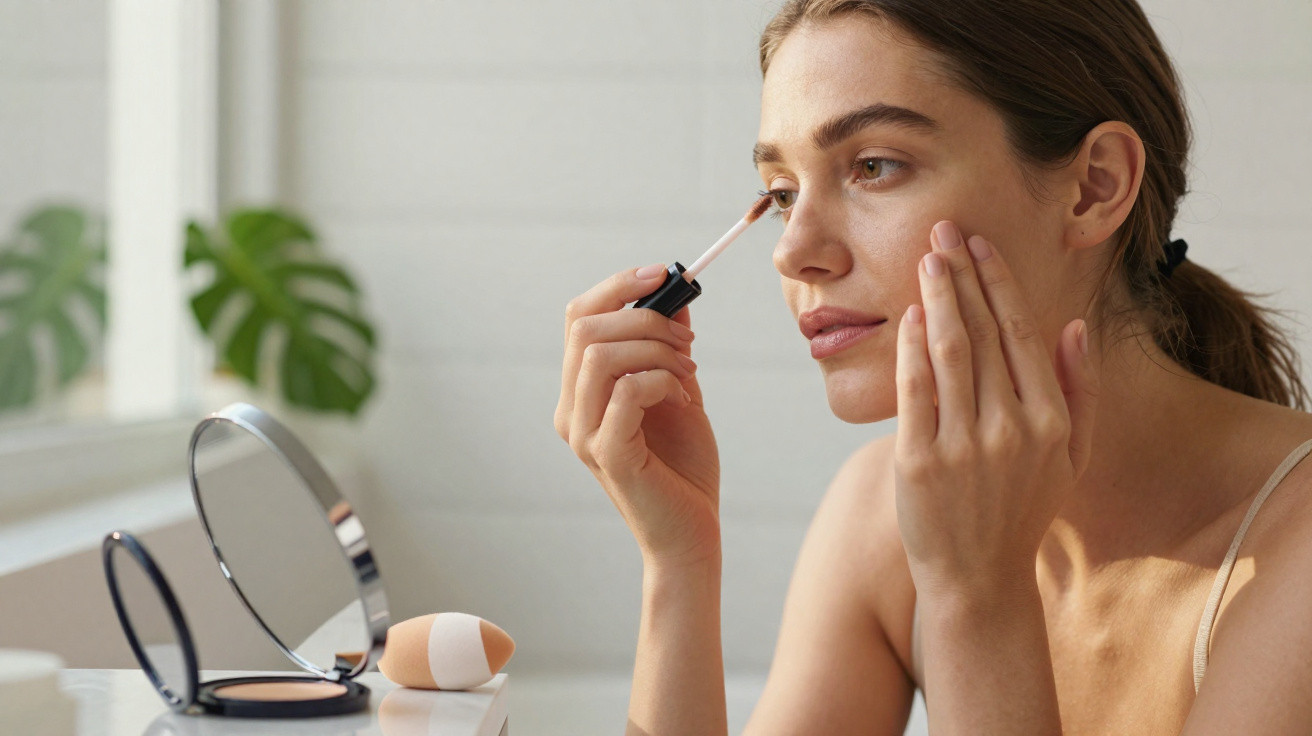
The woman staring back at me in the mirror blinks. She looks tired, despite having slept for eight hours. Beneath her eyes are a hint of bluish shadowing and a few fine lines that instantly make themselves known when she smiles. She dabs on concealer and blends it carefully – yet not even ten minutes later, the product has settled into every tiny crease as if it has made a home there. A glance at the mirror selfie camera in the lift confirms it: cakey makeup alert. We have all been there.
That morning, she decides not to try another TikTok “miracle technique”, but to discover what genuinely works in everyday conditions. No studio lighting, no filters and no “it was perfect after the fourth attempt”. Instead, she wants a method that lasts through sweating, laughing, yawning and travelling on the train.
The surprise starts with one tiny step that almost everyone skips.
Why concealer under the eyes constantly settles into fine lines
We love talking about the “perfect” concealer, yet rarely consider the surface it is applied to: the skin beneath the eyes. It is thin, dry and always moving. A product that looks flawless on Instagram skin often behaves in real life like a stubborn flatmate. It settles precisely where you do not want it.
Many people apply makeup to this area as though it were a smooth canvas. They drag concealer generously downwards, paint on triangles and layer highlighter over the top. The result is that the under-eye area looks older than it did beforehand, even though the aim was to look fresher, more awake and younger.
A make-up artist once told me about a shoot where a presenter rushed to the mirror after every advertising break. She was not checking her hair; she was trying to “smooth out” the lines beneath her eyes. What she saw was concealer cracking like dried paint. What she did was add another layer. What happened next: more product and even more flaking.
Eventually, the make-up artist removed everything and applied a minimalist base: tiny dots, blended thinly and set like a delicate veil. The presenter did not return to the mirror for the rest of the day. This small anecdote has since made its way through many make-up rooms because it demonstrates just how little product is actually needed.
The concealer itself is rarely the main issue. Far more often, the combination of dry skin, facial expressions and too much product takes centre stage. Skin moves when you laugh, blink and speak. Every crease is a small valley, and each hollow seems to draw excess concealer towards it. Unless the surface has been prepared, the texture clings to every uneven area.
The straightforward truth is this: concealer looks only as good as the thinnest layer you genuinely need. Anything beyond that works against you. The simplest approach is therefore not a complicated TikTok technique, but a radically pared-back routine.
The simplest everyday method for concealer: let it settle, rather than layering it
The key is a three-part process: hydrate, apply minimally, let it settle, then set it very lightly. It may sound unremarkable, but it changes how your concealer behaves throughout the day. Start with a lightweight, non-greasy eye cream or hydrating serum. Use only a rice-grain-sized amount for each eye, gently pat it in, then actually wait a moment until it no longer looks shiny or oily.
Next comes the concealer: apply it in dots directly where the shadow sits, usually closer to the inner corner of the eye. Do not pull it all the way down towards the cheek. A damp mini beauty sponge or a clean finger is enough. Pat the product in rather than wiping it across the skin. Then comes the almost magical part.
Rather than applying powder straight away, take a breath and look at your skin in the mirror. Wait for two or three minutes. During that time, the concealer does exactly what usually annoys you: it gathers in fine lines. This time, though, it is part of the plan. Take a clean cotton bud or lint-free cloth and very gently roll it over those lines. Do not rub; simply lift away the excess. What remains is an ultra-thin, even layer.
Only now should you use a transparent, extremely finely milled powder. Apply it not with a large brush, but with a tiny fluffy one, or with the lightly dampened sponge. Pick up a minute amount, tap off the excess, then gently press it beneath the eye rather than sweeping it on. This creates an invisible net over the concealer instead of brushing it away.
Most people think they need greater coverage. In reality, they need more patience with these exact two small steps. This process of letting it settle and removing the excess is the unglamorous trick professional make-up artists have used for years when cameras reveal everything mercilessly in 4K.
A make-up artist once put it this way:
“Your concealer can settle into the lines – as long as you lift it out before setting it. You dry your hands before putting on gloves, too.”
- Hydrated base – helps the concealer blend with the skin instead of flaking on its surface.
- Minimal application – lowers the chance of excess product slipping into creases.
- Removing excess – prevents a crusty effect and creates a smoother surface.
- Targeted setting with fine powder – provides stability without weighing down the eye area.
What this concealer method changes over time – beyond the mirror moment
At some point, you may notice that the way you view your eye area changes. It is no longer the “problem area” you battle each morning, but a part of your face that you work with. You see the lines and tiny creases and feel less frustrated by them, because your make-up no longer exaggerates them dramatically. The routine becomes almost meditative: pat, wait, lift away, set. Less drama, more control.
Let us be honest: nobody recreates a 20-minute YouTube tutorial at the bathroom mirror every day. That is why this straightforward method feels so freeing – it does not require ten brushes, only a few clear steps.
Perhaps one day you will share this trick with a friend who is frustratedly checking her selfie on the train and muttering, “Why does my concealer look so old after two hours?” You briefly explain the little in-between step involving the cotton bud. She tries it the following morning and messages you at lunchtime: “Okay, this is different.” Small moments like these do not change the world, but they give you back a small sense of agency.
And that is what beauty in real life is about: not perfection, but the reassuring feeling that your face still feels like you – even after eight hours of screens, three meetings and an unexpected fit of laughter.
| Key point | Detail | Benefit for the reader |
|---|---|---|
| Hydrated eye area | Lightweight, non-greasy skincare; allow it to absorb briefly | Fewer dryness lines and a smoother base for concealer |
| Minimal concealer application | Apply only to shadows in targeted dots; pat in rather than sweep | A natural finish and less risk of creasing |
| Remove excess and set precisely | After 2–3 minutes, roll over the area with a cotton bud, then use an ultra-thin layer of powder | Longer wear and concealer is far less likely to move into fine lines |
FAQ:
- Question 1: Which concealer is suitable for this method?
Liquid, lightweight concealers with medium coverage and a natural finish work best. Extremely matte or very thick formulas emphasise fine lines more quickly.
- Question 2: How much powder should I actually use?
Less than you think: an almost invisible amount. Pick up some product, tap the brush firmly, then gently press in what remains instead of sweeping it on.
- Question 3: Can I use this method without powder?
Yes, especially if you have very dry skin. In that case, removing the excess becomes even more important, although the concealer will not last quite as long.
- Question 4: What should I do if concealer still settles into lines during the day?
Carefully pat or roll over it with a clean finger or cotton bud; do not apply more. Fresh layers usually make the result flaky.
- Question 5: Do I definitely need a dedicated eye cream?
No. A gentle, well-tolerated fragrance-free hydrating serum is often enough. The main thing is to hydrate the skin without making it excessively shiny or greasy.














Comments
No comments yet. Be the first to comment!
Leave a Comment