
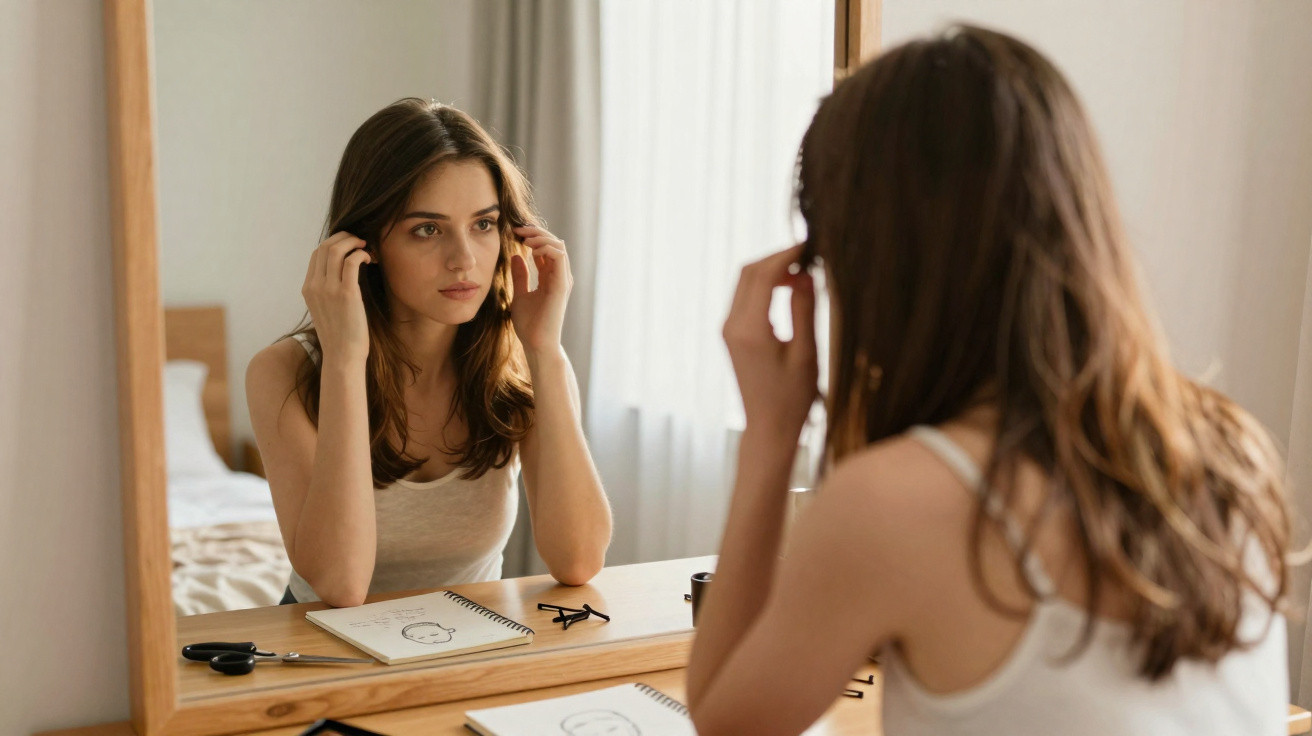
The woman staring back from the bathroom mirror seems familiar, yet not quite right. It is the same face, the same eyeliner and the same weary eyes from scrolling too late. But your mind keeps pausing. You have not had your hair cut or coloured it. You have simply shifted your hair parting from left to right, almost without thinking.
Later, a car-window reflection on the way to work gives you that small shock again. The difference is slight, like being tagged in a photograph taken from an unfamiliar angle. You carry yourself differently. You contribute a little earlier in a meeting. Someone says, “You look… different today,” and you are unsure whether it is intended as praise.
You have not turned into another person. Even so, your brain is certain that something essential has moved.
Why a tiny change in your hair can shake your whole identity
We like to regard hair as superficial, while quietly basing a large part of our self-image on it. Many people keep the same parting for years, even decades, without consciously choosing it. It becomes the familiar outline your brain expects around your face.
Switching it to the opposite side can therefore feel like entering your own home and discovering the sofa attached to the ceiling. Nothing objectively dramatic has occurred, but the tiny signals your mind relies on to recognise “this is me” suddenly feel disrupted.
That strange, slightly detached sensation is your sense of identity taking a second look for you.
Consider the day after a major haircut. Your hand reaches for hair that is no longer there, while the wind makes your neck feel exposed. Changing your parting is a milder version of this experience, but it touches an intriguing psychological nerve.
On TikTok and Reddit, people joke about gaining a “new personality” when they change their parting. There are no hard statistics, but a long enough scroll reveals the same theme:
“I changed my part and suddenly I’m speaking up in class,” “Switched my part, feels like my villain era,” “Right part = main character energy.”
Beyond the memes, there is a genuine, almost observable change in how people approach their day.
Psychologists describe this sort of effect as “enclothed cognition” – the idea that what we wear can influence our thoughts and actions. The familiar example is that people may perform differently simply by wearing a lab coat or a suit. A hair parting is not clothing, but it can still work as a kind of mental costume change.
Your face is your social passport. How your hair frames it continuously signals qualities such as approachability, edge, classic style, messiness or precision. By flipping your parting, you are doing more than moving hair: you alter the shadows, balance and perceived symmetry. The mirror presents your brain with a subtly different face, and your behaviour may shift to suit that new narrative.
How to use a hair-part flip as a tiny psychological reset
To experience the full effect, do not merely sweep your parting across once with your fingers and leave it there. Make it a small ritual. Dampen your roots or use a light mist. Comb your hair directly back, then create a precise line on the “new” side, as though you are drawing a fresh version of yourself.
Style it deliberately, whether that means extra volume, a sleeker finish or an easy wave. Then spend a few moments in front of the mirror properly taking in the slightly unfamiliar person looking back at you.
This five-minute adjustment can operate like a psychological reboot button.
The technique is particularly useful on days when you want to interrupt a pattern. Feeling stuck at work? Change your parting on a Monday and use it as a gentle reset. Anxious about an event? Try a different side that morning and see how it pulls you out of autopilot.
Emotionally, it can be a quiet message to yourself: today I’m showing up differently. Nobody else needs to know what you are doing. The shift happens chiefly in your own mind, which is precisely where it counts.
Let us be honest: nobody really does this every day.
There is a social dimension too. People are remarkably alert to minor changes in faces they know well. They may not realise that your parting has changed, but they are likely to sense that something is different.
“When we alter a familiar visual pattern, like a hairstyle part, we force the brain to re‑process a person as if they were slightly new,” explains a London‑based psychologist who studies self‑image. “That includes how we re‑process ourselves.”
To take the experiment slightly further, combine the hair flip with one other small “symbolic” adjustment: a different lipstick, a bolder top or glasses you do not normally wear.
- Change your parting deliberately rather than accidentally.
- Look at yourself for long enough to notice the “newness”.
- Observe other people’s reactions throughout the day without over-analysing them.
- Pay attention to your posture, voice and choices.
- Keep whatever feels right, and abandon anything that feels like a costume.
What your flipped part is really telling you about yourself
When your reflection catches you off guard, it reveals just how much of your identity rests on habits you have never examined. Your usual hair parting is one of those subtle, enduring choices that reinforces who you believe you are. Altering it for a day is like loosening one brick in a wall and realising that the entire structure is less fixed than it appeared.
At a subtle level, that can feel immensely liberating. It reminds you that your “look” is not a life sentence; it is simply a collection of defaults you happened to accept.
In social terms, a flipped parting also reveals the stories other people project on to you. A side parting may appear softer or more classic. A centre parting often communicates contemporary, minimalist, self-aware style. Moving between them may mean you are suddenly perceived as a little more assertive, more relaxed or more “put together”.
Those responses are not the truth about who you are. They are feedback on the image you are presenting. Witnessing them live can prompt you to consider which version best matches how you genuinely want to be seen.
The oddest element is how short-lived the effect may be. By the third day, your brain will usually have “updated the file”, and the new parting no longer feels so radical. The magic sits within the first day or two, when everything feels a little unfamiliar and slightly exciting.
That brief period is valuable. It is when you may notice yourself talking differently, sitting differently or making marginally braver choices, simply because your mental script has been interrupted. A hair part won’t fix your life, but it may remind you that meaningful change does not always have to be dramatic. Sometimes, it starts with a comb and five minutes in front of the mirror.
We have all experienced a moment when a tiny physical adjustment uncovers a part of ourselves we did not realise was waiting.
| Key point | Detail | Benefit for the reader |
|---|---|---|
| Micro-change, maximum effect | Moving your parting subtly changes how the brain interprets your face | Understand why you feel “different” without making a major change to your look |
| Intentional ritual | Turn the action into a mini ritual for a psychological reset | Use your parting as a practical tool for breaking a mental routine |
| Social feedback | Watch how others respond to this new framing of your face | Better understand the image you project and adjust it to suit who you truly are |












Comments
No comments yet. Be the first to comment!
Leave a Comment